
 GROWTH GUIDE
Fix Perplexity Citations Fast: 5 Step Canonical NAP Playbook
In this guide, “perplexity citations” means your local NAP citations: the name, address and phone listings for your business scattered across directories and websites. The single most important move is to build a canonical NAP worksheet and verify one Google Business Profile before touching anything else. Do that first, and every other listing gets easier to fix.
TL;DR:
- Consistency in business name, address, and phone number across all listings is crucial, with Google My Business Profile verification being the highest priority.
- Use your exact legal or DBA name, complete address with suite or unit number, and a local control phone line before digitizing or fixing other details.
- Focus first on Google and major data aggregators, then expand to niche directories, ensuring every listing matches your verified canonical NAP information.
- Regularly audit your top directories and website structured data to catch errors quickly, especially after any business changes like address or phone updates.
- Managed citation services can save time by maintaining consistent, accurate listings and deploying structured data automatically, especially for multiple locations.
Table of Contents
- Why exact NAP details matter for local search
- Google’s core rules on eligibility, address, and categories
- Step-by-step: build and publish your canonical NAP
- Common mistakes and how to verify your fixes worked
- How we approach citation consistency at scale
- How citations shape your local rankings
- Structured citations versus unstructured mentions
- Where citations come from beyond your Google profile
- Keeping your citations accurate over time
- Spotting and correcting citation errors
- What the citation advice everyone repeats gets wrong
- Get your citations handled without the manual chasing
- Sources
- FAQ
Why exact NAP details matter for local search
A citation is any mention of your business name, address and phone number (often shortened to NAP) on a directory, map service or other website. Search engines and AI tools both pull from these mentions to decide whether your business is real, findable and worth recommending to someone nearby.
The problem is consistency. When your phone number reads differently on your website than it does on a directory, or your suite number disappears from one listing, search systems see mismatched data rather than one trustworthy business. Google’s own eligibility guidance stresses that a Business Profile should reflect the business as it exists in the real world, not a marketing version of it.
That single standard drives most of what follows:
- Your business name must match what’s on your sign, invoices and website, not a keyword-stuffed variant.
- Your address needs to be complete, including suite or unit numbers, and verifiable.
- Your phone number should ring at your business, not a call center or tracking line you don’t control.
Get those three facts locked down before you worry about schema markup or directory submissions. Everything downstream depends on them.
Google’s core rules on eligibility, address, and categories
Google Business Profile eligibility, formatting and category rules decide whether a citation helps or hurts you. Miss one, and Google may suppress, merge or flag your listing regardless of how many directories you’ve updated.
A few rules matter more than the rest:
- Eligibility: your business needs a real, direct interaction with customers, either in person at a physical location or by phone or online contact, and Google generally allows one profile per eligible location, per the eligibility and ownership guidelines.
- Naming: use your business’s real name only. No added keywords, locations or services tacked on to game search.
- Address: provide a complete street address with suite or floor when applicable. Google prohibits PO boxes and remote mailboxes for this field, and service-area businesses without a public storefront can choose to hide their address while still serving a defined area, according to Google’s address management guidance.
- Phone: use a local number under your direct control rather than a shared call center or tracking number that changes.
- Categories: pick the fewest categories that accurately describe what your business is, not every service you offer.
Most Business Profile edits appear within about 10 minutes, though some can take up to 30 days to fully process, according to Google’s own guidance. That delay matters when you’re auditing whether a fix actually took.
Step-by-step: build and publish your canonical NAP
Treat this as a one-afternoon project with five stages. Skipping the order creates rework later.
- Build the worksheet. Write down your exact legal or DBA name, full street address with suite number, a phone number your business directly controls, your canonical location page URL, official hours and your primary category. If you operate as a service-area business, decide now whether your address will be public or hidden.
- Claim and verify your Google Business Profile. Match every field to the worksheet exactly, down to abbreviations like “St.” versus “Street.” Google’s representation guidelines cover naming and category conventions in more depth if you’re unsure how a field should read.
- Publish an official location page and matching schema. Your website should show the identical NAP, and your LocalBusiness JSON-LD should mirror it. Google Search Central’s LocalBusiness structured data documentation lists address and telephone as required properties, with geo coordinates and additional fields recommended for stronger results.
- Sync directories in priority order. Start with Google, then move to the major data aggregators and industry directories most relevant to your trade, and finish with niche or local directories. This phased order gets your highest-traffic listings correct first instead of spreading effort evenly across sources of wildly different value.
- Set a monitoring cadence. High-volume or multi-location businesses should run a quick weekly check. Solo owners can get away with a monthly audit. Either way, log every change and who made it, so you’re not guessing later which listing broke first.
Pro Tip: Keep your canonical NAP worksheet in a shared document with a change log. When a directory shows something different, you’ll know in seconds whether it’s outdated or wrong.
Once your worksheet and Google profile are solid, updating a directory listing becomes a copy-paste exercise instead of a research project. For a deeper walkthrough of the schema piece specifically, see our copyable JSON-LD patterns for local business schema.
Common mistakes and how to verify your fixes worked
Most citation problems trace back to a handful of repeat offenders.
- Abbreviation mismatches: “Ave” on one listing, “Avenue” on another.
- Inconsistent suite formatting: “Suite 200” versus “#200” versus no unit number at all.
- Central call center or tracking numbers instead of a line the business controls directly.
- Keyword-stuffed names that add services or locations Google doesn’t recognize as part of the legal name.
- Duplicate profiles for the same location, often created by accident during a move or rebrand.
- Storefront businesses hiding their address when they should be showing it publicly.
To verify a fix actually applied, check your profile in Business Profile manager, search for your business in Maps and review the Knowledge Panel, and run your location page through Google’s Rich Results Test or a schema validator to confirm the structured data matches the visible page. Remember that changes can take up to 30 days to fully propagate, so don’t assume a fix failed after a day or two.
When a listing is wrong and it’s not yours to edit directly, request ownership through the platform’s claim process, correct your own website first since it’s the canonical source, and contact directory support with documentation if a listing won’t budge. For a closer look at profiles that stop generating calls despite looking correct, our guide on diagnosing Business Profile issues walks through the usual culprits.
How we approach citation consistency at scale
Service Grower builds AI-optimized websites (AnswerReady™) and manages local search and AI visibility, reviews, and customer messaging for local businesses, which means citation consistency is a daily operational concern, not a one-time cleanup. Our 8 Week Playbook to Get Cited in AI Answers for Local Firms and our approach for marketers, 3 Levers That Get Your Business Cited in ChatGPT, both start from the same priority order used above: fix the canonical facts, then propagate.
Client testimonials point to measurable increases in bookings and reviews after cleaning up and maintaining these fundamentals. If you’d rather handle this yourself, the checklist above covers what you need. If you want it managed, that’s a conversation for later in this guide.
How citations shape your local rankings
Local search ranking systems weigh three things heavily: relevance, distance and prominence. Citations feed directly into prominence, because a business with consistent, verifiable listings across multiple trusted sources looks more established than one with a single, unconfirmed address.
Inconsistent citations don’t just look messy. They create doubt. If a directory lists your phone number differently than your Google Business Profile does, a search system has no reliable way to know which one is current, and that uncertainty can suppress how often you’re surfaced for nearby searches. The fix isn’t to chase every directory equally. It’s to make sure your most authoritative sources, starting with Google, are correct and matched everywhere else follows.
AI-driven answer engines work on a similar principle, pulling from the same pool of business data to decide who to recommend. A business with a clean, consistent citation footprint gives these systems less reason to hesitate. This is part of why the canonical worksheet approach outlined earlier matters beyond traditional search results: it’s the same foundation that supports visibility in newer AI-driven discovery tools.
Structured citations versus unstructured mentions
Citations generally fall into two categories, and they play different roles.
Structured citations are the ones you’d expect: directory listings with dedicated fields for business name, address, phone and category, like a formal directory profile or a Google Business Profile entry. These are easy for search systems to parse because the data sits in predictable places.
Unstructured citations are mentions of your business in free-flowing text, such as a local news article, a blog post naming your business and its address in a sentence, or a community forum post. These carry weight too, especially when they come from a source with its own credibility, but they’re harder for search systems to parse reliably because the NAP details aren’t isolated into fields.
Structured data on your own website, specifically LocalBusiness JSON-LD, sits at the intersection of both. Google Search Central’s documentation on LocalBusiness structured data notes that this markup should mirror the visible page it’s attached to, giving search systems a machine-readable version of the same NAP a visitor would see. Getting this right on your own site is more within your control than chasing every unstructured mention across the web, which is why it belongs early in your priority order.

Where citations come from beyond your Google profile
Google Business Profile carries the most weight for most local businesses, but it’s rarely the only citation source that matters.
Industry-specific directories, often tied to your trade (contractor associations, medical board listings, legal directories), tend to carry real authority within their niche. Data aggregators that feed information to multiple smaller directories at once are worth fixing early, since one correction there can ripple outward. General business directories, chamber of commerce listings and local news mentions round out the picture, along with social platforms that display business information in a structured way.
The trap is treating all of these as equally urgent. They’re not. A phased approach, starting with Google, then major aggregators and industry-specific directories, then smaller or niche sites, gets your highest-impact sources correct before you spend time on ones with less traffic and less influence.

Keeping your citations accurate over time
Building accurate citations once is straightforward. Keeping them accurate is the part most businesses underestimate.
- Store your canonical NAP worksheet somewhere versioned, so anyone editing a listing checks it first instead of guessing.
- Recheck your highest-traffic listings, starting with Google, on a schedule that matches your business size: weekly for high-volume or multi-location businesses, monthly for smaller ones.
- Update every listing whenever something legitimately changes, like a new phone system or an office move, rather than letting old data linger on secondary directories.
- Log who changed what and when, so a future audit doesn’t turn into detective work.
The businesses that avoid citation problems aren’t the ones with the most listings. They’re the ones with the fewest inconsistencies across the listings they have. That’s a maintenance habit, not a one-time project.
Spotting and correcting citation errors
Start by searching your own business name and address in quotes to see what comes up across search results and directories. Cross-check what you find against your canonical NAP worksheet, field by field.
Google’s Business Profile manager will show you your live profile data directly. Beyond that, a manual scan of your top five or ten directories, plus a search for your business in Google Maps, will surface most mismatches quickly. Running your website through Google’s Rich Results Test confirms whether your structured data still mirrors your visible page, since the two can drift apart after a redesign or address change.
When you find an error, fix the source first. If it’s your own website, update it directly. If it’s a directory, use their claim or edit process, and if that stalls, contact their support team with documentation, such as a screenshot of your official business license or utility bill showing the correct address. For listings that seem duplicated or that you don’t control, request ownership through the platform rather than trying to create a competing profile.
What the citation advice everyone repeats gets wrong
Most citation advice treats every directory as equally important, which sends owners chasing dozens of low-traffic listings before their own Google Business Profile and website even match. That’s backward. The businesses that struggle with local visibility almost always have a mismatch in the one or two sources that carry the most weight, not a missing entry on a directory nobody visits.
The other overrated piece of advice is treating this as a one-time cleanup. Citation accuracy decays the moment your phone system changes or you move offices, and nobody remembers to update the fourth-tier directory that still has your old suite number. A worksheet with a change log solves this better than any one-time audit ever will.
If you take one thing from this guide, prioritize your canonical facts and your Google Business Profile above everything else, then work outward. Everything else is sequencing, not strategy.
— Service Grower
Get your citations handled without the manual chasing
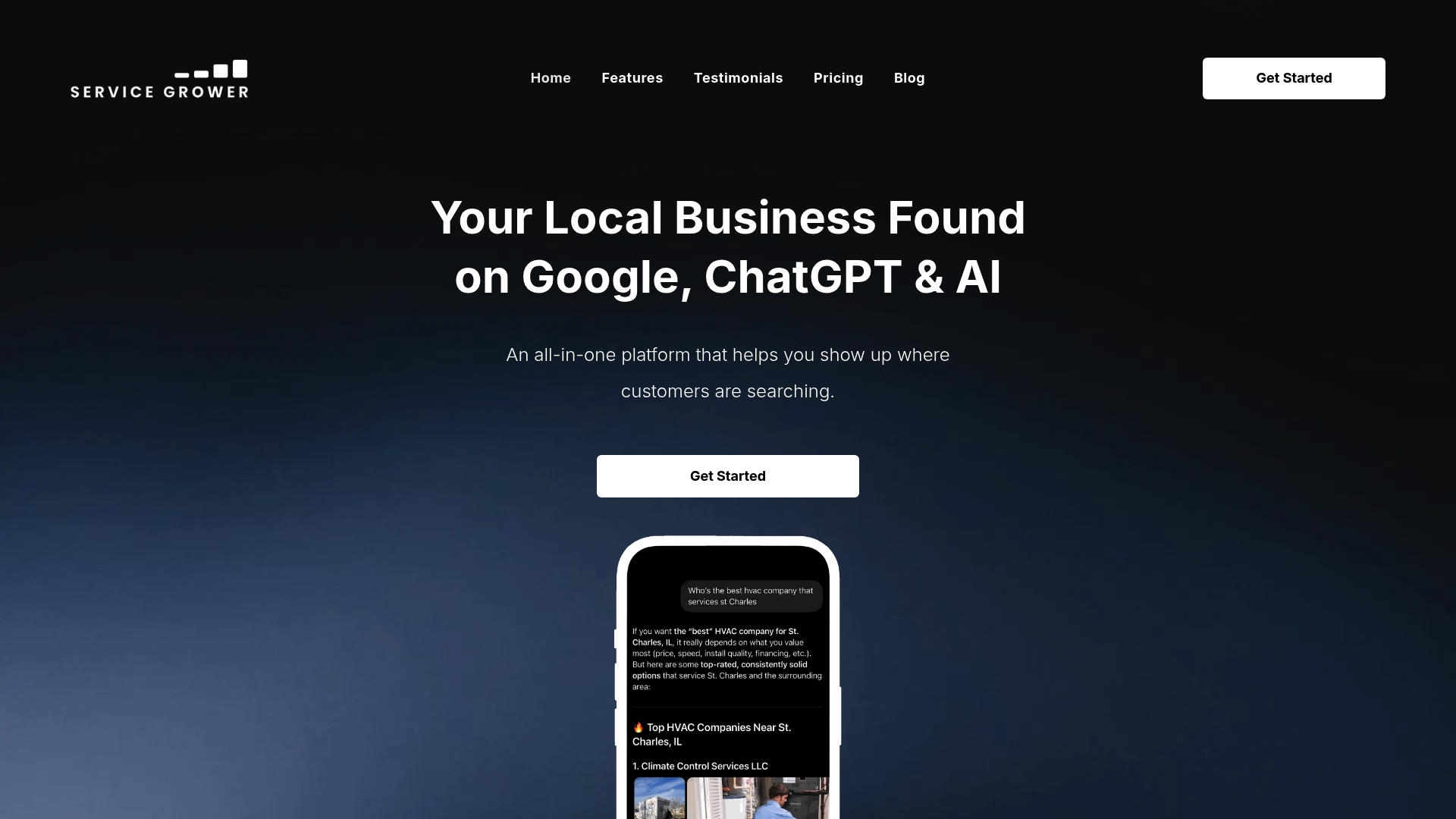
Cleaning up citations by hand works, but it takes real time you could spend running your business. Management services can handle the parts of this checklist that consume the most hours: location pages built to match your canonical NAP, LocalBusiness schema deployed correctly, ongoing Business Profile management and monitoring for the mismatches that tend to creep back in.
- Managed location pages that stay in sync with your official business details.
- Schema deployment so your structured data mirrors your visible page automatically.
- Ongoing Business Profile oversight paired with review and messaging management.
If you’d rather have this handled than manage a worksheet yourself, view the Service Grower plan for pricing and details.
Sources
- Business eligibility and ownership guidelines - Google Business Profile Help
- Manage your business address - Google Business Profile Help
- Local Business (LocalBusiness) Structured Data | Google Search Central
FAQ
What does “perplexity citations” actually refer to?
In the context of local business visibility, it refers to local NAP citations: mentions of your business name, address and phone number across directories, maps and other websites. It’s a different concept from AI chatbot source footnotes, which use the same word but describe something unrelated.
How long does it take for a Google Business Profile fix to show up?
Most edits appear within about 10 minutes, though some can take up to 30 days to fully process, according to Google’s own guidance. If a fix hasn’t shown up after a day, wait before assuming it failed.
Do I need to list my address if I run a service-area business?
Not necessarily. Google allows service-area businesses without a public storefront to hide their address while still defining the area they serve, per its address guidance. Storefront businesses that customers visit in person should keep their address public.
What’s the difference between structured and unstructured citations?
Structured citations sit in dedicated fields, like a directory listing or a Google Business Profile entry. Unstructured citations are mentions of your business in regular text, such as a news article or blog post, and they carry less predictable weight because a search system has to parse the details out of a sentence rather than a field.
Should I fix every directory listing myself or get help?
The worksheet and priority order in this guide work fine as a DIY project for a single location. If you’re managing multiple locations or don’t have the time to monitor listings monthly, a managed option like the Service Grower plan handles the ongoing syncing and monitoring for you.