
 GROWTH GUIDE
Marketers: 3 Levers That Get Your Business Cited in ChatGPT
Yes, you can rank in ChatGPT, but the mechanics differ from Google. Three levers matter most: crawlable HTML that leads with direct answers, entity signals from third-party mentions and reviews, and confirmed Bing indexation you can verify in Bing Webmaster Tools. Run a quick prompt check against your business category, then confirm your site is indexed on Bing. Those two moves tell you exactly where you stand before you change anything.
TL;DR:
- Pages that are server-rendered with your key facts visible in raw HTML and indexed by Bing are much more likely to be retrieved and quoted by ChatGPT.
- Listing your business on relevant review platforms, directories, and getting active reviews enhances your entity signals, which influence ChatGPT’s trust in citing your site.
- Testing your site with JavaScript disabled and confirming your pages are accessible in source code prevents missing critical facts for AI crawlers.
- Using question-based headlines and clear, quotable answers at the top of each page increases the chances of your content being directly quoted by ChatGPT.
- Regularly monitoring ChatGPT citation patterns through prompts and Bing index coverage helps track progress since ranking improvements depend on both technical fixes and reputation-building over time.
Table of Contents
- How ChatGPT and SearchGPT Retrieve and Choose Citations
- Technical Checklist to Make AI Crawlers Read Your Pages
- Content Playbook: Write Pages ChatGPT Can Actually Quote
- Authority and Distribution: Where Mentions Actually Move the Needle
- How to Measure ChatGPT Ranking Progress
- How Service Grower Puts This Playbook to Work for Local Businesses
- What Actually Moves Fast Versus What Takes Time
- Get Your Site Ready for AI Search With Service Grower
- Sources
- FAQ
How ChatGPT and SearchGPT Retrieve and Choose Citations
ChatGPT doesn’t cite you because it “knows” you from training data. When SearchGPT answers a query that needs current or local information, it runs a live web search, primarily through Bing’s index, builds a pool of candidate pages, and then decides which ones to quote or link. That’s two separate contests, not one.
The first contest is retrieval: does your page even make it into the candidate pool? The second is citation: once it’s in the pool, does the model trust it enough to quote it? A lot of marketers optimize for the first and assume the second takes care of itself. It doesn’t.

Being retrievable is necessary but not sufficient. A page can show up in the candidate set and still get passed over because a competitor’s page states the same fact more clearly, or because three other sites already corroborate a claim yours makes alone. That corroboration piece is where Google SEO habits stop transferring cleanly.
A few structural realities shape this pipeline:
- SearchGPT leans on Bing for live retrieval, so Google rankings alone won’t guarantee visibility.
- Pages that rank on Google but sit outside Bing’s index are functionally invisible to ChatGPT’s browsing mode.
- Brand co-occurrence, meaning your business name showing up alongside relevant category terms across multiple sites, appears to influence which candidate the model trusts enough to cite.
- The standard ChatGPT model (no browsing) answers from training data alone and can’t cite your page at all; only the search-enabled version retrieves live content.
That last point trips people up constantly. If you test your visibility in a plain ChatGPT conversation with browsing off, you’re not testing anything related to real-world citation. You have to test in a mode that actually searches the web.
Technical Checklist to Make AI Crawlers Read Your Pages
AI crawlers behave more conservatively than Googlebot in one critical way: many of them don’t execute JavaScript reliably, which means content injected client-side after page load may never get read at all. If your key facts, like hours, pricing, service areas, and credentials, live inside a JavaScript framework that renders after the initial HTML request, an AI crawler can miss them entirely.
Here’s the sequence to fix that, in priority order:
- Confirm your critical facts (name, address, phone, services, hours, pricing) exist in the raw server-rendered HTML, not just in a JavaScript bundle. View source, not just inspect element, and check what’s actually there before any script runs.
- Check your robots.txt file and explicitly allow GPTBot, OAI-SearchBot, and BingBot. A blanket disallow written years ago for a different reason can silently block AI retrieval today.
- Submit your sitemap to Bing Webmaster Tools and confirm indexation status. This is the single most skipped step among teams that only track Google Search Console.
- Cut unnecessary JavaScript on pages you want cited, and improve server response time. Slow time-to-first-byte pages get abandoned by crawlers with fetch budgets, the same way slow pages hurt Googlebot crawl efficiency.
- Run an SSR (server-side rendering) inspection tool or fetch-as-crawler test to confirm what a non-JavaScript client sees matches what a human sees in a browser.
Pro Tip: Fetch your own homepage with JavaScript disabled in your browser’s developer tools. If your phone number, service list, or pricing disappear, that’s exactly what an AI crawler experiences every time it visits.
This work overlaps almost entirely with basic technical SEO hygiene, which is good news. If you already run clean SSR pages with a fast Bing crawl budget, you’re most of the way to being retrievable. The gap most local businesses have isn’t obscure. It’s usually a slow, JavaScript-heavy site that Bing has barely touched.
Content Playbook: Write Pages ChatGPT Can Actually Quote
Structure earns citations. Content patterns that lead with direct answers under question-form headings get lifted and quoted at a noticeably higher rate than pages that bury the point in paragraph four.
The formula is simple to describe and easy to skip under deadline pressure: open each section with a 40 to 60 word answer that could stand alone as a complete response, then support it with detail underneath. Write the headline as a question a real person would type into a search box. Keep sentences short enough to quote without editing. A model doesn’t want to paraphrase your run-on sentence; it wants a clean, self-contained claim it can lift verbatim.
Short, quotable lead answers paired with question-form H2s correlate consistently with higher citation rates across multiple independent tests, which lines up with how these models actually work. They’re pattern-matching for extractable statements, not evaluating your prose style.
Specific tactics that compound:
- Put a one-line takeaway or boxed fact near the top of long pages, not buried at the end.
- Add FAQ schema and HowTo schema where relevant; structured markup gives the crawler a labeled answer instead of forcing it to guess.
- Use bullet lists for anything comparative (features, steps, pros and cons), since lists parse cleanly for extraction.
- Include one small piece of original data or a specific example on every important page. “Most HVAC calls in cold climates spike within 48 hours of a temperature drop below 20°F” beats “demand increases in cold weather” every time.
- Avoid vague hedging language in your lead answers. State the claim plainly, then qualify it in the next sentence if needed.
A page that states “Our average response time for emergency calls is fast” gives ChatGPT something concrete to quote. A page that says “we pride ourselves on fast response times” gives it nothing extractable. That distinction alone explains why some well-written, well-designed pages never get cited: they’re persuasive to humans and useless to a model hunting for a fact it can repeat.
E-E-A-T signals like author bios, named case studies, and citations to reputable outside sources also measurably raise the odds your content gets trusted enough to quote, not just retrieved. A page with no named author and no supporting evidence reads as lower confidence, even when the information is accurate.
Authority and Distribution: Where Mentions Actually Move the Needle
AI citations concentrate heavily on a small set of trusted domains, and third-party mentions strongly influence whether a brand gets cited at all. This is the part of ChatGPT SEO that looks the least like traditional link building and matters just as much.
Prioritize mentions on category aggregators, listicles, and review platforms where your business name sits next to the exact terms customers search. A “Best HVAC Companies in [Region]” roundup that names you does more for AI citation odds than a generic backlink from an unrelated blog, because it creates the co-occurrence pattern the model is pattern-matching against.
Where to focus outreach and review-management energy:
- Pitch contributed articles or expert quotes to trade publications and local business journals that already rank for your category terms.
- Request inclusion in review platforms and directories most relevant to your service, not just the largest generic ones.
- Actively manage and respond to reviews on Google and industry-specific platforms; a thin, unmanaged review profile signals lower trust than a smaller but active one.
- Track mentions that carry no link at all. Treating unlinked mentions and PR placements as citation-building, not just backlink-building matters because entity recognition doesn’t require a hyperlink, just consistent co-occurrence of your name and your category.
Both linked and unlinked mentions deserve a place in your tracking sheet. A model building an answer about “emergency plumbing in [city]” is pulling brand associations from wherever your name shows up next to that phrase, hyperlink or not.
How to Measure ChatGPT Ranking Progress
You can’t improve what you don’t check regularly, and checking ChatGPT visibility looks nothing like checking a Google rank tracker.
- Build a list of 15 to 25 representative prompts a real customer might type, covering your services, your city, and common comparison phrasing (“best [service] near [city],” “how much does [service] cost”).
- Run each prompt manually in ChatGPT’s search-enabled mode weekly or biweekly, and log whether your business is cited, at what position in the answer, and which URL got referenced.
- Scale the manual work with tooling once you have a baseline. Semrush’s AI Visibility tracking and Ahrefs’ AI-focused plugins and connectors automate prompt monitoring so you’re not doing this entirely by hand.
- Cross-reference citation activity against Bing Webmaster Tools index coverage; a sudden drop in citations often traces back to a crawl or indexation issue on the Bing side, not a content problem.
- Track four numbers over time: citation rate (percent of test prompts where you’re mentioned), AI share-of-voice against named competitors, average position within the answer, and Bing index coverage percentage.
Treat this like a dashboard, not a one-time audit. Citation patterns shift as ChatGPT’s retrieval sources update and as competitors publish new content, so a quarterly check misses movement that a monthly one catches.
How Service Grower Puts This Playbook to Work for Local Businesses
Most local businesses don’t have a content team running weekly prompt audits, and that’s the gap Service Grower’s platform is built to close. The AnswerReady™ Website product exists specifically to solve the server-rendering problem this article covers in the technical checklist: facts about hours, pricing, and services live in raw HTML rather than JavaScript that AI crawlers might never execute.
That technical foundation only helps if the entity signals around it are solid too. Service Grower’s AI presence and review management tools work on the other half of the equation, the co-occurrence and trust signals covered in the authority section above.
Where this comes together in practice:
- A server-rendered site handles the retrieval half of the problem automatically, without a business owner needing to understand crawl budgets or robots.txt syntax.
- Consistent review activity across platforms builds the third-party corroboration that citation decisions lean on.
- Centralized tracking of both technical indexation and mention activity means fewer blind spots between “we fixed the site” and “customers still can’t find us in ChatGPT.”
Pro Tip: If you’ve already fixed your site’s technical issues but citations still aren’t showing up, check your review volume and recency before touching the code again. Trust signals often lag behind technical fixes by weeks.
Businesses that struggle with this usually aren’t failing at one thing; they’re failing at the handoff between technical readiness and reputation signals, which is exactly why treating them as one connected system, rather than two separate projects, tends to produce faster results.
What Actually Moves Fast Versus What Takes Time
The honest answer to “how fast can you rank in ChatGPT” is that it depends entirely on which lever you’re pulling. Server-side rendering fixes and Bing indexation issues can produce visibility changes within weeks once a crawler actually reaches and reads the corrected page. That’s the encouraging part.
Authority signals move on a slower clock. Third-party mentions, review depth, and the kind of consistent brand co-occurrence that builds real entity trust compound over months, not days, because they depend on other websites and platforms publishing and updating content on their own schedule.
The businesses that see results fastest aren’t necessarily the ones with the biggest budgets. They’re the ones treating technical fixes, review management, and citation tracking as one connected workflow instead of three separate to-do lists handled by three different vendors. When the site, the reputation signals, and the measurement all live in the same system, a fix in one area shows up as a measurable change in another within the same reporting cycle.
— Service Grower
Get Your Site Ready for AI Search With Service Grower
Fixing JavaScript rendering, chasing Bing indexation, and building review volume across platforms is a lot to manage with separate tools and separate vendors. Some platforms run all three from one dashboard, which means a fix to your website’s technical structure and a new batch of customer reviews feed the same visibility score instead of living in disconnected reports.
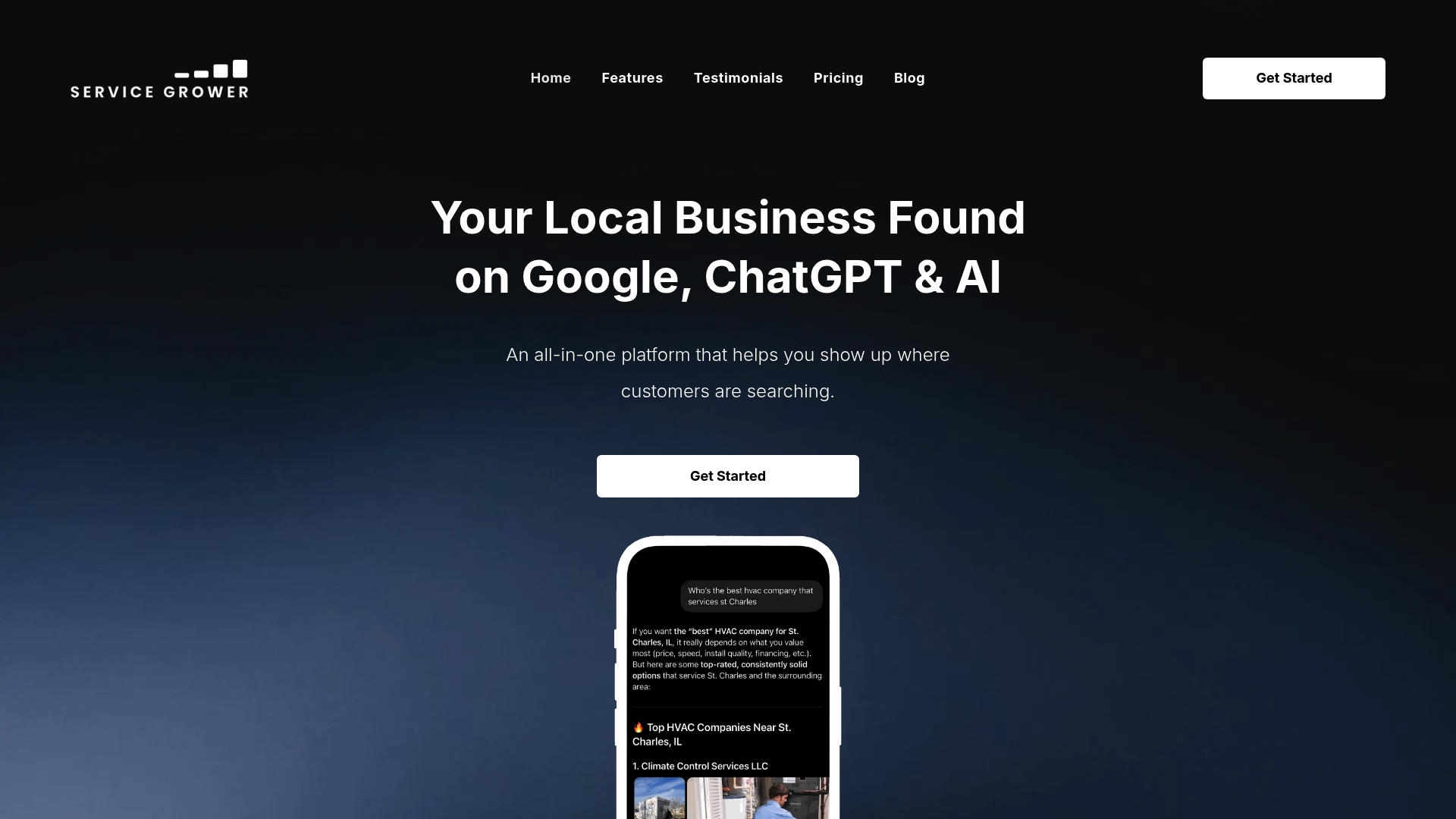
The platform’s AnswerReady™ Website product handles the server-rendering work this article’s technical checklist covers, so your hours, pricing, and services sit in raw HTML that AI crawlers can actually read. Pair that with AI presence management and review management tools built to strengthen the third-party trust signals that citation decisions depend on, and you’re covering both halves of the problem this article laid out.
Start by running Service Grower’s Free AI Visibility Check to see exactly where your business stands right now across ChatGPT and other AI tools before you spend another hour guessing at fixes.
Sources
- ChatGPT for SEO: Everything We Know So Far
- ChatGPT SEO: How to Show Up in ChatGPT Responses
- 10 ChatGPT SEO Tools That Help You Rank Higher
FAQ
How Do I Rank in ChatGPT?
Make sure your key facts live in server-rendered HTML, allow GPTBot and BingBot in your robots.txt, confirm Bing indexation in Bing Webmaster Tools, and build third-party mentions that pair your brand name with your category terms.
Which AI Is Ranked the Highest?
Rankings vary by benchmark and use case, so there’s no single agreed-upon leader; ChatGPT, Google’s AI tools, and other assistants each pull from different retrieval sources and excel at different query types.
What AI Is Better Than ChatGPT?
No AI tool is universally “better,” since each one, ChatGPT included, has different strengths depending on whether the task is live web retrieval, reasoning, or general knowledge recall.
How Fast Can You Rank on ChatGPT?
Technical fixes like server-side rendering and Bing indexation can produce visibility changes relatively quickly, while authority signals from third-party mentions and reviews typically take more time to build.
Does Fixing My Website Alone Guarantee ChatGPT Citations?
No. Retrieval and citation are separate problems: a crawlable, well-indexed page still needs enough trust signals, like reviews and third-party mentions, to be selected over competing pages in the candidate pool.