
 GROWTH GUIDE
Win the Map Pack in 2–8 Weeks: Local SEO for Service Businesses
Local SEO for services means optimizing your Google Business Profile, website, and reviews so your company shows up when people nearby search for what you do. The single highest-leverage move you can make today is claiming, verifying, and fully completing your Google Business Profile with the correct service-area setup. Expect early movement within 2 to 8 weeks and real compounding results by month three to six.
TL;DR:
- Fully claiming, verifying, and completing your Google Business Profile is the highest-impact step, with early improvements starting within 2 to 8 weeks.
- Prioritizing review acquisition and response speed has become increasingly important, with 2 to 10 new reviews weekly and responses within 24 hours boosting rankings.
- Building dedicated service and city pages on your website, optimized with local signals and schema markup, typically takes 3 to 6 months to show significant results.
- Consistency in profile management and review collection outperforms efforts focused on technical SEO, which generally reward patience over quick wins.
- Using an integrated platform that automates the review pipeline, profile updates, and reporting simplifies implementation and helps maintain accountability.
Table of Contents
- Why Local SEO Matters for Service Businesses
- How Local Search Ranking Actually Works
- Priority Local SEO Playbook: What to Do and When
- Google Business Profile: Getting Every Field Right
- Building a Website That Actually Ranks Locally
- Reviews and Citations: The Trust Layer
- What to Track and Test Along the Way
- How an Integrated Platform Simplifies the Playbook
- What Actually Deserves Your Time First
- Get Your Local Presence Managed, Not Managed by You
- Sources
- FAQ
Why Local SEO Matters for Service Businesses
Most homeowners don’t scroll past the map pack. They search “plumber near me” or “HVAC repair [city],” tap one of the three businesses Google shows at the top, and call. If your business isn’t in that pack, you’re invisible for the exact moment someone is ready to pay.
Google itself frames local ranking around three main factors: relevance, distance, and prominence, and a fully built-out profile is one of the few things a business owner controls outright.
Storefront businesses lean on distance because customers walk in. Service-area businesses (electricians, cleaners, landscapers who drive to the job) need to lean harder on relevance and prominence, since Google may hide the exact address anyway. That changes how you set up categories, service lists, and reviews.
What to expect once you start:
- Search visibility improvements usually begin in 2 to 8 weeks for profile and review changes
- Website and schema work typically takes 3 to 6 months to fully compound
- A complete Google Business Profile and steady review generation rank among the highest-impact local SEO moves a service business can make, often outperforming paid ads on cost per lead over time
How Local Search Ranking Actually Works
Google has said for years that local results come down to relevance, distance, and prominence. Relevance is how well your profile matches what someone typed. Distance is how close you are (or claim to be) to the searcher. Prominence is how well known and well reviewed your business is across the web, not just on Google.
What’s changed by 2026 is what feeds those three inputs. Google now leans on behavioral engagement, meaning clicks, calls, and direction requests logged against your profile, and AI systems increasingly triangulate your Google Business Profile, your website content, your schema markup, and your review text against each other to decide if you’re a trustworthy match for a query.
Here’s what you can actually influence, ranked by control:
- Category accuracy: your primary and secondary GBP categories, which you set directly
- Profile completeness: hours, services, photos, attributes, all editable fields
- Review velocity: how consistently new reviews arrive, which you can systematize
- On-page localization: whether your service pages mention the neighborhoods and job types you actually handle
Distance you can’t change. Everything else on that list, you can.
Pro Tip: Don’t obsess over your exact map pin position. Google increasingly rewards businesses whose website and reviews say the same thing their profile says, so consistency across all three beats chasing a perfect pin.
Priority Local SEO Playbook: What to Do and When
Trying to fix everything at once is how most owners give up after two weeks. Work this list in order. Each step builds on the one before it.
- Google Business Profile optimization (Week 1, 2 to 3 hours). Claim it, verify it, fill every field: categories, services, hours, attributes, service area. This is the foundation everything else supports.
- Review system setup (Week 1 to 2, 3 to 4 hours to build, then automatic). Set up post-job SMS review requests with smart routing that sends happy customers to Google and catches unhappy ones privately first.
- Service pages (Weeks 2 to 6, 4 to 8 hours per page). One dedicated page per core service, not one generic “services” page trying to cover everything.
- City pages (Weeks 3 to 8, 3 to 6 hours per page). One page per priority town if you serve multiple areas.
- NAP and citation audit (Weeks 2 to 4, 4 to 6 hours). Confirm your name, address, and phone number match exactly everywhere you’re listed.
- Schema markup (Weeks 4 to 6, 2 to 4 hours with a developer or template). LocalBusiness, Service, and FAQPage JSON-LD added to key pages.
- Local link outreach (Ongoing from month 2). Chamber of commerce, supplier partnerships, local news mentions.
- Speed and mobile fixes (Weeks 1 to 4, varies by site). Most local searches happen on a phone standing in a driveway or kitchen.
For the review system, aim for 2 to 10 new reviews per week depending on your market size, and respond to at least 80% of reviews within 24 hours, since response speed and review freshness carry real ranking weight now. For service pages, write at least 500 words, include local landmarks or neighborhood names, and embed a map.
| Step | Time to First Impact | Effort Level |
|---|---|---|
| GBP optimization | 2 to 4 weeks | Low |
| Review system | 3 to 6 weeks | Low to medium |
| Service pages | 6 to 10 weeks | Medium |
| City pages | 8 to 12 weeks | Medium |
| NAP/citation cleanup | 4 to 8 weeks | Low |
| Schema markup | 6 to 12 weeks | Medium |
| Local link outreach | 12+ weeks | High |
| Speed/mobile fixes | 2 to 6 weeks | Medium |
Pro Tip: If you can only do three things this month, do GBP optimization, the review system, and your top two service pages. That combination touches all three of Google’s core ranking factors at once.
Google Business Profile: Getting Every Field Right
Your primary category should be the single most specific match to what you do. “HVAC contractor” beats “contractor.” Add secondary categories only for services you genuinely offer, since a mismatched category actively hurts relevance rather than expanding your reach.
Fill out the Services section as its own list, not a paragraph buried in your business description. Each service listed there is essentially a mini keyword target Google can match against a search, so “drain cleaning,” “water heater installation,” and “emergency plumbing repair” should each get their own entry with a short description.
For photos and posts:
- Upload at least 10 photos covering your storefront or vehicles, your team, and completed jobs
- Post 2 or more times per week, rotating between updates, offers, events, and completed work
- Turn on messaging so customers can text questions directly from your profile
If you’re a service-area business without a public storefront, hide your home address in GBP settings and define your service area by city or ZIP code instead. This keeps you from being tightly pinned to one residential address while still telling Google exactly where you work. Getting these fields right is covered in more depth in a full Google Business Profile optimization playbook.
Pro Tip: Businesses that skip the Services section entirely are leaving one of the easiest relevance signals unused. It takes fifteen minutes to fill out and directly maps to what people type into Google.
Building a Website That Actually Ranks Locally
Your site needs one page per core service and one page per priority city you serve. A single “Services” page trying to rank for six different jobs across four towns rarely ranks for any of them.
Each service page should include an H1 naming the exact service, a 250 to 500 word introduction, a list of related services, general pricing guidance, local photos, an embedded map, and a handful of reviews specific to that service. Service pages built this way should also carry local trust signals like licenses and neighborhood references, which give both users and Google concrete proof you actually work in that area.
Structure the site as a hub-and-spoke: your homepage links out to service pages and city pages, and those pages link back to the homepage and to each other where relevant. This distributes authority across the whole site instead of concentrating it on one page.
Add JSON-LD schema for:
- LocalBusiness, covering your name, address (or service area), hours, and phone number
- Service, one block per service page describing exactly what’s offered
- FAQPage, turning common customer questions into structured data
- AggregateRating, reflecting your actual review score where you have enough reviews to support it
A technical guide to organization schema is worth reviewing if you’re implementing this yourself, and Service Grower’s own breakdown of copyable JSON-LD patterns for local business schema covers the exact code blocks for LocalBusiness, Service, and FAQPage markup. Every page needs a click-to-call button, a booking form, and chat visible without scrolling.
Reviews and Citations: The Trust Layer
Reviews are no longer a nice-to-have that sits quietly on your profile. Review velocity and response speed rose sharply in importance through 2025 and into 2026, and both now carry measurable weight in local rankings.
Aim for a steady weekly flow of new reviews rather than a burst of twenty followed by silence for three months. Google appears to reward consistency over volume spikes.
The workflow that works best is simple to automate:
- Trigger an SMS review request the moment a job is marked complete
- Route happy customers straight to your Google listing
- Route unhappy customers to a private feedback form first, so problems get solved before they become public
For citations, audit your listings on the top directories for your industry, confirm your name, address, and phone number match character for character everywhere, and fix mismatches before adding new listings. Word reviews naturally with the service performed and the city it happened in (“fixed our AC in [city] within an hour”) since that phrasing helps AI systems match your business to future searches for the same service and location.
What to Track and Test Along the Way
You don’t need a dozen dashboards. Track GBP clicks, phone calls, direction requests, and completed bookings inside GBP Insights, since that’s where Google shows you the behavioral signals it’s already weighing.
Pair that with GA4 using UTM-tagged links from your GBP profile and any local citations, plus basic call tracking so you know which page or listing actually generated the phone call.
Worthwhile small tests:
- Change your GBP post cadence from weekly to twice weekly and watch clicks for a month
- A/B test two different service-page headlines on your highest-traffic page
- Compare review request response rates between SMS and email
How an Integrated Platform Simplifies the Playbook
Running this playbook by hand means juggling GBP updates, review requests, website edits, and reporting across four or five separate tools. Service Grower combines those into one system: AnswerReady™ Websites handle the service and city page structure automatically, built-in review and messaging automation manages the SMS-to-review pipeline, and GrowthView analytics track the same GBP and call metrics covered above in one dashboard instead of three logins.
A typical workflow looks like this: a job gets marked complete, an automated text goes out asking for a review, the response routes based on sentiment, and the resulting review data feeds back into GBP updates and reporting, all without the owner touching four different apps.
What Actually Deserves Your Time First
Most owners overinvest in schema and city pages before their Google Business Profile is even fully filled out. That’s backward. GBP and review velocity move fastest and cost the least, so they come first regardless of budget.
Schema, city pages, and link outreach are compounding investments. They’re worth doing, but they reward patience over urgency. If you’re in a major metro with heavy competition, budget closer to 6 months before city pages show real traction; in a smaller market, 3 months is realistic. Hire help or adopt a platform once you’re spending more hours managing tools than doing the actual work you get paid for.
— Service Grower
Get Your Local Presence Managed, Not Managed by You
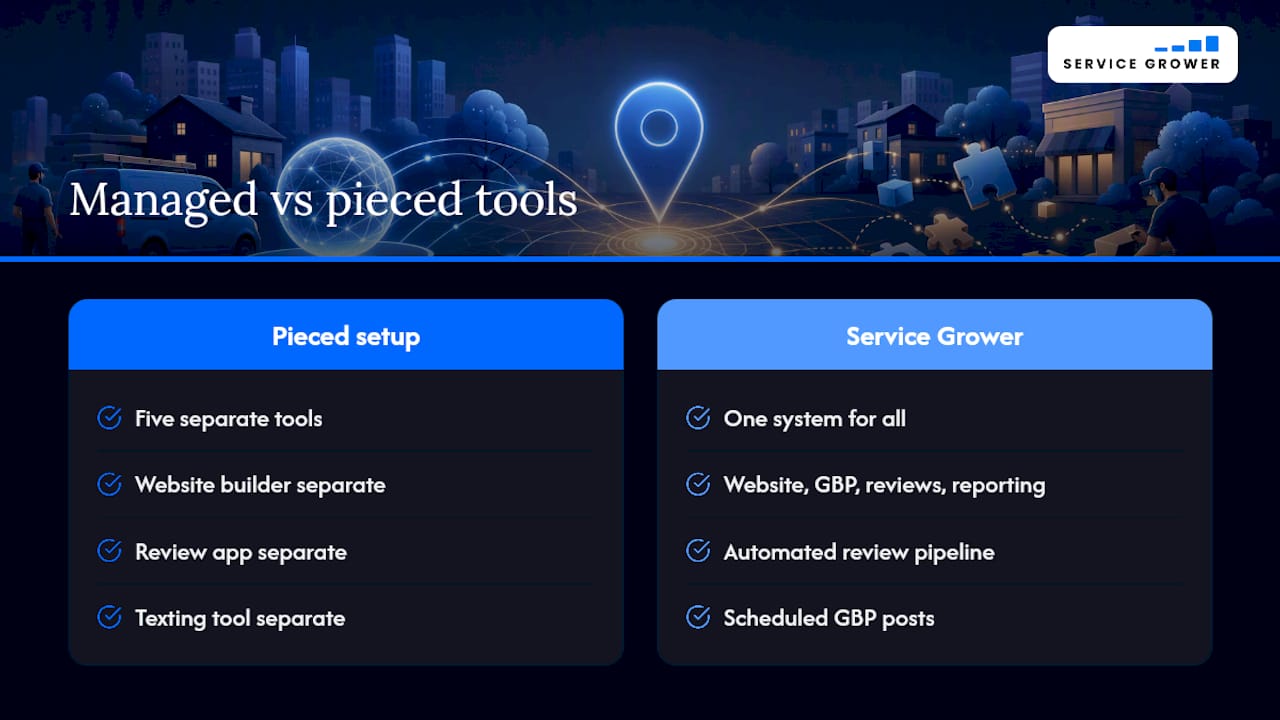
Service Grower is the alternative to piecing together five separate tools and hoping they talk to each other. Instead of a website builder, a separate review app, a separate texting tool, and a spreadsheet for tracking, it’s one system handling your website, your Google Business Profile, your review pipeline, and your reporting together.
That matters most for the parts of this playbook that punish inconsistency: a review request that goes out the same day a job finishes, a GBP post that actually gets published on schedule, a service page built with the schema already baked in. The Service Grower plan runs $249 per month and covers the platform end to end, with managed Google Ads and Meta Ads available at $249 per month each for businesses that want paid visibility layered on top of organic work. Messaging setup, including email domain and SMS configuration, is a one-time $25 fee for each.
If you want to see how this stacks up against building it yourself or hiring an agency, compare your options directly, or start with a look at the full platform overview and request a walkthrough of what your GBP and review setup would look like inside the system.
Sources
The guidance above draws on a mix of platform documentation and industry research, current as of this writing.
- What showing up on Google Maps means for your business — Google Business
- Local SEO 2026 — Complete Guide for Service Businesses | Sprout Sage
- Local SEO for Contractors: Trade-by-Trade Guide | Daly Advertising
Check Google’s own Business Profile help documentation periodically, since field options and verification requirements change without much notice.
FAQ
How Much Do Local SEO Services Cost?
Costs vary widely depending on whether you hire a freelancer, an agency, or use a managed platform. Service Grower’s plan runs $249 per month and bundles website management, GBP optimization, and review automation into one subscription rather than billing separately for each service.
Is SEO Dead Now That AI Search Exists?
No. AI systems like AI Overviews still pull from the same underlying signals, your Google Business Profile, your reviews, and your website content, so a strong local SEO foundation actually feeds AI visibility rather than competing with it. Businesses with complete, consistent profiles tend to get cited more often by AI tools, not less.
How Do I Get Started With Local SEO If I Don’t Have a Storefront?
Claim your Google Business Profile, hide your home address, and set your service area by city or ZIP code instead of relying on a pinned location. From there, follow the same priority order: GBP completeness, review velocity, then service and city pages.
What Is the 80/20 Rule in SEO?
Applied to local SEO, it means roughly 80% of your ranking gains come from about 20% of the work, mainly a complete Google Business Profile and consistent reviews, rather than from every tactic in a long checklist. Prioritizing those two areas first typically produces faster, larger gains than spreading effort evenly across every possible tactic.