
 GROWTH GUIDE
Four Website FAQ Layouts That Get Read: Examples & Copy for Designers
Copy an accordion when you have 8 to 20 short questions, a jump-linked list when answers run long, and a topic hub when the product or policy set is too big for one page. Whatever the layout, the page only works if it stays scannable, uses the visitor’s own words instead of internal jargon, and follows accessible disclosure patterns. The sections below walk through real layout choices, writing rules, accessibility requirements, and a checklist you can apply today.
TL;DR:
- Accordion layouts work best for short questions with answers that fit within a few sentences, ideally between eight and twenty questions per page.
- Structuring FAQs by visitor-task categories rather than internal departments improves relevance and searchability, especially for complex product lines or service sectors.
- Using native buttons with proper ARIA attributes and ensuring answers are always in the DOM enhances accessibility and prevents search and screen reader issues.
- Writing questions in the exact phrasing visitors use and leading answers with a clear, direct sentence increases search relevance and user engagement.
- Regularly review FAQs based on support logs and search data to prioritize impactful questions and retire outdated content, optimizing for both conversions and clarity.
Table of Contents
- Side-by-side FAQ page examples and visual patterns to copy
- Design patterns and templates you can reuse
- How to write FAQ questions and answers people actually search for
- Making FAQ accordions accessible by default
- Making FAQ content findable in search and measurable over time
- A reusable checklist and template snippets
- Examples of effective FAQ content categories by industry
- Strategies for prioritizing which questions to include
- Author perspective: what local service FAQs get wrong
- A managed option if you would rather not build this yourself
- Sources
- FAQ
Side-by-side FAQ page examples and visual patterns to copy
Four layouts cover almost every FAQ situation you will run into. Pick based on question count, answer length, and how much the page needs to double as a navigation tool.
- Accordion single page: best for 8 to 20 short questions where each answer fits in a few sentences and users want to scan headlines first.
- List with jump links: better when answers run long or need their own anchor for sharing and deep linking.
- Topic hub with multiple FAQ pages: fits complex product lines or policy sets where one page would bury the answer a visitor needs.
- Inline FAQ blocks: small Q&A clusters embedded directly on a service or pricing page to handle objections at the moment of decision.
The Mailchimp resource on building FAQ pages shows this range in practice, pointing to search bars, category filters, and expandable answers as the UI conventions that recur across brands regardless of industry.
Accordions fail when every answer is collapsed by default and buried three clicks deep, or when designers stuff 40 questions into one page with no grouping. A better fix is chunking by topic. Nielsen Norman Group’s research on FAQ value recommends splitting long lists into topic groups or separate answer pages rather than one endless scroll, since it improves both scanning and search visibility for specific queries.
List-with-jump-links pages break down when the anchor links do not match the visible heading text, forcing users to scroll to confirm they landed in the right place. Keep anchor text and heading text identical.
Topic hubs go wrong when the entry page dumps visitors into a search box with no visible categories. A hub needs at least three or four labeled entry points before search becomes the only option.
Inline blocks are easy to overdo. Two or three objection-focused questions near a call to action work better than a full FAQ section competing with the page’s main goal.
Design patterns and templates you can reuse
Typography and spacing do most of the work in making an FAQ page feel organized rather than cluttered. Questions need visual weight that answers do not: bold or a heavier font weight, slightly larger size, and consistent spacing above and below each entry so the eye can track down the page in a rhythm.
- Give every question the same type treatment and vertical spacing so scanning feels predictable.
- Answer the question directly in the first one or two sentences, then expand with detail below if needed.
- Default accordions to collapsed, except for the single most common question, which can stay open.
- Keep touch targets at least 44 pixels tall on mobile so tapping a question does not require precision.
- Place jump links in a sticky or top-of-page position so users do not lose their place after clicking.
A simple template that works across most sites: a “Popular questions” block with three or four always-visible answers, followed by a full accordion for everything else. This gives scanners immediate value while keeping the page from feeling like a wall of collapsed bars.
Pro Tip: Write the answer’s first sentence as if it were the only thing a visitor will read, because for most people, it is.
How to write FAQ questions and answers people actually search for
Questions should sound like something a visitor would type into a search bar or ask a support agent, not like a product spec sheet. Nielsen Norman Group’s UX writing coverage points practitioners toward plain language and skimmable structure as the two traits that separate FAQ content people use from FAQ content people skip. Mining support transcripts and on-site search logs is the most reliable way to find the exact phrasing visitors use, since it reflects real confusion rather than what a team assumes people want to know.
- Lead every answer with a direct sentence, ideally under 60 words, before adding context.
- Turn procedural answers into short numbered steps instead of a paragraph.
- Close with a link to the next action, whether that is a contact form, a pricing page, or a help article.
Three examples to adapt:
“Do you offer refunds?” Yes, refunds are available within 30 days of purchase if the product is unused. Contact support with your order number to start the process.
“Why won’t my account log in?” Most login failures happen because of an expired password reset link. Request a new link from the login page and check your spam folder if it does not arrive within a few minutes.
“What’s included in the starter plan?” The starter plan covers core features with usage limits that scale up on paid tiers. See the pricing page for a full feature breakdown.
Making FAQ accordions accessible by default
An accordion is only as accessible as its markup. The W3C APG accordion pattern specifies that each question should be a native button element, not a styled div, with the aria-expanded attribute toggled between true and false as the panel opens and closes. The W3C disclosure example for FAQ pages walks through the exact keyboard behavior and ARIA attributes expected, including how focus should move and how screen readers should announce state changes.
- Use a real button for every disclosure trigger, never a div or span with a click handler.
- Toggle
aria-expandedon open and close so assistive tech announces the current state. - Keep visible focus outlines intact and make sure tab order follows the visual order of questions.
- Render answer text in the DOM even when visually hidden, so browser find-in-page and screen readers can locate it.
That last point matters more than most teams realize. If an answer only loads into the page after a click, a visitor using Ctrl+F to search the page for a keyword will never find it, and neither will a screen reader that has not triggered the expand event. Test every new FAQ page with a keyboard alone and with a screen reader before shipping it.
Making FAQ content findable in search and measurable over time
A well-written FAQ page still needs to be structured so search engines and analytics tools can make use of it. Heading each question exactly as a visitor would phrase it, rather than as a marketing headline, gives search engines and AI answer engines a closer match to real queries.
- Use question-format headings that mirror natural visitor phrasing instead of internal terminology.
- Add FAQPage schema markup when answers are short and unlikely to change often, since schema tied to volatile content can quickly go stale.
- Track on-site search terms, accordion click-to-expand events, and organic queries landing on the page to see which questions get used.
- Promote a high-performing FAQ answer into a core product or policy page once analytics show it drives conversions, rather than leaving it stranded in a long list.
This turns the FAQ page from a static reference into a feedback loop: what people search for tells you what to write next, and what they click tells you what to promote.
A reusable checklist and template snippets
Before publishing, run through this list:
- Confirm placement: the FAQ is linked from the main navigation or footer, and jump links exist for pages longer than 10 questions.
- Check typography and spacing: questions are visually distinct from answers, and vertical rhythm stays consistent throughout.
- Verify answer length: each answer opens with a direct sentence under 60 words before any expansion.
- Test ARIA and keyboard behavior: every disclosure control is a native button with
aria-expandedtoggling correctly, and tab order matches visual order. - Confirm analytics: click-to-expand events and on-site search terms feed into a report someone actually reviews.
For the ARIA disclosure pattern itself, the developer note is simple: each question is a button inside a heading element, controlling a panel via aria-controls, with aria-expanded flipped on click and the panel’s content always present in the DOM.
Three question templates worth keeping on hand: a conversion template (“What happens after I sign up for [X]?”), a troubleshooting template (“Why isn’t my [feature] working?”), and a policy template (“What is your policy on [refunds/cancellations/data]?”).
Examples of effective FAQ content categories by industry
FAQ content works best when it is grouped by the questions a specific type of visitor actually has, not by internal department. A software company typically needs categories for billing, account setup, feature limits, and integrations. A healthcare provider’s site tends to group questions around appointment scheduling, insurance and billing, and what to expect during a visit. Retail and ecommerce sites usually separate shipping and returns from sizing and product care, since those are two different moments in the buying decision.
Local service businesses, such as contractors or auto shops, benefit from grouping questions by service type (repair versus installation, for example) alongside a separate cluster for pricing and scheduling questions, since those tend to be the two things a new customer searches for before calling. Travel and hospitality sites often split questions into booking and payment, cancellation policy, and on-site amenities.
The common thread across every category above is grouping by the visitor’s task, not by how the company is organized internally. A visitor does not care which department owns the answer. They care whether the category label matches the reason they came to the page in the first place.
Strategies for prioritizing which questions to include
Not every question a support team has ever heard belongs on the FAQ page. Start with support transcripts and on-site search logs, since these reflect what people actually ask rather than what a team assumes they should ask. Frequency is the first filter: a question ten people ask in a week belongs above one asked twice a year.

The second filter is friction. A question that stops someone from completing a purchase or a booking deserves a spot even if it comes up less often, because the cost of leaving it unanswered is losing that conversion entirely. Pair frequency with impact rather than ranking by volume alone.
Retire questions that no longer apply, and watch for questions that keep showing up in support tickets but are missing from the page entirely. That gap is the clearest signal of what to add next.
Author perspective: what local service FAQs get wrong
Most local service FAQs answer questions the business wants to explain, not the ones a visitor is actually stuck on before they call. An effective FAQ approach embeds task-specific blocks directly where a visitor is deciding whether to book, rather than isolating them on a separate page nobody scrolls to. Adapt the checklist above to your own site regardless of which platform you use.
— Service Grower
A managed option if you would rather not build this yourself
Writing and maintaining an accessible, well-organized FAQ page takes real time, and most local business owners have neither the hours nor the ARIA knowledge to get it right on the first try. Service Grower’s AnswerReady™ Website approach builds task-specific FAQ blocks into the site from the start, paired with review management and customer messaging so the same platform that answers a visitor’s question can also follow up with them.
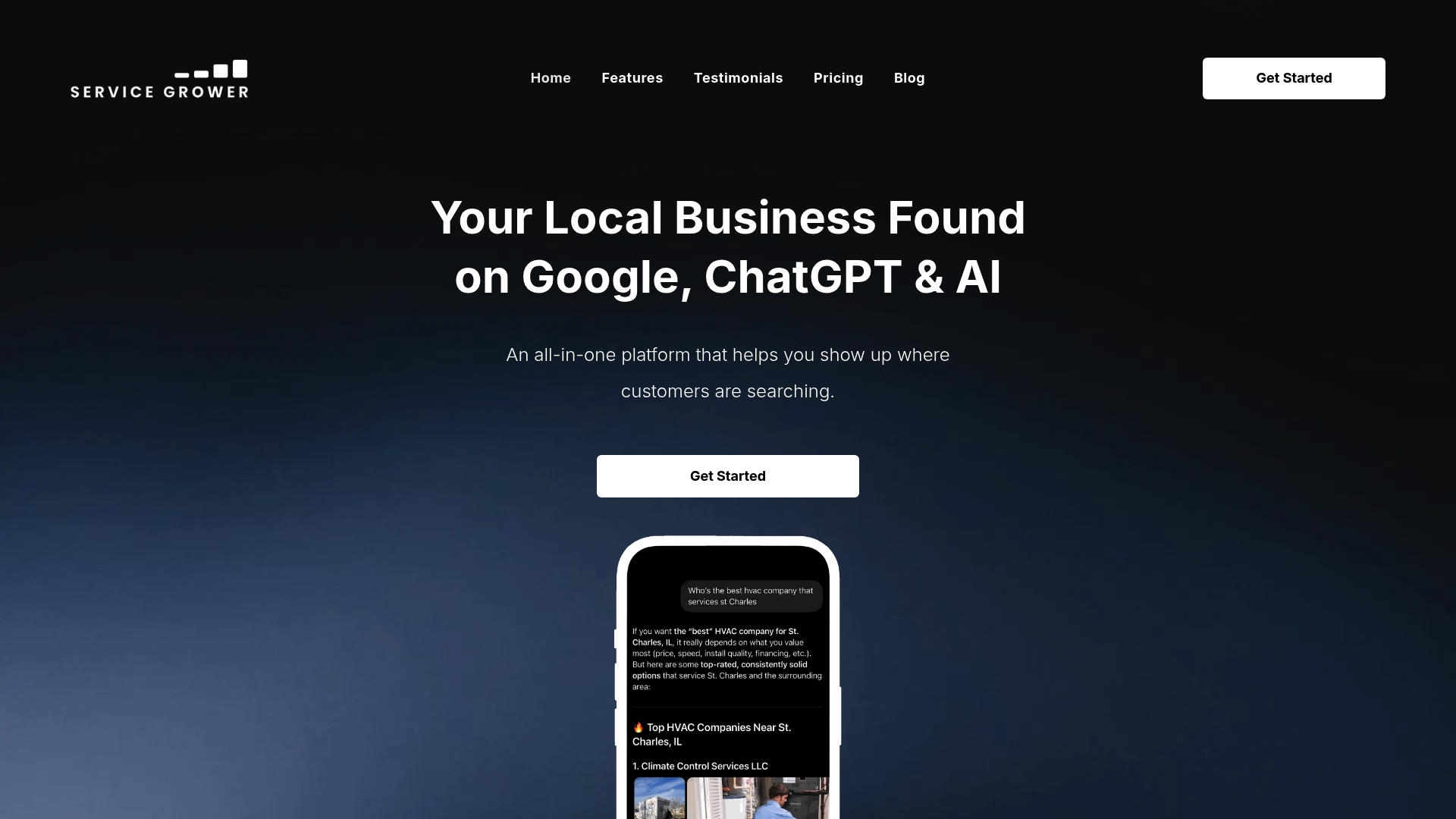
If you run a local business and want the patterns in this article handled for you rather than built from scratch, the Service Grower plan starts at $249 per month and includes the AnswerReady™ approach alongside review and messaging tools in one system. Check the pricing page for current details or request a look at how it works for your industry.
Sources
- FAQs still deliver great value - NN/G
- Accordion Pattern (Sections With Show/Hide Functionality) | APG | WAI | W3C
- How to Create an FAQ Page + 12 Examples (Mailchimp)
FAQ
Can you provide an example of a FAQ page?
A common example pairs a short accordion of 8 to 20 questions with a “Popular questions” block above it showing the three or four most searched answers already expanded. Larger sites, as shown in Mailchimp’s FAQ page examples, often add a search bar and category filters when the question count grows too large for a single scroll.
How do you write an FAQ for a website?
Start by mining support transcripts and on-site search terms to find the exact phrasing visitors use, then lead each answer with a direct sentence before adding detail. NN/G’s UX writing guidance recommends plain language and skimmable structure over polished marketing copy.
What is the best format for a FAQ document?
There is no single best format: an accordion suits 8 to 20 short questions, while a linked list of topic pages works better for longer or more complex answers. NN/G’s research on FAQ value supports chunking long FAQ sets by topic rather than forcing everything onto one page.
What is a FAQ page?
A FAQ page is a dedicated section answering the questions visitors most commonly ask before or after choosing a product or service. Well-built ones are chunked by topic and written in the visitor’s own vocabulary rather than internal terminology, which improves both usability and search visibility.
Why does FAQ page accessibility matter for accordions?
Screen readers and keyboard users rely on native button elements and the aria-expanded attribute to know whether a panel is open or closed, as outlined in the W3C APG accordion pattern. Without that markup, assistive technology cannot announce state changes, and content that loads only after a click can also break in-page search for every user.