 GROWTH GUIDE
Entity SEO for Local Businesses: A Practical Guide
Entity SEO for a local business comes down to one job: make it unmistakable to Google and to AI assistants who you are, what you do, where you do it and why people trust you. You do that by keeping your name, address, services and profiles identical everywhere, describing them in structured data on your site, and earning reviews and mentions that confirm the same facts. This guide shows how to do it step by step, what is proven, what is still uncertain, and how to tell whether it is working.
TL;DR
- An entity is a clearly identifiable thing, such as your business, your owner, your service area or your services. Entity SEO means optimizing around those things and their relationships, not only around exact keywords.
- For a local business, the work is consistency: one name, address, phone number and category across your website, Google Business Profile and listings.
- Add Organization and LocalBusiness structured data, build real service and location pages, and link your profiles with
sameAs. - Google says local results rest on relevance, distance and prominence, and that you cannot pay for a better local ranking. Reviews and web mentions feed prominence.
- Measure with calls, form requests and bookings first. Use Search Console reports as supporting evidence.
Table of Contents
- What entity SEO means when you run a local business
- How entity SEO differs from keyword SEO for local search
- Step 1: Become one clear business everywhere
- Step 2: Describe your business on your website in a way machines can read
- Step 3: Let reviews, citations and mentions confirm the facts
- Step 4: What entity SEO can and cannot do in Search, Maps and AI answers
- Step 5: Measure whether it is working
- Our perspective: the entity is the whole business, not a tag
- Where Service Grower fits
- Mistakes that undo entity work
- A 30 day plan
- FAQ
- Sources
What entity SEO means when you run a local business
Search engines no longer only match the words in a query to the words on a page. Ahrefs describes entity-based SEO as optimizing around distinct, identifiable entities (people, places, organizations, products and concepts) and the relationships between them, instead of relying only on exact keywords.
For a local business, the entities are concrete:
- The business itself: “Alvarez Heating & Air” is one organization with one name, one phone number and one location or service area.
- The people: the owner, the lead technician, the head barber, the travel advisor whose name clients ask for.
- The services: furnace repair, fade haircuts, cruise planning, catering.
- The places: the city, the neighborhoods, the county you serve.
The goal is for a search system to connect all of these correctly. When someone searches “AC repair near me” or asks an assistant for a trustworthy HVAC company in their town, the system has to decide which businesses are real, which are relevant, and which it can safely recommend. A business with a clear, consistent identity is easier to recommend than one that appears under three names, two phone numbers and an outdated address.
How entity SEO differs from keyword SEO for local search
Keyword SEO asks, “Which phrase should this page contain?” Entity SEO asks, “What is this page about, who is behind it, and does everything else on the web agree?”
Search Engine Land explains that entities give search systems a higher-level structure for understanding meaning, so they can retrieve relevant information even when a document does not contain the exact query wording. In practice, a page about “emergency furnace repair in Dayton” can be understood as relevant to “my heat is out tonight” because the system understands the concepts and how they relate.
| Question | Keyword-first approach | Entity-first approach |
|---|---|---|
| What do you optimize? | Pages for phrases | The business, its people, services and places |
| What counts as a mistake? | Missing a phrase | Conflicting facts across the web |
| Where does the work happen? | Mostly on your site | Your site, Business Profile, listings and mentions |
| What proves it works? | Rankings for terms | Calls, requests and bookings from the right area |
You still need the words people use. Entity SEO adds the layer that tells search systems those words belong to a real, specific business.
Step 1: Become one clear business everywhere
The foundation is your Google Business Profile. Google Search Central notes that you can claim and verify your profile to manage your address, contact information, business type and photos, and that this information can appear in Google Maps and the knowledge panel.
Treat that profile as the source of truth, then make everything else match it.
- Pick the canonical details. Write down your exact business name, address format, phone number, website URL, primary category and hours. Use the name customers actually see on your sign and invoices.
- Fill the profile completely. Google says complete, accurate information helps people find a business in relevant local searches, according to its local ranking guidance.
- Match your website. The footer, contact page and homepage should show the same name, address and phone number as the profile, character for character.
- Audit your listings. Check the major directories, your social profiles, industry associations and chamber of commerce pages. Fix any old addresses, tracking numbers and name variations.
- Choose one primary category and be specific. An “HVAC contractor” is clearer than a generic “home services” label.
If customers tell you your profile is live but the phone is quiet, our page on a Google profile not getting calls walks through the usual causes.
Common identity breaks
These are the inconsistencies we see most often in local businesses:
- A suite number on one listing and none on another.
- A call-tracking number on the website and the real number on the profile.
- “Co.” versus “Company” versus “LLC” in the business name.
- A moved location still showing the old address on a few directories.
- Service-area businesses that publish a home address on one platform and hide it on another.
None of these is a disaster alone. Together they make it harder for a system to be confident that all these records describe the same company.
Step 2: Describe your business on your website in a way machines can read
Your website is the one place you fully control, so it should state your identity in plain language and in structured data.
Structured data that matters
Google says Organization structured data can help it better understand and disambiguate an organization, and that the sameAs property can point to pages on other websites with information about it. Google also recommends using the most specific Organization or LocalBusiness subtype that fits and placing organization information on the homepage or a single page describing the organization.
For local details, Google’s LocalBusiness documentation says this markup can communicate business hours, departments, reviews and other details, and recommends defining each location with the most specific subtype possible. It lists name and physical address as required properties, and recommends telephone, URL, opening hours, geographic coordinates and the business subtype.
A stripped-down example for an HVAC company looks like this:
{
  "@context": "https://schema.org",
  "@type": "HVACBusiness",
  "name": "Example Heating & Air",
  "url": "https://www.example.com",
  "telephone": "+1-555-555-0100",
  "address": {
    "@type": "PostalAddress",
    "streetAddress": "100 Main St",
    "addressLocality": "Dayton",
    "addressRegion": "OH",
    "postalCode": "45402"
  },
  "sameAs": [
    "https://www.facebook.com/examplehvac",
    "https://www.linkedin.com/company/examplehvac"
  ]
}
The values must match your Business Profile exactly. If you want more patterns you can copy and adapt, see our guide to local business schema in JSON-LD, and our notes on FAQ schema for local businesses for pages that answer common customer questions.
Structured data is not a ranking switch. It is a clear label that removes guesswork about what the page says. Only mark up what is visible on the page, and keep it current.

Pages that give the entity substance
Markup without content is an empty label. A local business entity gets substance from pages like these:
- A real About page. Who owns the business, how long it has operated, licenses and certifications you actually hold, who the team is. Name real people.
- One page per core service. “Furnace repair” and “AC installation” deserve separate pages that explain the service, the process, typical situations and what customers should expect.
- One page per location or distinct service area. Write each with local specifics: neighborhoods, common problems in the area, real projects. Avoid swapping city names into identical text. If you operate several locations, our guide to store locator SEO covers how to structure them.
- A contact page that repeats your canonical details and shows your hours.
Link these pages to each other the way a customer would think about them: the service page links to the areas you serve, and each area page links back to the services offered there.
Step 3: Let reviews, citations and mentions confirm the facts
Your own site can claim anything. Other sources are what make the claims believable.
Google states that prominence is based partly on information across the web, including links, articles and directories, and that review count and score factor into local ranking, in its local ranking guidance. The same page says that replying to reviews shows customers their feedback is valued.
That gives you three practical levers.
Reviews
Ask every happy customer, while the job is fresh. A steady trickle looks more natural and informative than a burst once a year. Our guide to getting 5 to 10 Google reviews a month covers the link and QR code approach, and automating review requests shows how to time them. Respond to everything, including the bad ones, using the templates for negative reviews. Restaurants have extra rules to follow, which we cover in the 90 day plan for restaurant reviews.
Reviews also carry entity information. When customers write “they fixed our heat pump in Kettering”, they attach your business to a service and a place in their own words.
Citations and directories
A citation is any mention of your name, address and phone number on another site. Quality beats volume: your chamber of commerce, trade associations, supplier “find a dealer” pages, and reputable local directories. Each should use your canonical details.
Local mentions and links
The strongest mentions are the ones a real business earns: a sponsorship of a youth team, a feature in a local roundup, a supplier listing you as an installer. Curated local guides, such as this one featuring local businesses in Southern California, show the kind of regional context that ties a business to a place. Aim for mentions that name you, your location and what you do.
Step 4: What entity SEO can and cannot do in Search, Maps and AI answers
Honesty matters here, because plenty of articles overpromise.
What Google has said. Local results are based primarily on relevance (how well a profile matches the search), distance and prominence, per Google’s local ranking page. The same page says there is no way to request or pay for a better local ranking. You cannot buy your way into the map results, so accurate information and genuine reputation are the legitimate path.
What follows from it. Relevance is helped by accurate categories, services and a website that matches them. Prominence is helped by reviews and web presence. Distance you cannot change, which is why service-area clarity matters.

What is uncertain. Nobody outside the AI companies knows exactly how assistants such as ChatGPT choose which local businesses to name. Consistent facts, clear descriptions, strong reviews and independent mentions are sensible inputs, because they are what any system needs to verify a business. But no one can promise a result from a particular schema property or listing. Be skeptical of anyone who does.
For how this plays out in the map results specifically, our local SEO checklist for 2026 and our guide on winning the map pack for service businesses cover the practical sequence.
Step 5: Measure whether it is working
Measure outcomes before rankings.
- Calls, direction requests and website clicks from your Business Profile insights.
- Form requests and bookings by source. Ask every new customer how they found you and record it.
- Branded searches. More people typing your business name is a sign your entity is becoming known.
- Search Console. Google has published a generative AI performance report in Search Console Help, which is the official place to see how your site appears in AI features. Use it as supporting evidence, then check it against actual leads.
- Review count and rating month over month.
Give changes time. Fixing citations and structured data can show up within weeks, while reputation signals build over months. Keep a simple monthly log so you can connect effort to results.
Our perspective: the entity is the whole business, not a tag
We see the same pattern when local owners tell us customers cannot find them. The website says one thing, the Google profile another, the reviews sit on three platforms, and nobody has time to reconcile it. Search engines and AI assistants then see a blurry business.
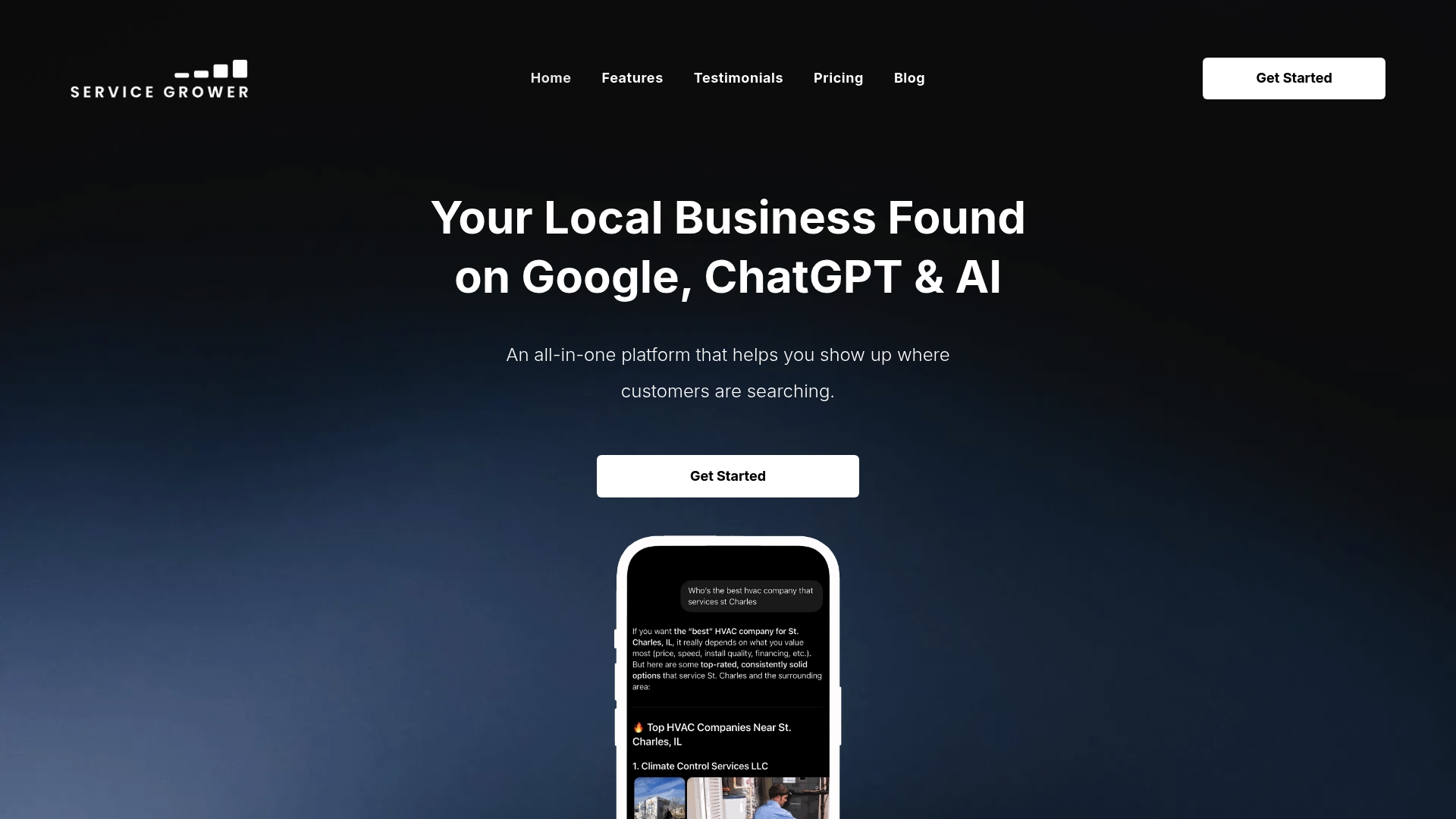
That is why we built Service Grower as one managed system instead of a pile of separate tools: a website built to answer customers’ questions (our AnswerReady websites), local search and AI visibility management, review and reputation management, and a single place to track customer interactions. When the website, the profile, the reviews and the messages all come from one system, the facts stay aligned without anyone chasing them.
Our view is that entity SEO is not a trick for the technical few. It is bookkeeping for your reputation. Keep your facts straight, show real proof, answer customers promptly, and the technology can do the rest.
— Service Grower
Where Service Grower fits
If you would rather not maintain the website, markup, profile and review process yourself, the Service Grower plan is $249 per month and covers the integrated online presence platform: an AI-optimized website, local search and AI visibility management, review management, and a portal for customer interactions and leads. See the details on our pricing page.
If you also want paid traffic while your organic presence builds, we offer managed Google Ads and Meta Ads at $249 per month each, listed on our services page. Optional email domain and SMS setup are $25 one-off each, listed on our system page.
Mistakes that undo entity work
- Changing the business name casually. Adding keywords to your Business Profile name creates a mismatch with your signage, site and listings, and can put the profile at risk.
- Marking up things that are not on the page. Structured data should mirror visible content.
- Cloned city pages. Pages that differ only by town name add nothing a system can use.
- Ignoring old listings. An abandoned directory profile with a previous address keeps contradicting you.
- Chasing every tool. The basics, consistent facts, honest reviews and clear service pages, deliver most of the benefit.
- Treating it as a one-time project. Hours change, staff change, services expand. Review your core facts quarterly.
A 30 day plan
| Week | Focus | Output |
|---|---|---|
| 1 | Identity audit | A single document with canonical name, address, phone, categories, hours and URLs |
| 2 | Fix profiles and listings | Business Profile completed; top directories and social profiles matched |
| 3 | Website | Organization and LocalBusiness markup, About page, service and area pages reviewed |
| 4 | Reputation and measurement | Review request process running, baseline numbers recorded for calls, requests and reviews |
FAQ
What is entity-based SEO?
It is optimizing around identifiable things such as organizations, people, places and services, and the relationships among them, instead of only matching exact keywords. For a local business, that means search systems can tell exactly who you are, what you offer and where.
Is entity SEO different from local SEO?
They overlap heavily. Local SEO covers the full set of work that earns local visibility, including your profile, reviews and website. Entity SEO is the thinking behind much of it: be one clear, consistent, verifiable business across every place you appear.
Does schema markup improve my local ranking?
Google describes structured data as a way to help it understand your organization and location, not as a ranking guarantee. Its local ranking guidance names relevance, distance and prominence as the main factors. Use markup for clarity and make sure it matches what is on the page.
Can I pay Google for a better local ranking?
No. Google states there is no way to request or pay for a better local ranking. You can run paid ads separately, but map and local result placement depends on relevance, distance and prominence.
How long does it take to see results?
Cleaning up inconsistent listings and adding structured data can be reflected within weeks, though timing varies. Reviews and mentions build over months. Track calls and bookings monthly rather than waiting on a single ranking report.
Sources
- What is Entity-Based SEO? (Ahrefs)
- Entity SEO: The definitive guide (Search Engine Land)
- Add Business Details to Google (Google Search Central)
- Organization structured data (Google Search Central)
- Local Business structured data (Google Search Central)
- How to improve your local ranking on Google (Google Business Profile Help)
- Generative AI performance report (Search Console Help)
- Local businesses in Southern California