
 GROWTH GUIDE
6–12 Slots That Convert: Booking Form Examples for Service Businesses
If you need a booking form fast, start with a short appointment request template when your calendar needs a human to confirm, or a live-availability widget when you can show real-time slots. Request-style forms work best for consultations and custom services, while live booking suits restaurants, classes, and rentals with fixed capacity. Pick a template below, test one real booking end to end, and confirm your confirmation email actually arrives before you publish the form.
TL;DR:
- Offering a limited, curated list of appointment slots for nonstandardized services can increase customer preference.
- For services with fixed inventory, displaying full availability organized into time blocks tends to be more effective.
- Most booking forms should include essential fields like contact details, service selection, date and time, and a clear confirmation step.
- Testing the booking process on mobile devices and pairing automated reminders improve confirmation rates and reduce missed appointments.
- Managed booking systems can handle ongoing maintenance and integration issues better than DIY templates for busy businesses.
Table of Contents
- Booking form examples by use case
- Essential fields every booking form needs
- Design and accessibility rules for booking forms
- How many time slots should you show?
- Build, embed, and test your booking form
- What a managed booking setup gets right that templates miss
- Why some businesses skip the DIY template route
- Sources
- FAQ
Booking form examples by use case
Every business type needs a different field order, so copy the structure that matches your service instead of forcing a generic template.
Appointments and consultations (salons, coaches, tutors, repair services): service needed, preferred date and time, name, email, phone, short reason or goal, policy consent, then a descriptive submit button like “Request My Appointment.” Use request-style booking here since most appointment businesses need to confirm availability manually before locking in a slot.

Hotels and tours: arrival date, duration or number of nights, number of guests, room or package selection, special requirements, payment details, and a cancellation-terms checkbox. Live availability calendars work well because inventory is fixed and known in advance.
Restaurants: date, time, party size, seating preference, and special occasion notes, kept to five fields or fewer so phone-based diners do not abandon the form. Real-time booking reduces no-show disputes because the table hold is instant.
Rentals (equipment, venues, vehicles): pickup and return dates, item or package selection, quantity, delivery address if relevant, and payment capture upfront. Rentals almost always need live booking since double-booked inventory is a real financial risk.
Classes and workshops: class or session selection, date and time, number of attendees, waiver or consent checkbox, and payment. Classes with fixed capacity should show live seat counts rather than a generic “request to join” flow.
When embedding any of these, keep the form on the same page as your pricing or service details so the reader does not have to hunt for context before committing.
Pro Tip: Match the template’s field count to how much trust the booking requires: a $20 class needs fewer fields than a $2,000 consultation.
Pro Tip: Test your confirmation message on a phone before launch. A broken mobile confirmation page is the most common reason bookings go unconfirmed.
Essential fields every booking form needs
A useful booking form, at minimum, includes the customer’s name and contact details, service or resource selection, date and time, group size where relevant, special requests, and a clear confirmation path. Everything beyond that is optional and should earn its place.
- Name and contact: full name, email, and phone, grouped together at the top so the form feels personal before it asks for logistics.
- Service or resource selection: a dropdown or radio group naming exactly what the customer is booking, never a free-text field.
- Date and time: paired fields with clear format hints, placed together rather than split across the form.
- Group size or quantity: only for services where capacity or pricing changes with headcount.
- Special requests: a short optional text box, labeled so customers know what belongs there.
- Confirmation step: a submit button with action language like “Confirm My Booking” rather than a generic “Submit.”
Keep placeholder text as an example only, never as the sole label: “e.g., (555) 123-4567” next to a visible “Phone Number” label, not instead of it.
Design and accessibility rules for booking forms
Show availability first, then ask qualification questions. This order, known as progressive disclosure, keeps the form short at first glance and only expands once the customer has committed to a date.
For date pickers, follow the patterns in the W3C date picker dialog examples: a labeled control, full keyboard operation, predictable focus movement after a date is chosen, and an accessible announcement of the selected date. The combobox date picker pattern adds grid semantics so assistive technology users can navigate a calendar the same way sighted users do.
- Label every field, never rely on placeholder text alone to explain what belongs in it.
- Use
aria-describedbyto explain date formats near the field itself. - Build in error handling that tells the customer exactly which field needs fixing, not just that something went wrong.
- Design mobile-first: date pickers and dropdowns should be large enough to tap without zooming.
Accessible calendars are a detail most off-the-shelf templates miss, according to the W3C APG combobox examples, which outline the keyboard commands and markup needed to avoid common failures.
How many time slots should you show?
Peer-reviewed experiments found an inverse-U relationship between the number of offered appointment slots and customer preference, documented in empirical studies on booking status. Very few slots can signal scarcity or low demand, while an overwhelming list can make the service look unpopular or disorganized, for many nonstandardized services.
- For nonstandardized services like salons or coaches, offer a curated moderate number of near-term slots rather than the full calendar.
- For standardized services like appointments at a public office, fuller availability organized into time blocks tends to work better.
- Run two simple tests: a curated short list against a limited high-demand list, then measure completed bookings against a full-calendar control.
Recent research on appointment systems backs this up, noting that availability itself signals quality and capacity, so slot presentation deserves testing rather than guesswork.
Build, embed, and test your booking form
Getting a form live is a short, ordered process. Skip a step and you risk a broken booking flow nobody catches until a customer complains.
- Choose a template that matches your use case from the examples above.
- Remove any field that does not affect scheduling or fulfillment.
- Add conditional logic so service-specific questions only appear when relevant.
- Connect notifications and payment processing only where the booking actually requires them.
- Embed the form on your site and test one full booking on a phone, including the confirmation step.
Before publishing, confirm calendar sync is working, test keyboard-only navigation through the date picker, and check that confirmation emails land outside the spam folder. Pairing automated SMS reminders with your confirmation flow is one of the simpler ways to cut down on missed appointments, since a text the day before a slot tends to get noticed faster than email.
Pro Tip: Send yourself a test booking from an incognito browser window. Logged-in sessions often hide errors a new customer would actually hit.
What a managed booking setup gets right that templates miss
Most booking-form failures aren’t about field order, they’re about what happens after the form is live: nobody updates the confirmation copy, nobody checks mobile rendering after a redesign, nobody reconnects the calendar sync after a plugin update. A template solves the form. It does not solve the maintenance.
That gap is why some local businesses choose a managed system instead of a self-built one, trading a bit of setup control for someone else watching the whole chain from form to confirmation to review request.

Why some businesses skip the DIY template route
Building and maintaining a booking form is one piece of a bigger problem: customers need to find your business before they ever reach the form. Some platforms combine booking forms with AI-optimized websites and visibility management so the booking widget sits on a page built to get found on Google and AI search tools, not just on a form that works once someone lands there.
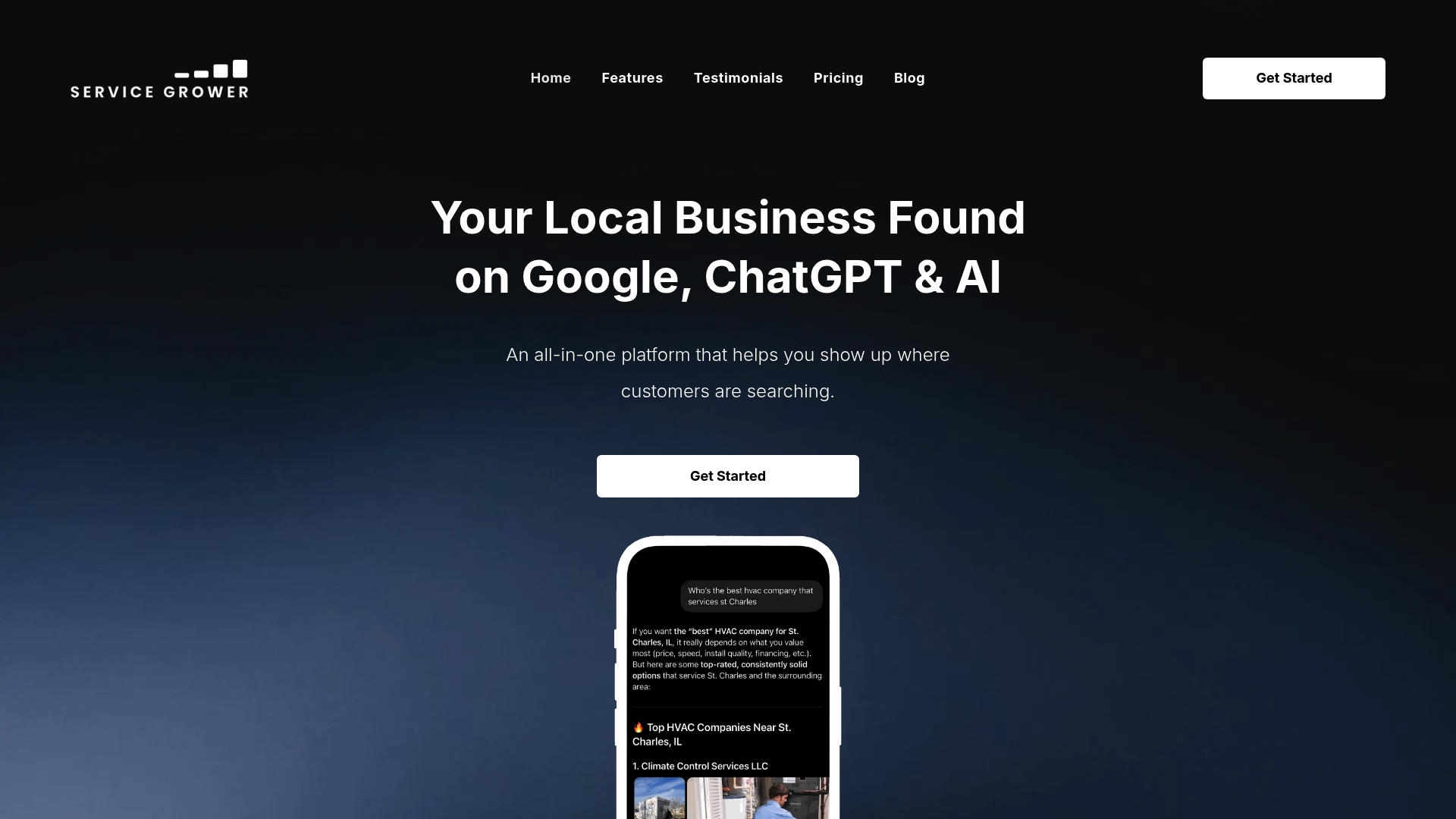
A managed setup makes sense when you would rather spend your week running the business than debugging a calendar sync or rewriting confirmation emails. Some platforms also handle customer messaging and review requests after the booking is confirmed, which keeps the loop from booking to repeat customer in one system instead of three.
- Booking and request forms built into the platform
- Websites designed to get found by search and AI tools
- Review management and customer messaging in the same dashboard
- Optional managed Google Ads and Meta Ads for businesses that want more bookings, not just a better form
Check current pricing and plans to see if a done-for-you setup fits your business better than piecing one together yourself.
Sources
- Date Picker Dialog Example | APG | WAI | W3C
- Empirical studies on the impact of booking status on customers’ choice behavior in online appointment systems | Journal of Business Economics
FAQ
Can you provide an example of a booking form?
A simple example is an appointment request form with service needed, preferred date and time, name, email, phone, a short reason for the visit, and a submit button. Hotels and rentals typically add arrival date, group size, package selection, and payment fields on top of that core set.
How do I create a booking form?
Start with a template matching your use case, remove fields that don’t affect scheduling, add conditional logic for specific services, connect notifications and payment only where needed, then embed the form and test a full booking on mobile. Confirm calendar sync and confirmation emails before sharing the link publicly.
What is a booking form?
A booking form is an online form that lets customers request or reserve a service, appointment, table, room, or rental slot without calling or emailing the business directly. It typically collects contact details, the service or date needed, and ends with a confirmation step.
What are some examples of forms similar to booking forms?
Related form types include consultation request forms, event RSVP forms, rental reservation forms, and class signup forms, each sharing the same core structure of contact details, selection, date, and confirmation. The main difference is which fields are required based on whether the booking needs real-time availability or manual confirmation.
How many appointment slots should a booking form show?
Research on appointment systems found that showing a moderate, curated number of slots, often 6 to 12 for nonstandardized services, tends to perform better than showing either very few or an overwhelming full calendar, based on peer-reviewed experiments. Standardized services with predictable demand can show fuller availability organized by time block.