
 GROWTH GUIDE
Fill Chairs in 2026 With a 21 Day Rebook System for Barber Shops
Fix three things first: your Google Business Profile and local search presence, a booking flow that takes two taps, and automated rebooking reminders so clients return without you chasing them. Get those right and you’ll see more new clients discovering you online and a higher percentage of them coming back, which lowers what you spend to keep a chair full. Before anything else, log into your Google Business Profile and confirm the booking link works and your photos are current.
TL;DR:
- Improving your Google Business Profile, review velocity, and local search presence is essential to outperform competitors and attract new clients.
- Using short-form videos like transformations and behind-the-scenes clips on Instagram and TikTok can convert viewers into booked appointments more effectively than static photos.
- Reducing booking friction through visible “Book Now” buttons and streamlining the booking process increases conversion rates and simplifies tracking source data.
- Implementing automated rebooking and client retention sequences significantly lowers no-show rates, especially when combined with follow-up reminders and referral incentives.
- An integrated platform like Service Grower consolidates SEO, booking, reviews, and automated messaging, saving time and improving overall marketing efficiency.
Table of Contents
- What Does Local SEO and Google Business Profile Optimization Look Like for a Barber Shop?
- How Should Barbers Use Social Media to Get Bookings?
- How Do You Reduce Booking Friction and Track Conversions?
- What’s the Best Way to Automate Rebooking and Client Retention?
- Do Local Paid Ads Actually Work for Barbershops?
- How Do You Build a Content Calendar Without Burning Out?
- What KPIs Should a Barber Shop Track Every Month?
- How Does an Integrated Platform Simplify Barber Shop Marketing?
- How Do You Build a Brand That Stands Out From Every Other Barber Shop in Town?
- How Can Sponsoring Local Events Grow a Barber Shop?
- Which Local Business Partnerships Make Sense for a Barbershop?
- Does a Barbershop Need a Blog or Newsletter Beyond Social Media?
- How Should Barbershops Use Reviews and Testimonials?
- What Seasonal Promotions Work Best for Barber Shops?
- The Quick Wins vs. the Long Game
- Get Your Barber Shop Marketing Running Without Doing It All Yourself
- Sources
- FAQ
What Does Local SEO and Google Business Profile Optimization Look Like for a Barber Shop?
Barbering is still one of the more crowded personal-care categories in the country, according to Statista’s employment data on the barber industry, which means the shop with the sharpest Google Business Profile (GBP) wins the search before a client ever picks up the phone. Local search signals and how recently you’ve collected reviews carry real weight in both map-pack rankings and the answers AI assistants give when someone asks “best barber near me,” according to SEMRush’s local SEO research.
Pro Tip: Set a recurring monthly reminder to audit your GBP listing the same day you review your bank statement. Ten minutes, same day every month, and it never falls through the cracks.
Here’s what belongs on that checklist:
- Fill in every category option, not just “Barber Shop.” Add “Men’s Hair Salon,” “Beard Trim,” or whatever else applies.
- List every service with a price range, not just a generic menu link.
- Keep hours, holiday closures, and service-area details current, especially around holidays when hours shift.
- Add attributes like “walk-ins welcome,” “wheelchair accessible,” or “identifies as veteran-owned” if they apply.
- Post fresh photos weekly: finished cuts, the chair setup, the shopfront. Caption them with the actual service (“skin fade,” “beard sculpt”) instead of generic captions.
- Ask for a review at checkout, then follow up with an automated text or email request within 24 hours of the appointment.
- Watch your review velocity, meaning how many new reviews come in per month, not just your star average.
On the website side, build individual service pages (fades, beard work, kids’ cuts) instead of one crowded homepage, and keep your name, address, and phone number identical across every directory listing. Inconsistent NAP data confuses search engines and quietly tanks your ranking. A barbershop website built around booking and search does both jobs at once instead of treating them as separate projects.
How Should Barbers Use Social Media to Get Bookings?
Short-form video beats static photos for reach and, more importantly, for turning a scroll into a booked appointment, according to Vagaro’s research on barbershop social content. The formats that consistently outperform everything else:
- Before-and-after transformations, filmed with the same angle and lighting every time so the contrast pops.
- Behind-the-scenes clips: sharpening tools, mixing a fade, the shop opening up before the first client.
- Client features, where a regular talks about why they keep coming back.
- Quick educational clips: how to maintain a fade between visits, what product to use on curly hair.
Pick two platforms, not five. Instagram and TikTok cover most barbershop audiences, and you can repurpose the same clip on YouTube Shorts with zero extra filming. Batch your filming once a week, then schedule three to five feed posts and a Story every day if you can manage it.
Pro Tip: Film five transformations back to back on your slowest day of the week. That’s a month of content in one sitting, and you’ll never scramble for something to post on a Tuesday morning.
None of it matters if the booking link is buried. Put it in your bio, pin a booking post to the top of your grid, and use the platform’s native “Book Now” button wherever it’s available. A social feed without a visible path to booking is just entertainment, not barbershop marketing with a return on it.
How Do You Reduce Booking Friction and Track Conversions?
Apply the 3-click rule: a client should get from “I found this shop” to “I have an appointment confirmed” in three taps or fewer. Test it yourself on your own phone, not a desktop, because that’s how almost every client will actually book.
- Put a visible “Book Now” button on your GBP listing, your Instagram bio, your TikTok bio, and your website header, not buried in a menu.
- If you offer straightforward services like cuts and beard trims, use direct online booking with real-time availability.
- If you offer higher-ticket services like custom color work or multi-hour treatments, use a lead capture form instead so you can quote and confirm before locking a slot.
- Set up call tracking and booking-source tagging so you know whether a client came from Google, Instagram, or a paid ad.
- Review your booking funnel monthly: where do people drop off between clicking and confirming?
The businesses that lose the most bookings aren’t the ones with bad marketing. They’re the ones sending interested clients to a five-step form on a slow-loading page. Fix the mechanics before you spend another dollar on new-client ads.
What’s the Best Way to Automate Rebooking and Client Retention?
Retention beats acquisition for one simple reason: a client who already trusts your work costs almost nothing to bring back compared to a new client from a cold ad. The timing of your outreach determines whether that happens automatically or not at all.
- Rebook in the chair before the client leaves. This single habit does more for retention than any app.
- Send an automated nudge around day 21 for clients on a four-to-six-week cycle who haven’t rebooked yet.
- Layer in reminders at 24 hours and again at 2 hours before the appointment to cut no-shows.
- Build win-back sequences for clients at the 30, 60, and 90-day lapsed marks, each with a slightly stronger offer than the last.
- Add a referral incentive (a discount or a free add-on) and consider a simple membership tier for your highest-frequency clients.
Shops using automated reminders and rebooking flows see meaningfully fewer no-shows than shops relying on memory alone, according to research on spa and salon software adoption, and industry data on no-show benchmarks from SearchPod’s 2026 barbershop marketing analysis puts typical no-show rates in the 5 to 15 percent range before automation kicks in. Text messages consistently get opened faster than email for this kind of time-sensitive reminder, based on messaging channel research from Happoin.
Pro Tip: *Word your win-back texts around the client, not the discount: "Your fade is probably growing out.
For no-show-prone clients specifically, require a card on file or a small deposit for the next booking. It filters out the guests who were never serious about the slot.
Do Local Paid Ads Actually Work for Barbershops?
Yes, but only if you measure cost per booked client instead of cost per click, which is the number most owners default to and the one that misleads them. Set your radius targeting to 3 to 5 miles around the shop. Anything wider wastes spend on people who will never drive across town for a haircut.
- Bid on high-intent keywords: “walk-in barber near me,” “beard trim [your neighborhood],” not broad terms like “hairstyles.”
- Run a rotating playbook: last-minute opening promotions when a slot frees up, a new-client offer to fill off-peak hours, and a membership push once you have capacity to spare.
- Track every call and booking back to the ad that generated it, then divide total spend by booked clients, not by clicks or impressions.
- Increase spend only after a campaign proves it converts at a cost per booked client you can afford, and test one new creative or offer at a time so you know what actually moved the number.
Local intent signals like these are also part of what feeds AI-driven local recommendations, not just traditional search rankings, according to SEMRush’s local search data. For shops ready to run paid campaigns without managing bid strategy themselves, lead generation strategies built for barbershops walk through the same radius and offer logic in more depth.
How Do You Build a Content Calendar Without Burning Out?
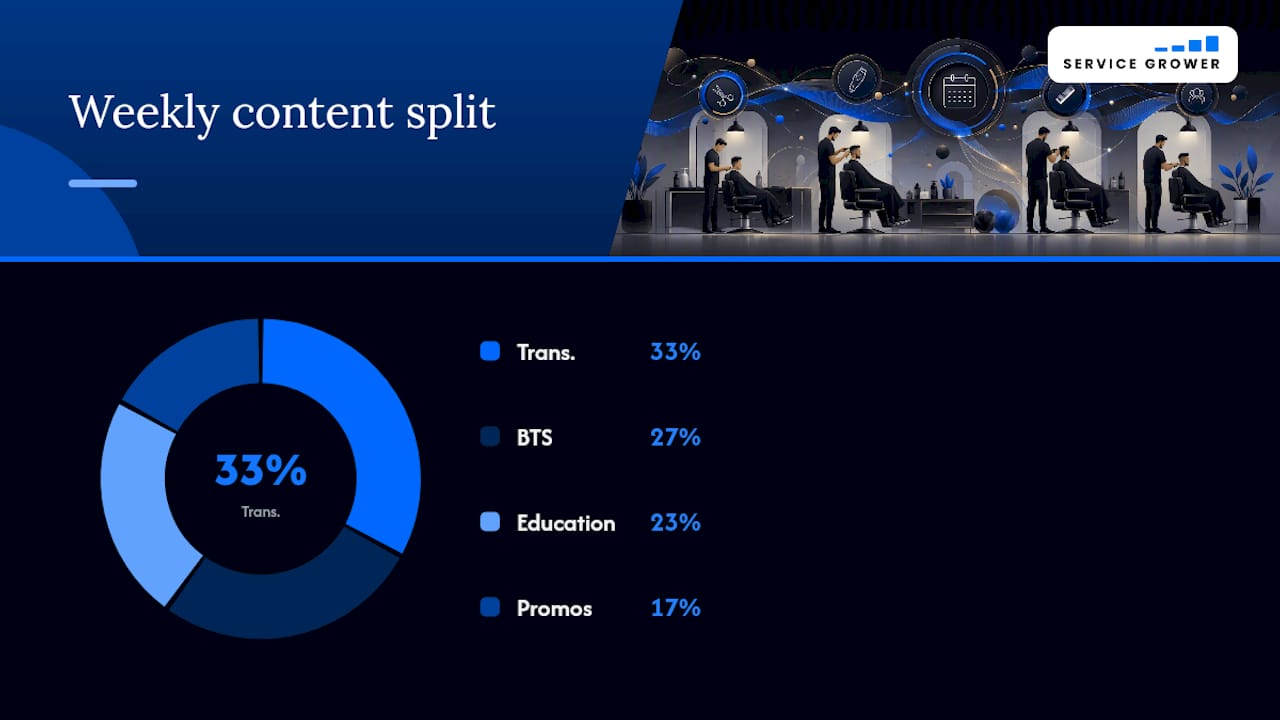
Batch it. Set one morning a week (or every other week) to film everything, then let scheduling tools drip it out. A simple cadence: two transformation posts, one behind-the-scenes clip, one educational tip, and one promo per week, with a daily Story if you have five extra minutes.
Gear stays cheap: your phone, a $25 tripod, and a $30 ring light cover 90 percent of what you need. Edit in-app with basic trims and captions rather than chasing complicated software.
Thirty quick ideas, grouped so you never stare at a blank calendar:
- Transformations (10): fade progressions, beard sculpting, color correction, kids’ first haircuts, gray blending.
- Behind-the-scenes (8): tool sharpening, product mixing, shop opening routine, new hire training.
- Education (7): at-home maintenance tips, product recommendations, seasonal hair care, face-shape guidance.
- Promos (5): flash discounts, referral pushes, membership announcements, holiday hours, new-client offers.
| Day | Content type | Time to shoot |
|---|---|---|
| Monday | Transformation post | 10 minutes |
| Wednesday | Educational tip | 5 minutes |
| Friday | Behind-the-scenes | 5 minutes |
| Weekend | Promo or client feature | 10 minutes |
What KPIs Should a Barber Shop Track Every Month?
Five numbers tell you almost everything: rebooking rate (returning clients divided by total clients in a period), cost per booked client (total marketing spend divided by new bookings attributed to that spend), review velocity (new reviews per month), average ticket value or ATV (total revenue divided by number of appointments), and no-show rate (no-shows divided by total bookings).
- Build a simple spreadsheet with one column per KPI and one row per month, so trends show up fast.
- Budget 5 to 10 percent of gross monthly revenue for marketing, a range that lines up with what Booksy’s 2026 barbershop marketing guide recommends for small service shops.
- Newer shops should weight that budget more heavily toward acquisition; established shops with a full book should shift most of it toward retention and reputation work.
- Run one small experiment per month (a new offer, a new ad creative, a new reminder script) and compare it against the prior month’s baseline before rolling it out shop-wide.
Skip the vanity metrics like follower counts. They don’t pay rent.
How Does an Integrated Platform Simplify Barber Shop Marketing?
Running local SEO, social scheduling, booking, and reminders as five separate tools creates five separate places where a client can fall through the cracks. A connected system turns marketing into something that runs quietly in the background instead of a list of tasks competing for your attention, a shift SearchPod’s analysis of 2026 barbershop marketing systems points to directly.
Here’s how the pieces map to a platform like Service Grower: AnswerReady™ websites handle the local SEO and service-page structure, SmartRequest manages the booking flow itself, built-in review tools handle the request-and-monitor cycle, GrowthView reports on the numbers, and automated email and text campaigns run the reminder and win-back sequences without you typing a single message by hand.
When you evaluate any platform for this, ask the same four questions every time:
- Does it own the full path from discovery to booking, or just one piece of it?
- Do you keep your own client and review data, or does it live locked inside someone else’s dashboard?
- Does the reporting actually tie ad spend to booked clients, or just to clicks?
- Can it send both email and text reminders without a separate tool bolted on?
How Do You Build a Brand That Stands Out From Every Other Barber Shop in Town?
Most barbershops within a five-mile radius look and sound identical online: dark logo, generic tagline, stock photos of clippers. Differentiation comes from picking one thing you do better or differently than every competitor and repeating it everywhere, not from a new logo.
That might be a specialty (curly hair expertise, straight-razor shaves, kids-only hours on weekends), a signature experience (a specific drink offered, a music playlist that’s genuinely yours), or a niche audience you serve better than anyone else in the area. Write it down as a single sentence and check every photo, caption, and website line against it. If your Instagram bio says one thing and your website says another, you don’t have a brand yet, you have a name.
Consistency matters more than cleverness. Use the same color palette, the same tone of voice in captions, and the same visual style in every photo, so a client scrolling past your post recognizes it as yours before they read a word. Shops that nail this typically get referred by name (“go see the guy who does the skin fades”) instead of by category (“go to a barber”), and that kind of word-of-mouth converts far better than any ad.
How Can Sponsoring Local Events Grow a Barber Shop?
Sponsoring a youth sports team, a local 5K, or a neighborhood block party puts your name in front of people who already trust the organizer, which is a shortcut no ad budget can fully replicate. Start small: a $100 to $300 sponsorship for a school team’s jerseys or a table at a community festival often outperforms a much larger ad spend on pure brand awareness, because it comes with implied social proof.
Host something yourself when you’re ready to go further. A “first haircut free” day for a local charity, a back-to-school cut event, or a barber pole giveaway during a slow week gives people a reason to visit who wouldn’t have searched for you otherwise. Bring a phone and a tripod. Every event is content for weeks afterward.
Look for events tied to your specific audience rather than generic community calendars. A shop that specializes in kids’ cuts gets more from sponsoring a Little League team than from a general chamber of commerce mixer. Track new clients who mention the event by name at checkout so you know which sponsorships are actually worth repeating next year.
Which Local Business Partnerships Make Sense for a Barbershop?
Gyms, apparel stores, and barbershops share almost the exact same customer: someone who cares about how they look and has disposable income to spend on it. Cross-promotion with these businesses costs nothing but a conversation and a stack of flyers or a shared social post.
A simple structure works best: your shop offers a discount code to the gym’s members, the gym offers a discount to your clients, and neither business pays the other a dime. Apparel and streetwear stores work the same way, especially if your clientele skews younger or more style-focused. Some shops go further and co-host a pop-up, where a local clothing brand sets up a small display in the shop for an afternoon while you cut hair.
Barbershop and beard-care product makers can be worth a supply partnership rather than just a discount swap. If a local grooming brand’s products are genuinely good, carry them, feature them in your before-and-after content, and let the maker return the favor by tagging you. It reads as more authentic than a paid ad because it is one.
Does a Barbershop Need a Blog or Newsletter Beyond Social Media?
Short-form video wins the discovery game, but it disappears fast and rarely ranks in search the way a written page does. A blog with a handful of service-focused articles (how often to trim a beard, how to pick a fade for your face shape) gives search engines something to index and gives clients something to find months after you posted it.
A monthly newsletter, kept short, does something social media can’t: it lands directly in an inbox instead of competing with a hundred other posts in a feed. Use it for things that don’t fit a 30-second video: a seasonal promo, a new hire announcement, a reminder about holiday hours, or a client spotlight with a longer story than a caption allows.
Neither needs to be frequent to work. A blog post a month and a newsletter every four to six weeks is enough to stay visible without turning content into a second job. The payoff shows up slowly, mostly in search traffic and in email open rates, rather than in an immediate spike of bookings.
How Should Barbershops Use Reviews and Testimonials?
A review is free advertising written by someone your next client actually trusts more than you. Ask for one at checkout while the good haircut is still fresh in the client’s mind, then back it up with an automated text or email request within a day so the ones who forget in the chair still get a nudge.
Respond to every review, good or bad, within a day or two. A thoughtful reply to a three-star review often does more for trust than another five-star one, because it shows a real person runs the shop and takes feedback seriously. Never argue in public. Move a dispute to a phone call or a direct message and resolve it there.
Feature strong reviews as content, not just as text on your website. Turn a great line from a review into a quote graphic for Instagram, or read a favorite one out loud in a video caption. Review velocity, meaning a steady stream of new reviews rather than a pile from three years ago, is one of the clearer trust signals both clients and search algorithms respond to.
What Seasonal Promotions Work Best for Barber Shops?
Timing a promotion to a moment people are already thinking about grooming beats any generic discount. Back-to-school season drives a predictable spike in kids’ cuts, so a “fresh start” bundle in late summer books itself. Holiday season from late November through New Year’s is the single busiest stretch for most shops, which means the smarter play is raising prices slightly on peak days and offering gift cards instead of discounts, since gift cards bring in a new client months later when they’re redeemed.
Father’s Day, graduation season, and wedding season each create a short window where a “look sharp for the occasion” offer converts better than it would any other week of the year. Summer slowdowns, when people travel and skip appointments, are the right time for a loyalty push or a referral incentive rather than a straight discount, since you’re trying to keep existing clients engaged rather than compete for new ones.
Build a simple annual calendar with four or five key windows marked, plan the offer a month ahead each time, and reuse the ones that worked the previous year instead of reinventing a promotion from scratch every season.
The Quick Wins vs. the Long Game
Most shop owners chase the wrong priority first. They spend on ads before fixing their GBP listing and booking flow, which is backwards: a broken funnel just makes paid traffic more expensive to waste. Fix discovery and booking mechanics this month. They’re free or nearly free, and they compound immediately.
Retention beats acquisition for almost every small shop, full stop. A shop with a loyal client base and a mediocre Instagram will outearn a shop with viral videos and no rebooking system. The 21-day nudge and the reminder cadence matter more than your follower count ever will.
Hire outside help once you’ve proven the fundamentals work manually and you’re out of hours in the day, not before. DIY is fine when you have time; a managed system earns its cost once your calendar is the bottleneck, not your ideas.
— Service Grower
Get Your Barber Shop Marketing Running Without Doing It All Yourself
An integrated platform can replace the need for multiple separate tools and agencies in barbershop marketing by handling search-optimized websites, booking, review requests, and rebooking texts all in one place, so nothing falls through the gap between apps.
Everything covered above, from a GBP-friendly website to a 21-day rebook nudge, runs through one connected system instead of a patchwork of logins. The Service Grower plan starts at $249 per month, and managed Google Ads and Meta Ads run at $249 per month each if you want paid local campaigns handled for you instead of built from scratch. Text and email automation for reminders and win-backs lives in the messaging system, with a one-time $25 setup fee for email domain configuration and another $25 for SMS setup.
If you’re comparing this against a traditional agency retainer or a general website builder, see how the approach stacks up against a marketing agency before you decide. Ready to see it running on your own shop’s numbers? Check current pricing and request a walkthrough at Service Grower.
Sources
- Statista — industries with the highest levels of employment of barbers (US)
- SEMRush Local — local SEO statistics
- Massage Magazine — spa software trends and automation
FAQ
How Do I Promote My Barber Shop?
Start with your Google Business Profile, since that’s where most local searches begin: complete every field, post fresh photos weekly, and collect reviews consistently. Layer in short-form video on one or two platforms and automated rebooking reminders, and you cover discovery, conversion, and retention without spreading yourself across a dozen tactics at once.
Can a Barber Realistically Make $100,000 a Year?
It’s achievable for barbers who combine a full, consistently rebooked client base with a healthy average ticket value from add-on services like beard work or premium styling. The math depends heavily on chair utilization and rebooking rate, which is exactly why tracking those numbers monthly matters more than chasing new clients alone.
Are Men Really More Loyal to Their Barbers Than to Romantic Partners?
That specific claim shows up widely in marketing content, but there’s no verifiable, sourced study behind the exact figure, so it shouldn’t be treated as an established statistic. What’s well documented is that barbershops with strong personal relationships and consistent rebooking habits see far higher retention than shops treating each visit as a one-off transaction.
How Do You Attract New Customers as a Barber?
Hyper-local paid ads with a 3 to 5 mile radius, a strong Google Business Profile, and referral incentives from existing clients tend to bring in new business fastest. Track cost per booked client rather than cost per click so you know which channel is actually worth scaling.
What Does Service Grower Cost for a Barbershop?
The Service Grower plan runs $249 per month, with optional managed Google Ads or Meta Ads at $249 per month each, according to current pricing. Text and email setup fees are a one-time $25 each for domain and SMS configuration.