
 GROWTH GUIDE
Travel Agent Lead Generation: A Playbook That Prioritizes Quality
Start with either a mediated lead program for immediate bookings or a focused owned-channel funnel that captures high-quality inquiries. Both work. The choice comes down to your cash runway and how much time you have to build. Whichever you pick, the same rule decides your outcome: inquiry quality and response speed drive revenue, not raw lead volume.
Your first moves:
- Pick a niche (family cruises, adventure travel, luxury honeymoons) before you spend a dollar on ads.
- Build one landing page with a single call to action, not a homepage trying to sell everything.
- Add a progressive form or chat widget that qualifies visitors instead of just collecting emails.
Key Takeaways
Travel agent lead generation works best when mediated programs cover short-term cashflow while owned channels, built around a single niche, compound in value over time.
| Point | Details |
|---|---|
| Choose your model deliberately | Use mediated lead programs for immediate bookings; build owned channels for long-term equity. |
| Niche before you spend | A defined specialty converts better than a generalist site competing on price. |
| Qualify before you nurture | Progressive trip-brief forms and chat capture raise completion rates over static forms. |
| Track the right cost | Measure booked-trip acquisition cost by source, not cost-per-form. |
| Consolidate the stack | Service Grower’s AnswerReady™, SmartRequest, review management, and GrowthView cover the full inquiry-to-itinerary funnel. |
Table of Contents
- Mediated vs. Unmediated Lead Models: What They Are and How to Choose
- Owned Online Foundation: Sites, Landing Pages, and Reviews That Convert
- Which Paid Channels Actually Produce Qualified Travel Leads?
- Capture and Qualify: Turning Traffic Into Real Inquiries
- Referral Programs and Partnerships That Build Trust Fast
- Your 90-Day Plan: From Setup to Booked Trips
- Why This Works and How Service Grower Maps to the Tactics Above
- Compliance and Data Privacy in Travel Lead Generation
- What Independent Agents Get Wrong About Lead Generation
- Build the Owned Channel This Article Recommends
- Sources
Mediated vs. Unmediated Lead Models: What They Are and How to Choose
Mediated lead generation means buying access to demand someone else built. Think host agency lead programs, consortia marketplaces, and pay-per-lead services. Unmediated generation means you build the pipeline yourself through SEO, paid ads, content, and email. Mediated programs give you pre-qualified traffic immediately, often through a commission split rather than an upfront fee, while owned channels take longer but build equity you keep.
The trade-off is straightforward: mediated leads solve a cashflow problem today; owned channels solve a cost problem over the next two years.
Before signing with a mediated provider, check these things:
- Exclusivity. Are leads sold to one agent or shopped to five?
- Vetting depth. Does the provider confirm budget and travel dates before handoff, or just an email address?
- Return policy. Can you get credit for a dead or fake lead?
- Historical conversion data. Ask for booking rates from agents in your niche, not agency-wide averages.
Owned Online Foundation: Sites, Landing Pages, and Reviews That Convert
A professional web presence built around one clear specialty consistently outperforms generalist sites competing against OTAs on price. Your landing page needs three things: a stated specialty above the fold, one call to action (not three competing buttons), and a clear path to start a trip brief.

Your Google Business Profile and review count function as trust signals before a prospect ever reads your itinerary pitch. Listings in recognized directories like IGLTA do the same work, lowering the perceived risk of booking with an independent agent instead of a big-box chain.
To know if the page is working, track three numbers:
- Capture source — which channel actually drove the click.
- Trip-brief completion rate — how many starters finish the form.
- Qualification score — how many completed briefs match your ideal client profile.
Pro Tip: Put your specialty in the headline, not the subhead. “Family Safari Specialist” converts better than “Travel Advisor” every time, because it tells the visitor in two seconds whether they’re in the right place.
Which Paid Channels Actually Produce Qualified Travel Leads?
Google Ads captures people who already have travel intent typed into a search bar. Meta ads work better for interest-based targeting, reaching people who haven’t started searching yet but match your niche’s demographic. Remarketing sits between the two, recapturing visitors who read your site but didn’t convert on the first pass.
The mistake most agents make: sending paid traffic to a homepage. Every dollar of ad spend should land on a tailored page or lead magnet built for that specific audience and offer.
Run one test at a time:
- One audience.
- One offer.
- One landing page.
- Measure qualified-inquiry cost and booked-trip acquisition cost, not just clicks.
A niche-specific paid test, paired with structured Google Ads campaigns, consistently beats broad keyword buys chasing generic terms like “travel agent near me.”
Capture and Qualify: Turning Traffic Into Real Inquiries
A generic newsletter signup gets ignored. A destination guide or packing checklist tied to your specialty gets downloaded, because it pre-qualifies the visitor as someone actually planning that kind of trip.
Your progressive trip-brief form should start small: name, email, destination interest. Save budget range and travel dates for step two, after the visitor has already committed to filling out step one. Asking for budget upfront kills completion rates.
- Step one: destination, trip type, timeframe (loose is fine).
- Step two: budget range, party size, must-have experiences.
- Step three: contact preference and best time to reach them.
Conversational AI agents and guided chat flows raise completion rates compared with static forms, largely because they feel like a conversation instead of paperwork. Route every captured lead into your CRM immediately, tagged by specialty and qualification score, so follow-up starts within minutes, not days.
Pro Tip: If a lead sits untagged in your inbox for six hours, you’ve probably already lost them to a competitor who called first.
Referral Programs and Partnerships That Build Trust Fast
Word-of-mouth and email remain the highest-ROI channels for independent advisors, and a formal referral program turns casual mentions into a repeatable pipeline.
- Offer past clients a credit (say, $50 off a future trip) for every booked referral, tracked with a simple unique code.
- Automate a post-trip email asking for both a review and a referral while the trip is still fresh in memory.
- Partner with wedding planners, photographers, or corporate HR teams who touch your ideal client before you do.
- Speak at or sponsor a niche community event (a running club for marathon-travel packages, a homeschool group for family trips) to generate warm introductions.
Your 90-Day Plan: From Setup to Booked Trips
Week one is about foundation, not perfection.
- Week 1: Choose your niche, publish a single specialty landing page, enable basic capture, and claim your Google Business Profile.
- Month 1: Launch one paid test to that landing page, add a progressive trip-brief form or chat widget, and set up automated follow-up sequences.
- Quarter 1: Review qualification rates and booked-trip acquisition cost by source, cut what isn’t working, double down on what is, and start outreach to two or three referral partners.
Don’t skip straight to scaling. Agents who jump budget before checking booked-trip acquisition cost usually end up funding someone else’s low-fit leads.
Why This Works and How Service Grower Maps to the Tactics Above
A coordinated inquiry-to-itinerary system beats disconnected tools because it tracks a lead from first click through booked trip, not just cost-per-form.
An agency that can measure booked-trip acquisition cost by source stops guessing which channel actually pays the bills. That single number changes budget decisions more than any click-through rate ever could.
Service Grower’s platform maps directly onto the tactics above:
- AnswerReady™ websites build the niche-specific landing pages this article recommends.
- SmartRequest forms handle the progressive trip-brief capture and routing.
- Review management builds the trust signals discussed in the owned-foundation section.
- GrowthView analytics tracks qualification and acquisition cost by source, the exact metrics this playbook depends on.
Compliance and Data Privacy in Travel Lead Generation
Every form you deploy collects personal information: names, travel dates, sometimes payment intent. That makes privacy law a practical concern, not a legal afterthought bolted onto your website’s footer.
If you serve or advertise to residents of the European Union, the General Data Protection Regulation (GDPR) applies regardless of where your agency is based. It requires clear consent before you collect data, a stated purpose for collecting it, and a way for people to request deletion of their information.
U.S. agents working with California residents fall under the California Consumer Privacy Act (CCPA), which gives consumers the right to know what data you’ve collected and to opt out of its sale. Other states, including Virginia and Colorado, have passed similar laws with their own thresholds and requirements, so check the rules for any state where you actively market.
Practical steps that cover most of this ground:
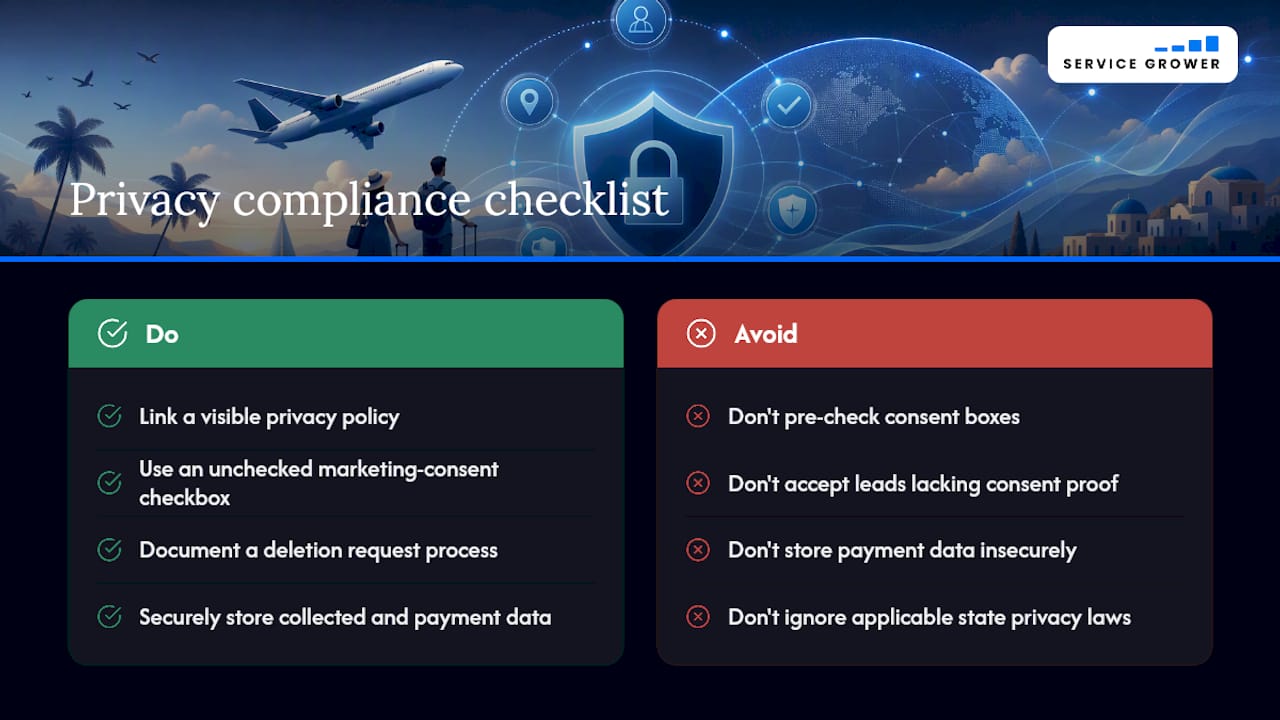
A visible privacy policy linked from every form. A checkbox for marketing consent that isn’t pre-checked by default. A documented process for someone to request their data be deleted. Secure storage for anything collected through your CRM or booking forms, especially payment-related details.
None of this should slow down your capture flow much. A single consent checkbox and a linked policy satisfy the baseline for most independent agents. Where it gets complicated is if you’re buying mediated leads from a third party. Ask exactly how that provider obtained consent before you accept a batch of contacts. If they can’t answer clearly, that’s a reason to reconsider the source, not just a compliance footnote.
What Independent Agents Get Wrong About Lead Generation
Most advisors treat lead generation as a volume problem. Buy more leads, run more ads, post more content. The evidence points the other direction: agents who commit to one specialty and build content and paid tests around it consistently out-convert generalists running broader campaigns.
Expect real traction within 60 to 90 days if you’re running a focused test, not a scattershot campaign. Costs vary widely depending on niche and channel, so treat your first month as a controlled experiment, not a scaled bet. Run one channel, one offer, one landing page before you touch a second variable.
— Service Grower
Build the Owned Channel This Article Recommends
Service Grower turns the recommendations above into a working system instead of a to-do list you never finish. A niche landing page, a progressive capture form, review management, and acquisition-cost tracking usually mean stitching together four separate tools and hoping they talk to each other. Service Grower runs them from one dashboard.
AnswerReady™ builds the specialty-focused site this playbook calls for. SmartRequest handles the progressive trip-brief forms and chat capture. Review management strengthens the trust signals that convert cold traffic into booked trips, and GrowthView shows you qualification rates and acquisition cost by source, so you know which channel is actually worth scaling. Agents who consolidate these functions report faster follow-up times and a clearer read on which leads are worth chasing.
If you’re ready to see how it fits your specialty, book a 15-minute call and walk through your current setup with someone who can map it against these tactics directly. You can also see the full platform before you commit to anything.