
 GROWTH GUIDE
90 Day Video First Tattoo Shop Marketing That Converts DMs
The single highest-leverage move for any tattoo shop right now is posting consistent short-form video, animated Reels and time-lapses of real work, paired with a booking flow that turns a DM into a paid deposit in one exchange. Everything else in tattoo shop marketing supports that loop. An integrated platform can automate the review requests, listing upkeep, and booking admin around it, freeing artists to spend their hours tattooing instead of managing tabs.
TL;DR:
- Posting consistent short-form video content, such as Reels and time-lapses, significantly boosts discovery and attracts new clients for tattoo shops.
- Streamlining the booking process to a single direct link with clear deposit requirements enhances conversion rates and reduces client drop-off.
- Automated review requests and regular profile updates on Google Business Profile improve local visibility and search ranking.
- Focusing on a dedicated artist’s personal brand builds loyalty and attracts clients seeking that specific style or personality.
- Small ad budgets targeted at warm audiences and coupled with retargeting campaigns deliver higher ROI than broad-scale advertising.
Table of Contents
- Top 6 Tattoo Shop Marketing Strategies, Ranked by Impact
- How Do You Turn Social Media Followers Into Booked Deposits?
- Should Your Booking Page Have One Link or Several?
- Why Isn’t Your Tattoo Studio Showing Up in Google Search?
- What Email Automations Actually Bring Tattoo Clients Back?
- How Much Should a Tattoo Shop Spend on Ads?
- Flash Days, Referrals, and Merch: Marketing You Can Run This Month
- Which Marketing Numbers Should a Tattoo Shop Actually Track?
- Your First 90 Days of Tattoo Shop Marketing, Week by Week
- How Do You Run a Consultation That Actually Converts?
- How Should a Tattoo Shop Handle Negative Reviews and Comments?
- How Do You Build an Artist’s Personal Brand Inside Your Shop?
- What Other Video Content Works Beyond Reels?
- How Do You Plan Seasonal Tattoo Promotions?
- How Can Local Business Partnerships Bring in New Tattoo Clients?
- The Real Gap Between Marketing Advice and What Studios Have Time For
- Let Service Grower Handle the Admin Side of Your 90-Day Plan
- Sources
Top 6 Tattoo Shop Marketing Strategies, Ranked by Impact
Not every shop needs the same fix. A studio with empty chairs on Tuesdays has a discovery problem. A studio turning away DMs has a conversion problem. Match the tactic to your actual bottleneck before you spend another dollar or hour on marketing.
- Post video, not just photos. Vertical, short-form clips consistently outperform static portfolio shots for reach, since platform algorithms and audience behavior now favor video-first formats across nearly every social channel. Action: film your next three finished pieces as 15-second time-lapses before you post another static photo.
- Collapse your booking path to one link. Every extra tap between “interested” and “deposit paid” loses clients. Action: replace any link-in-bio hub with a direct link to your booking-and-deposit page.
- Turn on automated review requests. Reviews compound your local visibility and your DM trust signals at the same time. Action: set up a text or email that fires 24 hours after a session asking for a review.
- Build one artist’s personal brand hard. A single artist with a recognizable style and voice pulls in dedicated followers faster than a shop-wide account ever will. Action: pick your strongest content performer and give them a dedicated posting schedule.
- Run a flash day regularly. Flash days generate quick cash flow and a burst of new-client bookings with minimal design overhead. Action: schedule your next one and start teasing it two weeks out.
- Retarget the people who already looked. Warm audiences (video viewers, site visitors) convert at a fraction of the cost of cold reach. Action: launch a $5 to $10 a day retargeting campaign aimed at your last 30 days of video viewers.
If your shop is quiet, start with strategies one and two. If you’re mid-traffic but losing leads in your DMs, focus on two and six. If you’re already booked out, strategies three and four protect and compound what you’ve built.
How Do You Turn Social Media Followers Into Booked Deposits?
Video is the discovery engine. The DM is where that discovery either converts into revenue or dies in your inbox. Treat both halves as one system, not two separate jobs.
Field reporting on tattoo studio growth in 2026 shows that animated Reels and time-lapse content dramatically outperform static posts for pure discovery, and that most of the lost revenue in tattoo marketing happens after discovery, in a slow or clumsy DM reply. A shop that gets thousands of views but replies to inquiries a day and a half later is leaking bookings it already earned.
Aim for a regular posting cadence of several Reels per week, mixed with carousels and Stories to fill the gaps. The recommended content mix for tattoo artists leans heavily on:
- Animated reveals of finished pieces, shot in good light with a clean pan.
- Time-lapses of the actual tattooing process, sped up to 30 to 60 seconds.
- “Available flash” Reels that show the design, state the price on screen, and link straight to booking.
- Quick artist-to-camera clips explaining a design choice or a client’s story (with permission).
The DM side needs a script, not improvisation. When someone asks about availability, your reply should hit three things in one message: confirm you have a specific slot, state your fixed deposit amount, and drop the direct booking link. Something like: “I’ve got Thursday the 14th open for a piece this size. $50 deposit locks it in, here’s the link: [your booking page].” No back-and-forth, no vague “let me check.” Reply promptly every time to avoid losing warm leads to the next shop in their feed.
Pro Tip: Save your deposit-and-link message as a canned response in Instagram or your phone’s keyboard shortcuts. The fastest reply usually wins the booking, not the best portfolio.
Track two numbers weekly: your discovery rate (reach and profile visits from Insights) and your DM-to-deposit conversion rate (deposits paid divided by DM inquiries). If discovery is climbing but deposits aren’t, the problem isn’t your content. It’s your reply speed or your deposit friction.
Should Your Booking Page Have One Link or Several?
One. A single, direct link to your booking-and-deposit page consistently converts better than a Linktree-style menu of five or six options. Every extra choice you hand a prospective client is a chance for them to get distracted, click the wrong thing, or just close the tab. If someone lands on your profile ready to book, make that the only decision they have to make.
Your portfolio itself needs structure, not just volume. Organize it by style filters (fine line, traditional, black and gray, and so on) so a prospect can find work that matches what they want in seconds. Include healed photos, not just fresh ink; healed results build more trust than day-one shots ever will. Add a short, plain-language paragraph explaining your process, from consultation to aftercare, and post clear pricing cues for flash pieces so there’s no awkward pricing DM required.
Your booking form should do more than schedule a slot. Build it to capture:
- How the client heard about you (this feeds your discovery-rate tracking directly).
- A required deposit, collected at booking, to cut down on no-shows.
- Accepted payment methods, stated up front so there’s no confusion at the appointment.
- Basic design details (placement, size, reference images) so your artist walks in prepared.
Page speed matters more than most shop owners assume. A slow-loading mobile page kills bookings before a client even sees your work, since most tattoo shop traffic arrives on a phone, often from a social link. Keep your microcopy short and direct: “Deposit required to confirm your slot” reads clearer than a paragraph explaining your cancellation policy in the middle of the booking flow. Tools like Service Grower’s SmartRequest are built around exactly this kind of single-path booking form.
Why Isn’t Your Tattoo Studio Showing Up in Google Search?
Your Google Business Profile is your digital storefront, and Google’s own guidance is direct on this: complete profiles with accurate categories, attributes, and regular photo updates get more visibility and more clicks than sparse or stale ones. If you set your profile up once, three years ago, and never touched it again, that’s likely costing you local ranking today.
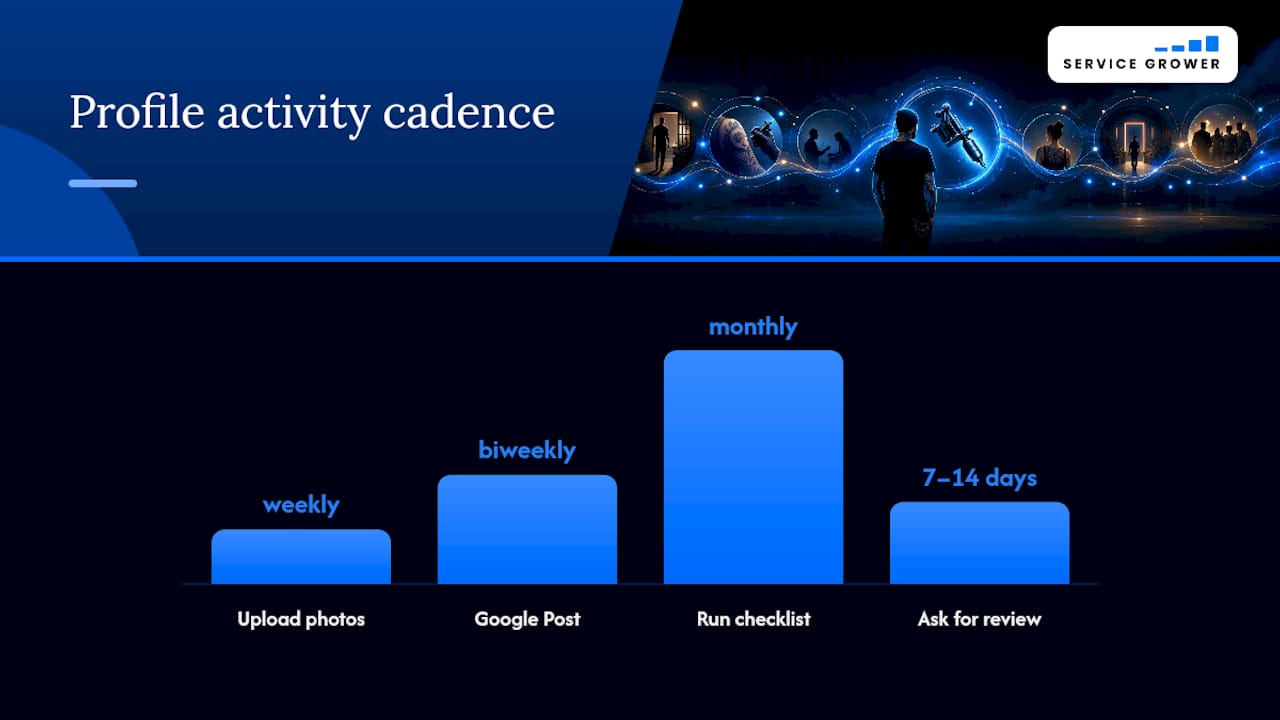
Run through this checklist monthly, not once:
- Confirm your primary and secondary categories are accurate (tattoo shop, plus any relevant secondary categories like piercing or art studio).
- Fill in every applicable attribute, from accessibility to payment types.
- Upload fresh photos weekly, not just at setup, since Google Business Profile Help notes recency signals matter.
- List your services as individual line items with rough pricing where you can, per the local SEO checklist most small businesses skip.
- Post a Google Post at least biweekly, whether it’s a flash announcement or a fresh piece.
Reviews are the other half of local ranking, and they don’t happen by accident; understanding why to prioritize local SEO helps explain how completeness and reviews boost your discoverability. Ask for a review 7 to 14 days after the appointment, once the piece has healed enough that the client is proud to show it off. QR codes at the front desk and register make this frictionless, and an automated email or text sent at the right window outperforms a verbal “leave us a review” every time. A simple ask works best: “Love how it turned out? A quick review helps other people find us; here’s the link.” Automating review requests and using direct QR or SMS links measurably increases both review volume and local visibility.
The connection between profile activity and rankings isn’t mysterious. Google rewards profiles that look active and trusted, and completeness plus consistent reviews directly improve discoverability for local searches like “tattoo shop near me.” If your Google Business Profile isn’t pulling calls, the gap is usually a specific fixable setting, not a fundamental flaw in your business.
What Email Automations Actually Bring Tattoo Clients Back?
Tattoo clients don’t need a weekly newsletter. They need three well-timed messages that hit at the moments they’re actually thinking about you.
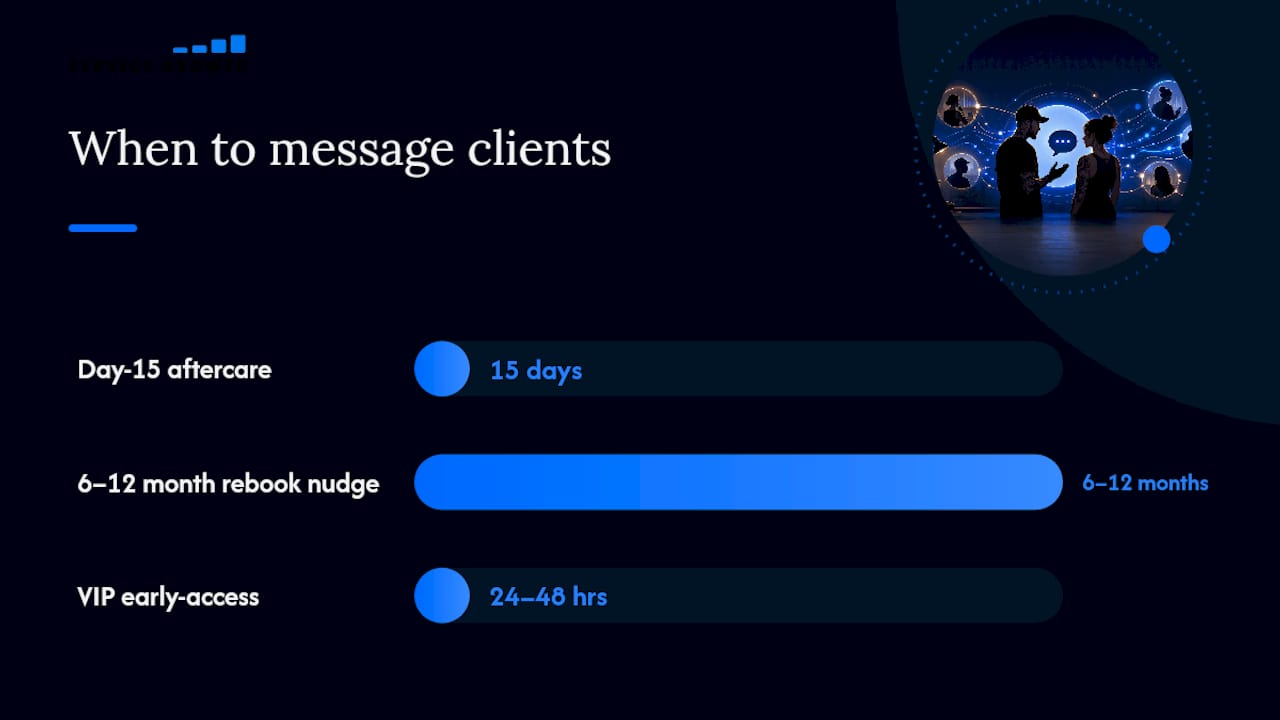
- A day-15 aftercare check-in. Ask how the healing is going and remind them a review helps other people find your shop. This lands when the piece looks its best and the client’s excitement is still high.
- A 6 to 12 month rebook nudge. Most collectors don’t stop at one piece. A simple “thinking about your next one?” message with your current flash availability brings a real percentage of past clients back without any ad spend.
- A VIP early-access sequence. For repeat clients or your email list, give first access to flash drops or limited-slot promotions 24 to 48 hours before you post publicly.
Your lead magnet doesn’t need to be a downloadable guide. For tattoo clients, “flash availability alerts” and “limited drop notifications” convert far better than generic content offers, because they tie directly to something the client can act on immediately.
Segment your list into new leads, past clients, and VIPs, and keep each segment’s cadence different: new leads get a welcome sequence, past clients get the rebook nudge, VIPs get first access. That’s the entire structure. It doesn’t need to be more complicated to work.
How Much Should a Tattoo Shop Spend on Ads?
Small, focused budgets beat broad reach every time in this business. Retargeting warm audiences, people who watched your Reels, visited your site, or opened a DM, works on $5 to $15 a day, and funnels that push social traffic to a single booking link with a small retargeting layer reliably reduce no-shows and lift conversion.
Your ad creative should mirror your best-performing organic content, such as animated reveals, time-lapses, or flash pieces with clear pricing. Keep the call to action simple and singular, like ‘book now’.
For Google, focus on local-intent search terms: “tattoo artist near me,” “flash spots [your city],” and style-specific searches like “fine line tattoo [city].” These searchers are close to booking already; you’re not educating them, you’re capturing intent that already exists.
- Track ad performance by deposits generated, not clicks or impressions.
- Compare cost per deposit against average client lifetime value to judge real ROI.
- Kill any ad set that isn’t converting within two weeks of steady spend.
- Favor video creative over static images across every platform.
Retargeting campaigns with small daily budgets tend to outperform cold prospecting for local service businesses precisely because the audience has already shown intent.
Flash Days, Referrals, and Merch: Marketing You Can Run This Month
Digital tactics get the attention, but a well-run flash day still fills a chair faster than almost anything else. Price flash pieces below your standard custom rate, announce the drop two weeks ahead across your Reels and Stories, and require a deposit at booking to lock in real commitments instead of maybes.
- Post a countdown series in the two weeks before the flash day to build urgency.
- Cap the number of available spots publicly, since scarcity drives faster booking decisions.
- Collect deposits immediately through your booking page, not through DMs.
Referral programs work when the incentive is specific and easy to understand. A flat discount on a client’s next piece, or a small merch item, for every friend they send who books, outperforms vague “tell your friends” asks by a wide margin. Put a small card with the referral offer in every aftercare packet.
Merch and gift vouchers round out the offline mix. Keep the rollout simple: a small rack of shirts or stickers near the register, and gift vouchers listed as a standing option on your booking page and at checkout, especially heading into gift-heavy seasons.
Which Marketing Numbers Should a Tattoo Shop Actually Track?
Four numbers tell you almost everything you need to know about whether your tattoo shop marketing is working.
- Discovery rate: how many new people see your content or profile weekly, pulled from Instagram Insights or your Google Business Profile views.
- DM-to-deposit conversion rate: deposits paid divided by inquiries received, the clearest signal of whether your booking flow is actually working.
- Repeat rate: the percentage of clients who book a second session within 12 months, a direct measure of retention.
- Revenue per hour: total booked revenue divided by chair hours, the number that tells you if you’re pricing and scheduling correctly.
A simple spreadsheet updated weekly beats a fancy dashboard nobody checks. Once a month, sit down and ask: is discovery down? Post more Reels. Is DM conversion low? Tighten your deposit script and reply speed. Is repeat rate flat? Your email automations probably need attention.
Your First 90 Days of Tattoo Shop Marketing, Week by Week
- Weeks 1 to 2: Set your bio, collapse your link-in-bio to a single booking link, and audit your Google Business Profile categories and photos.
- Weeks 3 to 6: Publish your first 12 Reels (3 a week), mixing time-lapses, animated reveals, and flash announcements.
- Weeks 7 to 8: Turn on automated review requests and launch your first structured referral offer.
- Weeks 9 to 10: Run a low-budget retargeting test ($5 to $10 a day) aimed at your last 30 days of video viewers.
- Weeks 11 to 13: Run a flash day, review your KPI spreadsheet, and adjust cadence based on discovery and conversion numbers.
At 30 days, you should see your booking link live and your first Reels posted. At 60 days, look for a measurable lift in DM-to-deposit conversion and a growing review count. At 90 days, your repeat rate and revenue per hour should both show early movement, along with a working, low-cost retargeting funnel.
How Do You Run a Consultation That Actually Converts?
A rushed or vague consultation is where a lot of bookings quietly fall apart. Clients who feel unheard about placement, size, or design intent often ghost after saying they’ll “think about it.”
Structure every consultation, whether it’s in-person, by DM, or over a quick call, around three things: confirm the design concept in plain language back to the client, give a real price range instead of a vague estimate, and state the deposit and next step before the conversation ends. Ambiguity kills bookings faster than a high price ever does.
For custom pieces, ask about placement and sizing early, since these decisions affect both design and price. Show reference images from your own healed portfolio that match the requested style, not generic internet references. That builds confidence that you understand the specific look they want.
Close every consultation with a clear next step: “I can get you in on the 14th. I’ll need a $50 deposit to hold that slot; here’s the link.” Never leave a consultation open-ended. A defined next action, paired with your booking link, turns a good conversation into an actual appointment on the books, and it protects your artist’s calendar from tentative maybes that never convert.
How Should a Tattoo Shop Handle Negative Reviews and Comments?
Your online reputation isn’t just your star rating. It’s how you respond when things go sideways, and prospective clients read those responses closely.
Respond to every negative review, publicly and quickly, without getting defensive. Acknowledge the specific concern, state what you’re doing about it, and invite the person to continue the conversation privately. A calm, professional reply to a bad review often does more for your credibility than another five-star review would, because it shows future clients how you handle problems.
Never delete or ignore criticism unless it violates platform guidelines outright. Silence reads as avoidance. A thoughtful response, even to an unfair review, signals that your shop takes client experience seriously.
The same discipline applies to comments on your Reels and posts. A snarky or dismissive reply to a critical comment can spread further than the original comment ever would. Keep your tone measured, and when a conversation turns hostile, move it to DMs rather than letting it play out publicly on your feed.
How Do You Build an Artist’s Personal Brand Inside Your Shop?
Shop-wide accounts have a ceiling. A dedicated artist brand, built around one person’s style, voice, and personality, tends to pull a more loyal following because people book artists, not studios.
Give your strongest content performer their own consistent posting rhythm, separate visual style, and a voice that matches their personality on camera or in captions. Let them talk about their influences, their process, and their specific niche, whether that’s fine line, blackwork, or bold traditional pieces. Followers who connect with an individual artist’s story convert into loyal repeat clients far more reliably than followers who just liked one photo.
Cross-promote between the shop account and each artist’s personal account, but don’t force every artist into an identical content template. The variation between artists is part of what makes a multi-artist shop interesting to follow, and it lets each artist attract the clients who specifically want their style.
What Other Video Content Works Beyond Reels?
Reels handle discovery. Longer-form and behind-the-scenes video build the deeper trust that turns a follower into a booked client.
Full tattoo process videos, even a condensed two to three minute cut, show skill and cleanliness in a way a 15-second clip can’t. Post these to YouTube or as a pinned Instagram video for prospects doing deeper research before committing to a custom piece.
Artist story content, a short video of an artist explaining how they got into tattooing or what draws them to a particular style, builds the personal connection that turns casual followers into people who specifically want an appointment with that artist. Behind-the-scenes clips of sterilization procedures, setup, and shop environment address a real, unspoken concern many first-time clients have about hygiene and professionalism, often without them ever voicing it directly.
How Do You Plan Seasonal Tattoo Promotions?
Tattoo demand shifts with the calendar, and smart shops plan around it instead of reacting to it. Spring and early summer tend to bring interest in exposed-skin placements like arms and legs. Fall often brings a wave of cover-up and rework interest. Holiday season drives gift voucher sales hard, especially in the final two weeks before major holidays.
Plan flash themes around recognizable moments: Friday the 13th flash specials remain one of the most reliable recurring promotions in the industry, and small-batch seasonal flash sheets (Halloween, Valentine’s Day, New Year) give you a natural, recurring content and booking hook every few months without needing a new idea from scratch each time.
How Can Local Business Partnerships Bring in New Tattoo Clients?
Barbershops, piercing studios, and local art galleries share your exact audience without competing for the same appointment slot. A referral arrangement with a nearby barbershop, where each business keeps a small stack of the other’s cards or flash sheets at the counter, costs nothing and reaches people already primed for exactly the kind of work you do.
Art galleries and local makers’ markets offer another angle: a pop-up flash booth at a local art event puts your work in front of people who already value original art and are more likely to book on the spot. Joint Instagram takeovers or shared posts with a complementary business (a barber getting a small piece, tagged and cross-posted) reach both audiences at once for the cost of one appointment slot.
Keep these partnerships informal and mutual. A shared discount code, a joint flash day, or a simple cross-post arrangement works better than a formal contract for most local pairings, and it costs nothing but a conversation to start.
The Real Gap Between Marketing Advice and What Studios Have Time For
Most tattoo shop marketing advice assumes an owner has hours a week to spend on content calendars, review follow-ups, and profile audits. In practice, the people running these shops are also the ones tattooing eight hours a day. That gap between the advice and the available time is where most marketing plans quietly die.
An integrated platform closes that gap by handling the repetitive pieces automatically. Service Grower’s AnswerReady websites, review management, and AI presence tools work together instead of as separate logins, which matters because combining booking, reviews, and analytics in one system speeds the loop from content to booking to retention. DIY makes sense when you have the hours and enjoy the work. A managed platform makes more sense once your team grows past one or two people, or your goal shifts from “staying afloat” to actively scaling bookings.
— Service Grower
Let Service Grower Handle the Admin Side of Your 90-Day Plan
Running the roadmap above by hand, booking forms, review follow-ups, profile updates, ad tracking, takes real hours every week that most shop owners would rather spend tattooing. The platform is built to run that admin layer in the background while you focus on the chair.
The platform maps directly onto the tactics covered here: SmartRequest handles the single-link booking and deposit flow, Reputation management automates the review requests that feed your local ranking, and AI Presence keeps your Google Business Profile and AI-search visibility current without a monthly manual audit. GrowthView analytics track the same discovery rate and conversion numbers covered above, so you’re not maintaining a separate spreadsheet by hand.
If you’re not sure where your shop currently stands, start with a free AI visibility check to see how your studio shows up across Google and AI search results right now. From there, Service Grower’s team can walk through which pieces of the 90-day roadmap are worth automating first for your specific shop and staffing level.
Sources
- Manage your Business Profile - Google Business Profile Help
- Tattoo artist marketing 2026: the complete client-acquisition guide
- Key digital marketing trends for 2024 | Digital Marketing Institute