
 GROWTH GUIDE
What Makes a Local Landing Page Actually Rank and Convert
A local landing page is a dedicated page built for one city, neighborhood, or service area, packed with the specifics only a real local business would know. The single factor separating pages that work from pages that don’t: unique local proof paired with a frictionless path to contact. Stock photos and swapped-out city names won’t cut it; you need real reviews, real photos, and a conversion path that works on a phone screen. If you build one page today, connect it to your Google Business Profile and load it with local proof before you touch anything else.
- Write one dedicated page per city or service area, not a shared template with a find-and-replace city name.
- Pull in genuine local reviews, real jobsite photos, and NAP details unique to that location.
- Link the page directly to the matching Google Business Profile listing.
TL;DR:
- Use one dedicated page per location, linking it to the correct Google Business Profile and including real local proof such as reviews and photos.
- Include six core modules: a local hero section, a crawlable NAP block, location-specific service details, an embedded map, genuine reviews/photos, and structured data with local schema.
- Optimize your URL, title tag, and headings for location-specific keywords, ensuring they work together without redundancy or duplication.
- Place contact options like click-to-call, a short booking form, and trust signals above the fold to boost mobile conversion and reduce bounce rates.
- Automate updates for reviews, hours, and staff information using live data feeds or an integrated platform to maintain accuracy and save operational time.
Table of Contents
- What Every Local Landing Page Needs to Rank
- Getting the On-Page SEO Right
- What Belongs Above the Fold
- Trust Signals That Convince Both Humans and AI
- Location Pages vs. Service Area Pages: Which One Do You Need?
- Scaling Without Creating Doorway Pages
- Your Launch Checklist for One Local Landing Page
- Why an Integrated Platform Changes the Math
- What Most Local SEO Advice Gets Backwards
- Let Service Grower Handle the Heavy Lifting
- Key Takeaways
- Sources
What Every Local Landing Page Needs to Rank
A local landing page succeeds or fails based on a handful of modules, and skipping even one weakens the whole thing. Search engines and AI models increasingly reward pages that pack in aggregated local information, original photography, and location-specific reviews, so treat these as requirements, not nice-to-haves.
- A location-specific hero section. The headline should name the city or neighborhood outright (“Emergency Plumbing in Denver, CO”), paired with a CTA button that’s visible without scrolling.
- A crawlable NAP block. Your name, address, and phone number need to appear as real text, not embedded in an image, and they must match your Google Business Profile exactly.
- Service details specific to that location. List what you actually do in that area, including any local permits, service radius limits, or regional pricing quirks.
- An embedded map with directions. A live Google Map, not a static screenshot, helps both users and search engines confirm the location is real.
- Local reviews and original photos. Reviews mentioning the specific city, plus photos of your team or job sites in that area, do more for trust than any paragraph of copy.
- Area-specific FAQs and LocalBusiness schema. Answer questions unique to that market (parking, service hours, local regulations), then wrap the page in structured data that names that exact branch.
These six elements track closely with what Ahrefs identifies as the core components of location pages that consistently perform: localized URLs and titles, a conversion-ready top section, real maps and photography, clear service listings, and visible social proof.
Pro Tip: Before publishing, have someone unfamiliar with the business read only the hero and NAP block. If they can’t tell within five seconds what city you serve and how to reach you, the page needs work.
Getting the On-Page SEO Right
Your URL, title tag, and headings need to work together instead of fighting for the same keyword in awkward ways. A clean pattern like /locations/denver-plumbing beats a nested structure buried three folders deep. Flat URLs crawl faster and pass link authority more efficiently than pages tucked under generic category paths.
Your title tag should follow a formula: Service + City + Brand, something like “Emergency Plumbing in Denver | [Business Name].” That structure hits the search term directly while still giving searchers a reason to click over a competitor. Your H1 can mirror the title tag closely, but don’t make it identical, word-for-word repetition across every location page is exactly what triggers duplicate-content flags.
Meta descriptions get skipped constantly, which is a mistake since they’re free ad copy. Write one per location that names a specific benefit or differentiator, not a generic line copied across fifty pages.
- Use a flat, readable URL structure with the city name spelled out, not abbreviated or coded.
- Match title tag and H1 in intent, but vary the exact phrasing to avoid template duplication.
- Write a unique meta description per page mentioning a real local detail.
- Place location keywords naturally in subheadings, not stuffed into every sentence.
- Watch for near-duplicate body copy across pages; even great structure can’t save it.
What Belongs Above the Fold
The top third of your page does most of the conversion work, and most businesses waste it on a generic welcome message instead of a reason to act. A visitor lands, glances for eight seconds, and either finds a way to contact you or leaves.
Above the fold should include a click-to-call button, a primary CTA, visible hours, and some form of trust signal like a review score or certification badge. CTA copy that names the location performs better than generic phrasing: “Book a Furnace Repair in Denver” gives a visitor more confidence than “Schedule Service” ever will, because it confirms they’re in the right place.
Give visitors more than one way to reach you. A phone number for people who want to talk now, a short booking form for people who’d rather not call, and maybe a text-to-schedule option if your business supports it. Since most local searches happen on mobile, page speed and thumb-friendly buttons aren’t optional polish, they’re the difference between a call and a bounce.
- Click-to-call button visible without scrolling on mobile.
- Primary CTA button with location-specific copy.
- Hours and a trust badge (certifications, review score) near the top.
- A short contact form as a secondary option to phone calls.
- Page load time under three seconds on mobile connections.
Businesses that optimize their local pages this way see measurable increases in local organic traffic and Local Pack visibility compared to generic service pages that never mention a location by name. Track calls, form fills, and click-through rate from search results as your baseline KPIs, and set up call tracking early so you’re not guessing where leads originate.
Trust Signals That Convince Both Humans and AI
Trust signals do double duty now. Use the AI Search Audit to test your local page’s readiness for AI citations and search engines. They convince a human to pick up the phone, and they give AI models enough confidence to cite your business when someone asks a local question through ChatGPT or a similar tool.
- Embed a live Google Map tied to the exact address on your Google Business Profile, and link the page back to that GBP listing so the two reinforce each other.
- Use original photography, not stock images. Photos of your actual team, storefront, or completed jobs in that city carry weight that generic imagery never will, and saving descriptive file names and alt text helps search engines understand what’s in the shot.
- Display reviews mentioning that specific location. A wall of five-star ratings from a different city does nothing for a Denver searcher; reviews naming Denver do.
- Fill out LocalBusiness schema completely. Address, phone, hours, and geo-coordinates all need unique values, since LocalBusiness is the correct scoped schema type for individual branches, not the broader Organization schema.
- Use sameAs schema properties to link your GBP, social profiles, and directory listings back to the page, tightening the entity connections search engines rely on.
The businesses getting cited by AI tools right now aren’t the ones with the cleverest copy. They’re the ones whose local pages read like proof: real reviews, real photos, real addresses that match everywhere they appear.
Embedding current local reviews and linking the GBP profile directly to the page strengthens the entity signals both Google’s local algorithm and AI systems use to decide who’s worth recommending.
Location Pages vs. Service Area Pages: Which One Do You Need?
Not every business has a storefront in every town it serves, and that distinction determines which page type you build. A location page fits a business with a physical address, staffed hours, and walk-in traffic. A service area page fits a business that travels to the customer, like a plumber, mobile detailer, or landscaper, and needs to rank in a city without claiming an office there.
| Factor | Location Page | Service Area Page |
|---|---|---|
| Best for | Physical storefront or branch | Mobile or on-site service businesses |
| Address shown | Full street address, verified | General service radius, no street address |
| Map style | Embedded pin at exact location | Boundary or radius overlay |
| GBP setup | Standalone listing per address | Single GBP with service areas defined |
A hub-and-spoke structure works well for both: build an “Areas We Serve” hub page that links out to every individual city or neighborhood page, and cross-link those pages back to relevant service pages. Decide which towns earn a dedicated page based on search volume and current job density, not just proximity to your main office. For service area pages, state your typical response time or travel boundary plainly, since that’s often the deciding factor for someone comparing you against a closer competitor.
Scaling Without Creating Doorway Pages
The moment you need a dozen local pages instead of one, thin content becomes the real risk. Search engines penalize templated pages that just swap a city name without adding anything genuinely local, and readers notice the same shortcut.
- Split every page into fixed and variable zones. Brand messaging, service standards, and core value props stay fixed across all pages. Local staff bios, reviews, hours, and FAQs vary by page.
- Set a minimum unique-content target. Roughly half the page can be standardized template; the other half needs to be genuinely written for that location, not lightly reworded.
- Automate the variable zones with live feeds. Pull current reviews, updated hours, and local team info from a connected data source instead of manually editing fifty pages every time something changes.
- Build an editorial QA step into your workflow. Before publishing a new location page, check it against an existing one for copy-paste sections that never got localized.
- Add modules that only make sense locally. A neighborhood parking guide, a note about permit requirements specific to that county, or a shoutout to a local landmark near your office all read as effort a template can’t fake.
Pro Tip: Keep a running local-facts document per city (nearby landmarks, common local terms, regional quirks) so writers aren’t starting from a blank page every time you expand into a new market.
Your Launch Checklist for One Local Landing Page
Before you write a single line of copy, gather your assets: local reviews, real photos, service details specific to that market, and your GBP credentials. Then work through the build in order.
- Draft the hero headline and CTA naming the city directly.
- Add the NAP block as crawlable text matching your GBP exactly.
- Write location-specific service details and area FAQs.
- Embed the Google Map and confirm the pin matches the address.
- Add local reviews and original, captioned photography.
- Implement complete LocalBusiness schema with unique fields.
- Set up click-to-call, a booking form, and mobile speed checks.
- Link the finished page from your locations hub and submit it in your sitemap.
- Set up call tracking and form-fill tracking before driving traffic.
Give the page four to six weeks before drawing conclusions. Early signals worth watching include impressions in Search Console for the city name, Local Pack appearances, and whether calls or form fills start trending upward.
Why an Integrated Platform Changes the Math
Building one great local landing page by hand is manageable. Building thirty that stay accurate, unique, and current is where most businesses quietly give up, and that’s the operational gap an integrated platform is built to close.
- Keeping reviews current across dozens of pages by hand eats hours every week that could go toward actual customer work.
- AI-assisted content paired with live data feeds (reviews, hours, staff) keeps pages fresh without a writer rewriting the same page every month.
- Multi-location businesses and franchise-style operators tend to see the fastest return, since the time saved scales directly with the number of pages.
The businesses that struggle most with local pages aren’t bad at marketing. They’re stretched too thin to keep dozens of pages accurate at once, and that’s an operations problem before it’s a content problem.
What Most Local SEO Advice Gets Backwards
Most guides treat local landing pages as an SEO checklist to complete once and forget. That’s backwards. A page stuffed with keywords and a scraped city name might rank for a few weeks, but it converts nobody, and Google’s own guidance increasingly rewards pages built around genuine local proof over technical polish.

The bigger mistake is treating conversion and SEO as separate problems solved in separate phases. The same elements that satisfy LocalBusiness schema requirements and rank you locally, such as real reviews, real photos, a real address, are the same elements that make a stranger trust you enough to call. Build for one and you’ve mostly built for the other.
Where businesses actually fall behind is maintenance, not launch. A page built well in January and never touched again drifts stale by June: reviews go outdated, hours change, staff photos no longer match the team. Prioritize a system for keeping pages current over squeezing out one more perfectly optimized launch page. Scale comes from process, not heroics.
— Service Grower
Let Service Grower Handle the Heavy Lifting
Service Grower is the alternative to hiring an agency or juggling five disconnected tools for local landing pages: one platform builds the page, keeps it stocked with fresh reviews, and tracks whether it’s actually converting. Instead of manually updating hours, chasing reviews, and hoping your schema markup is correct, Service Grower’s AnswerReady websites handle the AI-optimized build while review aggregation and customer interaction tracking run in the background.
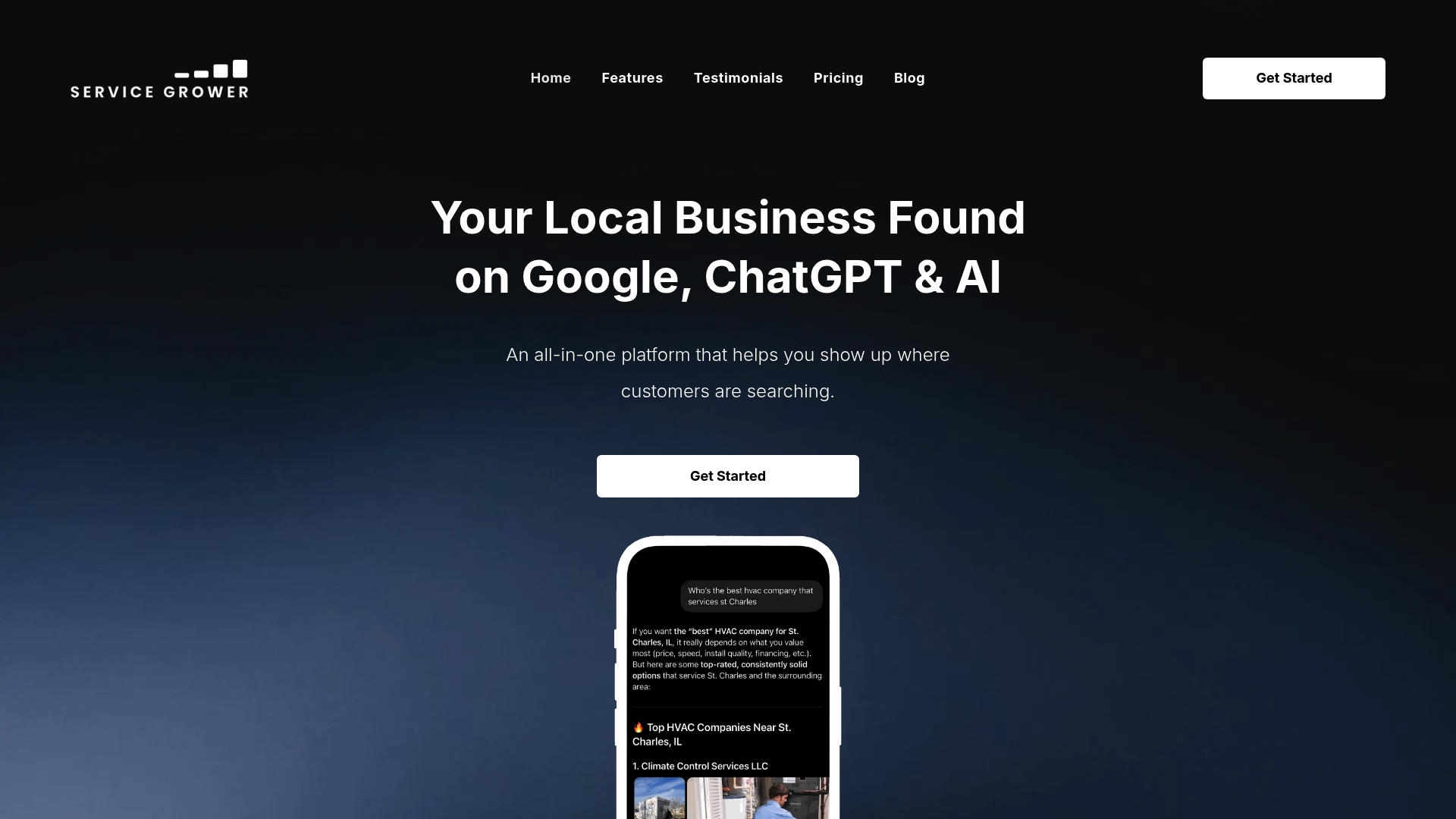
The platform covers the workflow end to end: AnswerReady sites built around local search and AI visibility, a review and reputation management layer that keeps testimonials current without manual chasing, SmartRequest for booking and lead capture, and GrowthView analytics so you can see which pages are actually driving calls. Businesses running Google and Meta ads can layer managed campaigns on top instead of stitching together separate vendors. If you’re weighing whether to build local pages in house or hand off the maintenance grind, start by checking what Service Grower’s platform covers and see whether a demo fits how your business operates.
Key Takeaways
Local landing pages rank and convert only when unique local proof (reviews, photos, schema) pairs with a mobile-fast, conversion-ready layout above the fold.
| Point | Details |
|---|---|
| Build one page per location | Avoid shared templates with swapped city names; each page needs its own proof. |
| Match physical address vs. service radius | Use location pages for storefronts, service area pages for mobile businesses. |
| Load the top third with CTAs | Click-to-call, booking CTA, hours, and trust badges belong above the fold. |
| Automate variable content zones | Pull reviews, hours, and staff info from live feeds to keep pages current at scale. |
| Consider an integrated platform | Service Grower combines AnswerReady sites, review management, and analytics in one system. |
Sources
- How to Build Location Pages That Rank, Convert, and Get Cited
- The Complete Guide To Local SEO For Multiple Locations
- Location Landing Pages: 6 Crucial Elements Of Local Visibility
- Local Landing Pages: SEO Guide for Multi-Location Growth | Web Tonic™