
 GROWTH GUIDE
Three Step Lead Follow Up Automation for Faster Multi Channel Wins
Automated lead follow-up delivers a near-instant first response and a short, behavior-driven sequence that replaces guesswork with consistent timing. Industry research points to roughly five touches on average before a lead converts, and Service Grower’s own workflow tools are built around that math. Start by wiring your highest-volume capture source to one tested three-step sequence before you touch anything else.
TL;DR:
- Routing leads within minutes preserves momentum and increases the likelihood of conversion, especially for high-priority or urgent prospects.
- Enrichment and deduplication processes must occur before the first outreach to ensure data accuracy and prevent slow or duplicated follow-ups.
- The sequence should include an immediate, personalized acknowledgment, a value-driven follow-up, and a direct call-to-action, with pause-on-reply logic at each step.
- Using email as the primary channel is ideal for low-pressure nurturing, while SMS and calls should target high-intent or urgent leads, with escalation rules based on response behavior.
- Starting automation on high-volume, simple leads proves success before expanding to more complex, high-value prospects, with continuous monitoring and refinement.
Table of Contents
- What Makes Lead Follow-Up Automation Actually Work
- How Do You Build a Working Follow-Up Sequence?
- Which Channel Should You Use, and When?
- Can AI Personalize Follow-Up Without Sounding Robotic?
- What Should You Measure to Prove It’s Working?
- Launch Checklist: What Trips Teams Up First
- How Service Grower Fits Into an Automated Follow-Up Stack
- What Changes on Your Team Once This Scales
- Get Your Follow-Up System Running in Weeks, Not Quarters
- Sources
What Makes Lead Follow-Up Automation Actually Work
Most automation tools look similar on a demo call. The difference shows up in four places: how fast a lead gets routed, how clean your data stays, how the sequence behaves once someone replies, and how well it protects your sender reputation. Get those four right and everything else, templates, dashboards, integrations, becomes easy to bolt on later.
Instant trigger logic matters more than almost anything else in the stack. A lead who fills out a form and waits four hours for a reply has usually already contacted two competitors. Routing rules that assign hot leads to a rep within minutes, not the next business day, preserve the momentum that drives higher meeting rates.
Here’s what a solid automated lead follow up build needs underneath the surface:
- Trigger and routing logic that scores and assigns leads by source, deal size, or urgency the moment they arrive
- Enrichment and deduplication that pulls company, role, and behavioral data into your CRM before the first message goes out
- Branching with pause on reply so a sequence stops the instant a lead responds, instead of emailing someone mid-conversation
- Approval workflows and send throttling that cap daily volume and protect domain reputation from spam flags
Skip any one of these and the system either moves too slowly to matter or moves so fast it looks robotic.
How Do You Build a Working Follow-Up Sequence?
Building a sequence that actually converts is less about tools and more about sequencing decisions made in the right order. Here’s the build, step by step:
- Pick one primary trigger. Website form fills, missed calls, or a specific CRM stage change work well. Map every required field (name, email, source, intent) before building anything downstream.
- Segment into two or three tiers. A demo request deserves a faster, more aggressive cadence than a newsletter signup. Define send windows for each tier now, not later.
- Write the sequence in three moves. An immediate acknowledgment (automated but personal-sounding), a value-add follow-up 24 to 48 hours later, and a direct call-to-action message a few days after that. Build in pause-on-reply logic at every step, and set a hard rule for when a human takes over.
- Set assignment and escalation tasks. Decide who gets notified when a lead goes cold, and after how many missed touches.
- Pilot on one segment for two to three weeks, then adjust based on what you see.
This mirrors the structure Artisan AI’s build guide recommends: start narrow, prove it works, then widen.
Pro Tip: Launch your first sequence on your highest-volume, lowest-complexity lead source. A clean win on simple leads builds the internal case for automating the messier, higher-value ones later.
Which Channel Should You Use, and When?
Email, SMS, phone, and social each do different jobs, and treating them interchangeably is where most lead nurturing automation programs lose replies instead of gaining them.
- Email carries the bulk of your nurture sequence. It’s low-pressure and easy to personalize at scale.
- SMS and phone work best for high-intent leads, demo requests, quote inquiries, anyone who signaled urgency.
- LinkedIn or social outreach fits executive and B2B buyers who rarely respond to cold email but check their inbox for messages from people they can vet publicly first.
A practical escalation rule looks like this: if a lead doesn’t respond after two emails, trigger an SMS. If that goes unanswered, create a phone task for a rep instead of sending a third automated message. Space touches out, generally 24 to 72 hours apart depending on lead temperature, and always build in pause-on-reply logic so a live conversation never gets interrupted by a scheduled blast. Keep an eye on opt-in requirements per channel; SMS in particular carries its own consent rules that email doesn’t.
Can AI Personalize Follow-Up Without Sounding Robotic?
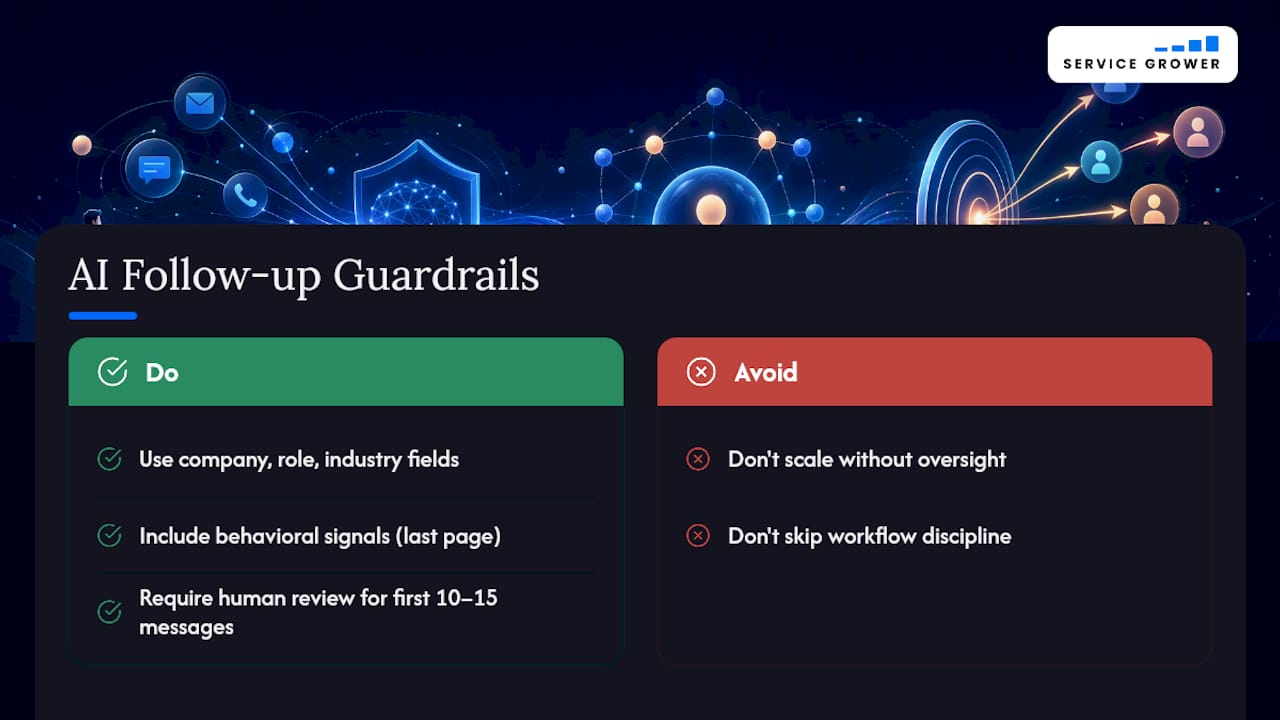
Yes, but only with guardrails. Personalization should pull from fields you already have: company name, role, industry, and behavioral signals like the last page someone viewed on your site. Feed a drafting tool that context and it stops sounding like a template.
The bigger risk is scale without oversight. Gartner projects that AI agents will vastly outnumber human sellers by 2028, yet fewer than 40% of sellers expect those agents to actually improve their productivity, largely because teams skip the workflow discipline that makes AI drafts trustworthy.
Pro Tip: Require human review on the first 10 to 15 AI-drafted messages in any new sequence. That’s usually enough to catch tone drift before it reaches a real inbox.
What Should You Measure to Prove It’s Working?
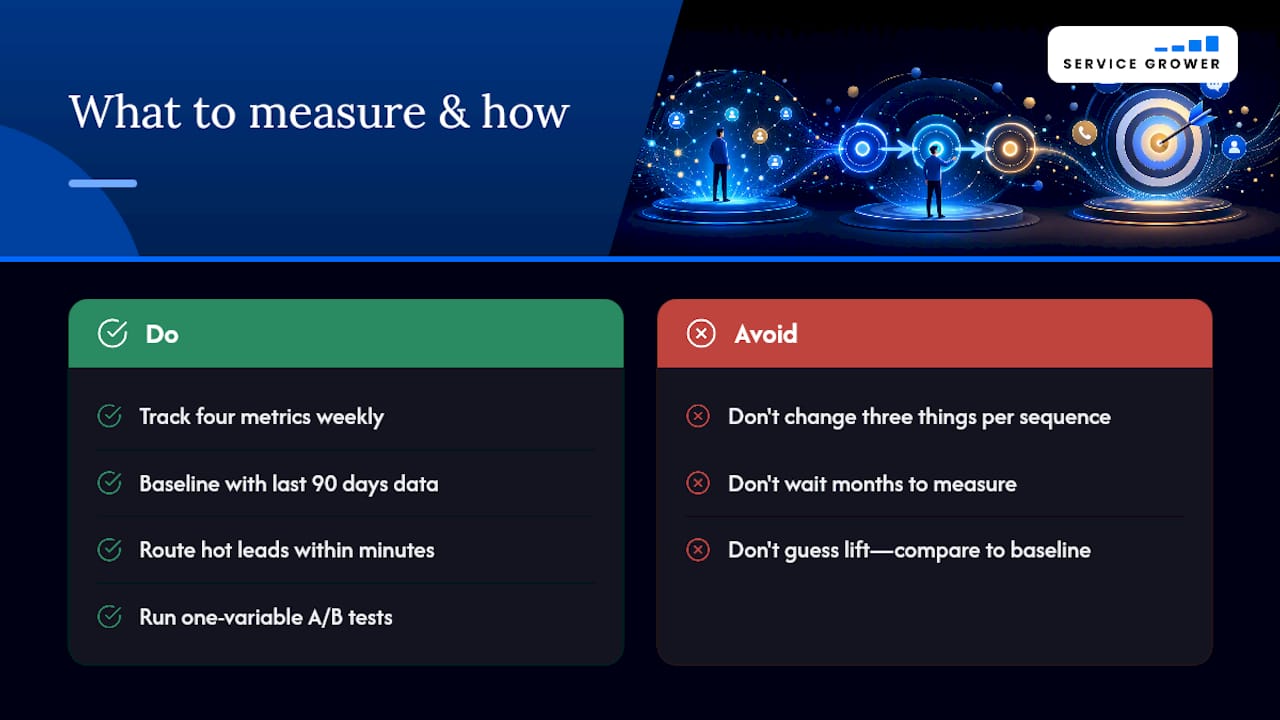
Four numbers tell you almost everything: time-to-first-response, reply rate, meetings booked, and pipeline velocity. Track them weekly, not monthly, especially in the first quarter after launch.
Establish a baseline before you flip automation on. Pull your last 90 days of manual follow-up data, average response time, close rate, then compare post-launch numbers against it directly instead of guessing at the lift.
Automation that routes hot leads to the right rep within minutes and coordinates outreach across channels preserves the momentum that manual, delayed follow-up loses.
Run small, one-variable tests: subject line, opening line, or send time. Change one thing per sequence, not three, or you won’t know what moved the needle. Review your dashboard every two weeks for the first two months, then monthly once the sequence stabilizes.
Launch Checklist: What Trips Teams Up First
Most failed rollouts trace back to the same handful of mistakes, all avoidable with a short pre-launch check.
- Verify field mapping and consent status before the first message sends. A broken CRM field means personalization breaks silently.
- Warm up your sending domain gradually if volume is new; deliverability problems are far easier to prevent than fix.
- Pilot on a defined sample (50 to 100 leads is plenty) with a two to three week timeline and a clear success metric going in.
- Watch for the classic failures: no pause-on-reply logic, generic copy that ignores segment data, routing rules that silently drop leads, and sequences with no escalation path when a rep goes quiet.
Monitor replies and deliverability weekly after launch, and treat the first sequence as a draft you’ll revise, not a finished product.
How Service Grower Fits Into an Automated Follow-Up Stack
Service Grower brings capture, follow-up, and reporting into one system instead of forcing you to stitch together a form builder, a CRM, and a texting tool. SmartRequest handles booking and request forms at the point of capture. GrowthView tracks the metrics that matter, reply rate, response time, booked meetings, in one dashboard. AnswerReady™ Websites and review management round out the visibility side, so leads and reputation live in the same place.
An integrated platform means a lead’s first touch, follow-up sequence, and outcome tracking never live in three disconnected tools waiting to fall out of sync.
and would sit well here as concrete proof points for prospective users evaluating the platform.
What Changes on Your Team Once This Scales
Reps spend less time chasing cold leads and more time on live conversations that are already warm. Someone still needs to own sequence performance and train new hires on when to override automation. Expect the first real signal of improvement within four to six weeks, not overnight.
— Service Grower
Get Your Follow-Up System Running in Weeks, Not Quarters
Service Grower gives you the fastest path from “we should automate follow-up” to a sequence that’s actually live, because capture forms, lead tracking, and reporting already sit in one platform instead of three you’d have to connect yourself.
That matters most in the first 30 days, when most teams lose momentum stitching together tools instead of testing messages. With SmartRequest capturing leads and GrowthView tracking reply rates and booked meetings from day one, you skip the integration work entirely and get straight to measuring what’s converting. If you want a second opinion on your current setup or a walkthrough of how this fits your lead flow, book a 15-minute call and bring your biggest bottleneck. You’ll leave with a specific next step, not a generic pitch. You can also see the full platform first at Service Grower.
Sources
For deeper technical detail on sequence design and AI personalization, Dexcore’s automation guide is worth a read. For nurture-specific cadence and content strategy, see Babylove Growth’s lead nurturing breakdown.
- Gartner press release: Gartner predicts by 2028 AI agents will outnumber sellers by 10x, yet fewer than 40 percent of sellers will report AI agents improved productivity
- How to build an automated lead follow-up system - Artisan AI
- Automated Sales Follow-Up: A 7-Step Guide (2026)
- RAIN Group / sales prospecting research