
 GROWTH GUIDE
A Customer Testimonial Strategy That Actually Drives Sales
A customer testimonial strategy is a repeatable system that captures specific, outcome-driven proof and deploys it exactly where prospects hesitate. It is not a folder of five-star quotes on a “reviews” page nobody visits. The core move: prioritize testimonials that name a real result, then place them at the exact moment a buyer is deciding whether to trust you.
Three things to do this week:
- Identify three recent customer wins with a measurable before-and-after (time saved, revenue gained, problem solved).
- Trigger an ask within 48 hours of a win, while the outcome is still fresh in the customer’s mind.
- Put one strong, attributed quote directly on your pricing page, next to the exact plan a hesitant buyer is eyeing.
Pro Tip: Products displaying customer reviews see meaningfully higher conversion rates than those without any social proof at all. The gap isn’t about having reviews. It’s about having the right one in the right spot.
Key Takeaways
A testimonial strategy succeeds when outcome-specific proof is collected on a trigger, verified for consent, and placed at the exact page where a buyer’s objection lives.
| Point | Details |
|---|---|
| Ask at the right trigger | Request testimonials within 48 hours of a milestone, high NPS score, or renewal decision. |
| Demand specifics, not praise | Use before→action→after prompts so quotes include real numbers, not generic compliments. |
| Match format to funnel stage | Use quote cards for speed, video for high-stakes pages, case studies for complex B2B sales. |
| Place proof at objections | Put testimonials on pricing, checkout, and feature pages tied to the specific hesitation there. |
| Track consent and refresh dates | Log permission scope and re-verify testimonials older than 18 to 24 months. |
| Centralize capture and deployment | Service Grower’s SmartRequest and review orchestration tools help local businesses collect, tag, and place testimonials without manual spreadsheet tracking. |
Table of Contents
- What Is a Customer Testimonial Strategy, Exactly?
- Do Testimonials Actually Increase Conversions?
- Which Testimonial Format Fits Which Page?
- How Do You Get Customers to Give Testimonials?
- Where Should You Place Testimonials for Maximum Impact?
- How Do You Measure Whether Testimonials Are Working?
- How Do You Build a Testimonial Engine Instead of a Pile of Quotes?
- How Should Testimonials Change by Buyer Persona?
- What Are the Legal Risks of Using Testimonials?
- Do B2B and B2C Customers Need Different Testimonial Approaches?
- How Do Sales and Support Teams Use Testimonials Day to Day?
- Frequently Asked Questions
- Sources
What Is a Customer Testimonial Strategy, Exactly?
A testimonial is a customer’s voluntary statement about their experience with your product, tied to their name and often their photo or title. That’s different from a review, which is usually solicited by a third-party platform (Google, Yelp, G2) and follows that platform’s format. It’s also different from a case study, which is a longer narrative document built around one customer’s full journey, typically with your marketing team’s help.
Here’s when to use each:
- Short quotes work fast, low effort, and fit anywhere: hero sections, pricing pages, email signatures.
- Case studies work for complex B2B sales where a buyer needs to see the full “how” before committing.
- User-generated content (UGC), like a screenshot of a customer’s own social post, works because it reads as unprompted and unpolished.
Every format needs the same foundation: real attribution (name, title, company) and a documented record that the customer agreed to be quoted publicly.
Do Testimonials Actually Increase Conversions?
Yes, and the effect shows up earlier in the funnel than most marketers assume. Testimonials shorten sales cycles because they answer the objection a prospect would otherwise raise on a sales call, before that call ever happens. A pricing page with a testimonial that says “we cut onboarding time from six weeks to nine days” does the objection-handling work a sales rep used to do manually.
The research backs this up. Testimonials that include measurable outcomes and specific challenges outperform generic praise by a wide margin, according to HubSpot’s analysis of what actually convinces buyers. “Great service, highly recommend” tells a prospect nothing they didn’t already assume.
Where testimonials help most in the funnel:
- Top of funnel: social proof on landing pages reduces bounce for cold traffic.
- Middle of funnel: feature-specific quotes answer “does this actually do X?”
- Bottom of funnel: pricing-page testimonials with ROI numbers push fence sitters to buy.
Don’t let a strong testimonial live in one place. Repurpose it into a sales deck slide, a follow-up email line, and a LinkedIn post. One good quote, collected once, can do work in five different channels if someone on your team owns redistributing it.
Which Testimonial Format Fits Which Page?
Format choice should follow funnel stage and production effort, not personal preference. Here’s how to match them:
- Quote cards. Fastest to produce, cheapest to update, and ideal for homepage heroes, pricing pages, and email footers. Weakest for complex sales because they lack context.
- Video testimonials. Take more effort to produce but carry the most weight. Attributed testimonials with a name, title, and photo consistently outperform anonymous praise, and video adds a layer of authenticity text can’t fake. Best for high-consideration purchases and demo request pages.
- Case studies. Best for B2B sales enablement, where a prospect’s economic buyer wants proof beyond a sentence. Slower to produce, longer shelf life.
- User-generated content. A screenshot, a tagged social post, an unsolicited review pulled with permission. Lowest production cost, and it reads as more credible precisely because it wasn’t scripted for you.
Pro Tip: Don’t force every customer story into video. A distracted operations manager who solved a real problem in three sentences of text often converts better than a five-minute video nobody finishes watching.
For quick production, keep a simple quote template on hand: name, title, company, the specific problem they had, the specific result, and permission to publish. Missing any one of those five elements is a signal to follow up before using the quote anywhere.
How Do You Get Customers to Give Testimonials?
Timing is the single biggest lever in testimonial collection. Ask too early and you get vague praise. Ask too late and the details have faded.
Trigger moments that produce the strongest testimonials:
- Right after a customer hits a milestone (first sale through your platform, a support ticket resolved fast, a renewal decision).
- Immediately after a high NPS score, when a customer has just told you in a survey that they’d recommend you.
- At the 90-day mark, when a customer has enough data to describe a real before-and-after.
The prompt itself matters more than most marketers assume. Structured, trigger-based requests produce a higher volume and quality of testimonials than generic “leave us a review” blasts. Ask a version of these three questions:
- “What was the situation before you started using [product]?”
- “What specifically changed, and can you put a number on it?”
- “What would you tell someone on the fence about trying this?”
That before→action→after structure is what separates a usable testimonial from a throwaway compliment.
For capture, remove friction wherever you can: a one-click “yes, quote me” button in a follow-up email, a mobile-friendly form that takes 90 seconds, or a quick voice memo request for customers who’d rather talk than type. Whatever format you use, capture written consent at the same time. Note the channel, the date, and the exact scope of use (website only, or website plus social plus paid ads).

Pro Tip: Send the ask from a real person’s name, not a “no-reply” address. Response rates on testimonial requests jump noticeably when the email looks like it came from someone the customer actually worked with.
Where Should You Place Testimonials for Maximum Impact?
Placement is where most testimonial programs quietly fail. Companies collect great quotes, then bury them on a standalone “testimonials” page nobody clicks. Testimonials matched to the specific objection a page is trying to overcome multiply their impact compared to scattering generic praise across the site.
Placement rules that work:
- Homepage hero: one strong, outcome-specific quote that addresses the core skepticism a first-time visitor has.
- Pricing page: a testimonial next to each tier that answers “is this worth the price?” with a real ROI figure.
- Feature pages: a quote from a customer who specifically used that feature, not a general endorsement.
- Checkout or signup: a short, trust-building line near the final commitment step, where hesitation peaks.
- Sales decks and email nurture sequences: rotate testimonials by the objection the prospect raised on the last call.
Map every testimonial you collect to a specific objection: price, complexity, risk of switching, implementation time. A testimonial that solves “will this actually work for a company my size” belongs on a different page than one solving “is the onboarding painful.”
Quick tests worth running:
- A/B test a quote card against a short video testimonial on the same pricing page and measure scroll depth plus conversion.
- Test testimonial length: one sentence versus a three-sentence version with a specific metric.
- Test proximity to the CTA button, testimonials placed directly above a “Start Free Trial” button often outperform ones placed lower on the page.
Run each test for at least two full sales cycles before calling a winner. Testimonial impact is subtle and easy to misread on small sample sizes.
How Do You Measure Whether Testimonials Are Working?
Most teams track whether a testimonial page gets traffic. That’s the wrong metric. Testimonial performance should be measured by conversion-quality signals, not just engagement, because a testimonial that gets clicks but attracts the wrong-fit leads isn’t actually helping.
Metrics worth tracking:
- Interaction rate: how often visitors expand, click, or hover on a testimonial module.
- CTA lift: conversion rate on pages with a testimonial near the CTA versus without.
- Qualified conversion movement: whether leads who saw a specific testimonial convert into sales-qualified opportunities, not just form fills.
Governance matters as much as measurement. The FTC’s 2024 rule against fake or misleading testimonials means every testimonial needs a documented paper trail, not just a screenshot saved in a shared drive.
Governance checklist for every testimonial in your library:
- Consent status (verbal, written, or contractual) and the date it was granted.
- Attribution details (name, title, company) verified as accurate.
- An edit log if any wording was trimmed for length or clarity.
- A refresh date, testimonials older than 18 to 24 months should be re-verified or retired.
Set a quarterly cadence to review your top-performing testimonials and retire ones referencing outdated product features or pricing.
How Do You Build a Testimonial Engine Instead of a Pile of Quotes?
Scaling from a handful of quotes to a system that runs itself requires structure. A five-stage model, collect, classify, curate, deploy, review, turns testimonial work into repeatable infrastructure instead of a scramble every time sales asks marketing for “something to send this prospect.”
- Collect. Marketing owns trigger-based outreach; support and customer success flag strong candidates as they happen.
- Classify. Tag each testimonial by persona, use case, objection addressed, and funnel stage the moment it comes in.
- Curate. Someone edits for clarity (never for meaning) and confirms the quote still matches current product claims.
- Deploy. Place the testimonial on the specific page or sales asset matched to its tag.
- Review. Quarterly audit for consent expiration, outdated claims, and underperforming placements.
A workable tagging taxonomy looks like this:
| Tag Category | Example Values |
|---|---|
| Persona | small business owner, enterprise IT buyer, solo operator |
| Use case | onboarding speed, cost savings, customer support quality |
| Objection addressed | price, complexity, switching risk, implementation time |
| Funnel stage | awareness, consideration, decision, post-sale |
Store this library somewhere both sales and marketing can search it in under a minute, not buried in a shared drive with inconsistent file names. A quarterly roadmap should include: one new collection channel per quarter (support tickets, NPS follow-ups, sales call recordings), one new format tested (video, audio, UGC), and one placement experiment measured to completion.
How Should Testimonials Change by Buyer Persona?
A testimonial that convinces a solo operator will often fall flat with an enterprise buyer, and vice versa. The mismatch is one of the most common reasons testimonial programs underperform even when the underlying quotes are strong.
Small business owners respond to speed and simplicity: “I set this up in an afternoon and started getting calls that week.” Enterprise buyers care about risk mitigation, scale, and process: a testimonial from someone with a “VP of Operations” title carrying a specific metric about deployment across multiple locations does more work than a warm generic quote.
Technical buyers (an IT director, a systems admin) want proof the tool integrates cleanly and doesn’t create new headaches. Testimonials for this audience should mention specific integrations, security details, or migration timelines. Budget-conscious buyers, common in small business segments, respond best to testimonials with a clear cost or time savings number attached.
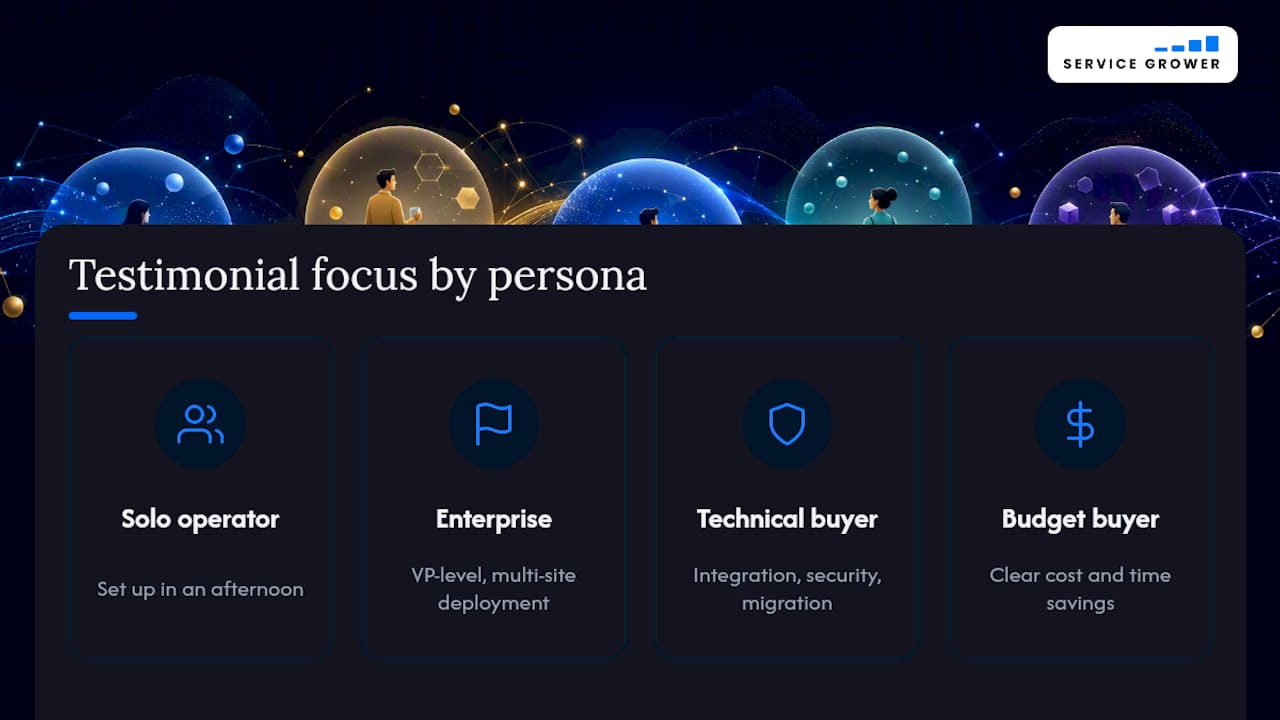
Practical approach: tag your testimonial library by persona (from the taxonomy above) and build a short “match list” your sales team can reference. If a prospect on a call sounds price-sensitive, send the testimonial with the clearest ROI number. If they sound risk-averse, send the one from a similar-sized company that made the switch without disruption.
This is also where segment-specific case studies earn their production cost. A detailed narrative works harder for an enterprise buyer weighing a six-figure decision than it does for a solo operator who just wants to see it works.
What Are the Legal Risks of Using Testimonials?
Authenticity isn’t just an ethical preference anymore, it’s a regulatory requirement. The FTC’s finalized rule on fake reviews and testimonials makes it illegal to write, buy, or sell fabricated testimonials, and it applies even to testimonials from real customers if they’ve been edited to misrepresent what was actually said.
Three practical rules follow from this. First, never edit a testimonial in a way that changes its meaning, trimming for length is fine; changing “it helped a little” into “it transformed our business” is not. Second, get documented consent that specifies exactly how the testimonial will be used, website only is a different scope than website plus paid social ads, and using it beyond the agreed scope creates real legal exposure. Third, if you compensate a customer for a testimonial (a discount, a gift card, free months of service), disclose that relationship wherever the testimonial appears.
There’s a business case underneath the legal one. A testimonial caught being fabricated or misrepresented doesn’t just create regulatory risk, it destroys the trust the whole strategy depends on. One exposed fake review does more damage to a brand than a dozen honest, average ones ever could.
Keep a simple internal log for every published testimonial: source, date collected, consent scope, and whether any compensation changed hands. It takes minutes to maintain and it’s the difference between a defensible program and a liability.
Do B2B and B2C Customers Need Different Testimonial Approaches?
Yes, and treating them the same is a common reason collection rates stay low. B2C customers respond to quick, low-friction asks: a one-click rating after a purchase, a text message follow-up, a short prompt embedded in a receipt email. Volume matters more than depth here, because B2C buying decisions are usually made fast and testimonials just need to confirm “other people like me were happy.”
B2B customers need a different approach entirely. Decision cycles are longer, the stakeholders are professionals with reputations attached to their name, and a rushed request feels transactional. The strongest B2B testimonials often come from a genuine relationship, an account manager who’s built trust over months should be the one to ask, not an automated email blast. Offer to draft the quote based on a short call, then let the customer edit it. Busy executives will often approve a testimonial faster if you’ve done the writing work for them, as long as they retain full editing control.
Timing also differs by segment. B2C testimonials work best requested immediately after a purchase or delivery. B2B testimonials work best requested after a renewal decision or a measurable milestone, since that’s when the customer has enough context to speak to real outcomes rather than first impressions.
One tactic that works across both: partner content. A detailed case study format, similar to what you’ll find on sites like Stefanomazzei, can turn a single strong B2B relationship into an asset that supports an entire sales cycle rather than one page on your site.
How Do Sales and Support Teams Use Testimonials Day to Day?
A testimonial library that only lives on your website is leaving most of its value on the table. Sales enablement is where testimonials often do their heaviest lifting, just not in the way most teams set it up.
Give sales reps a searchable way to pull the right testimonial mid-conversation, tagged by the objection it addresses, not buried in a generic slide deck nobody updates. A rep on a call who hears “we’re worried about the switching cost” should be able to find and send a relevant testimonial within seconds, not dig through old email threads.
Customer support teams sit on an underused goldmine. A support ticket that ends with a customer thanking the team for solving a hard problem is a natural, low-friction testimonial request, the customer is already in a positive, grateful state of mind. Train support staff to flag these moments and loop in whoever owns testimonial collection, rather than letting the moment pass.
Onboarding and customer success teams should do the same at renewal time. A customer who just renewed has implicitly told you the product works, that’s the moment to ask for a testimonial that speaks to long-term value rather than first impressions.
The common thread: testimonial collection shouldn’t sit only with marketing. It works best as a distributed habit across sales, support, and success, with marketing owning the system that catches, tags, and deploys what comes in.
What’s the Single Biggest Testimonial Mistake?
Most testimonial programs fail from underuse, not lack of good material. Companies collect strong quotes, then bury them on a standalone page instead of placing them where a buyer is actually hesitating. Add to that: no measurement of whether a testimonial changes behavior, and generic praise that could describe any competitor just as easily.
The highest-leverage fix for the next 30 days: pick your three biggest recurring sales objections, find or collect one strong testimonial for each, and place them directly at the point in your funnel where that objection surfaces. Skip the redesign of your whole testimonials page. Fix the three spots where deals are actually being lost first.
How Service Grower Runs Your Testimonial Engine For You
Building the five-stage system described above, collect, classify, curate, deploy, review, takes real operational effort most marketing teams don’t have spare hours for. Service Grower is built to run that engine without adding headcount to your team.
SmartRequest handles low-friction capture, sending trigger-based requests after bookings or service completions so you’re asking customers at the right moment instead of guessing. Review orchestration inside the platform centralizes consent tracking and attribution details, so you’re not chasing down permission records in a spreadsheet when a testimonial needs updating. AnswerReady™ Websites then place that proof exactly where AI search tools and human visitors are evaluating you, and GrowthView analytics shows which testimonials are actually driving bookings, not just page views. For local businesses juggling reviews across Google, social, and their own site, having one platform that connects capture to deployment to measurement solves the fragmentation that kills most testimonial programs before they scale. If you want to see how it maps to your specific business, book a 15-minute call or visit the Service Grower platform to explore the tools directly.
Frequently Asked Questions
How many testimonials does a website actually need? Quality beats quantity. Three to five strong, outcome-specific testimonials placed at key objection points outperform twenty generic ones scattered across a testimonials page nobody visits.
How often should testimonials be updated? Review your library quarterly and treat any testimonial older than 18 to 24 months as a candidate for re-verification or retirement, especially if it references pricing or features that have since changed.
Can I edit a customer’s testimonial for clarity? Yes, trimming for length or fixing grammar is standard practice. What you can’t do is change the meaning of what the customer said, doing so risks violating FTC rules on misleading testimonials.
Do video testimonials really perform better than text? For high-consideration purchases and demo pages, yes, video testimonials with a visible name and face tend to build more trust than anonymous text quotes. For quick, low-friction pages like pricing tables, a short attributed text quote often works just as well with far less production effort.
What’s the fastest way to start collecting testimonials this week? Identify three customers who recently hit a clear win, send a short prompt asking for their before-and-after story with a specific number, and get written consent for public use before publishing anything.
Sources
- Why Customer Reviews and Testimonials Convert: Research-Backed Insights | HubSpot
- Federal Trade Commission announces final rule banning fake reviews/testimonials
- Customer Testimonial Systems in 2026: How to Turn Feedback Into Real Conversion Value
- Customer Testimonials: The Complete Guide to Types, Collection, and Strategy | Credibly