
 GROWTH GUIDE
Marketers: Make Lead Generation Predictable by Prioritizing ICP Quality
Lead generation is the process of attracting potential customers and capturing their contact information or intent signals, then nurturing them toward a sale. The priority that matters more than any tactic is defining who actually qualifies as a good lead for your business and then measuring quality over raw volume from day one. Everything else in this guide, from channel mix to AI pilots, builds on that foundation.
TL;DR:
- Prioritize defining and tracking what qualifies as a good lead, focusing on quality over quantity to ensure pipeline predictability.
- Align marketing and sales around a shared ideal customer profile and qualification criteria, and continuously update based on closed deals and rejections.
- Use a four-stage process: define ICP and data needs, attract and capture leads, qualify and score them, then nurture and convert, while feeding feedback into targeting.
- Invest in inbound or outbound tactics depending on your timeline, with inbound suited for long-term growth and outbound for immediate pipeline needs.
- Start AI pilots with intent detection and ensure legal compliance by maintaining transparency, obtaining explicit consent, and avoiding hidden scoring methods.
Table of Contents
- What Is Lead Generation, and Why Does Pipeline Predictability Depend on It?
- The Four-Stage Lead Generation Process
- Inbound vs. Outbound: Which One Should You Fund First?
- Which Lead Generation Strategies Should You Test First?
- What Turns a Visitor Into a Lead?
- How Do You Score and Route Leads So Sales Works the Right Ones?
- Which Metrics Actually Diagnose a Broken Funnel?
- How Should Teams Use AI in Lead Generation Right Now?
- What Legal and Ethical Rules Govern Lead Generation?
- Service Grower’s Take: Why Integration Beats Isolated Tools
- Ready to Turn Your Website Into a Lead Generation System?
- Sources
What Is Lead Generation, and Why Does Pipeline Predictability Depend on It?
Lead generation covers every action that moves a stranger into your contact database with enough context to follow up. A form submission on a pricing page, a webinar registration, a demo request, a downloaded report with a work email attached. Each is a common capture action that signals some level of buying interest.
It’s worth separating this from demand generation, a related but different job. Demand generation builds broad market awareness. Lead generation focuses on capturing verified contacts and converting that awareness into qualified pipeline. Confusing the two is why marketing teams celebrate traffic spikes that never turn into revenue.
Quality determines whether your pipeline is predictable or a monthly guessing game. A program generating 500 mediocre leads a month is worse than one generating 80 well qualified ones, because sales teams burn hours chasing contacts who never had budget or authority. The fix starts with:
- A written ideal customer profile with firmographic and behavioral criteria
- A shared definition of “qualified” that marketing and sales both accept
- Tracking that follows leads past the form fill into closed revenue
Teams that align marketing and sales around ICP and shared acceptance rules grow faster than teams optimizing for lead count alone, according to ZoomInfo’s analysis of pipeline performance.
The Four-Stage Lead Generation Process
Every functioning lead generation program runs through the same four stages, whether the team realizes it or not. Naming them explicitly makes it possible to audit where a program is actually breaking down.
- Define your ICP and the data you need. Decide what firmographic details (industry, company size, role) and behavioral signals (page visits, content downloads) matter before you build a single offer.
- Attract and capture. Build an offer, a lead magnet, or a channel campaign, then promote it through the right channels for that audience.
- Qualify and score. Filter incoming contacts by fit and intent so sales spends time on the leads most likely to close.
- Nurture and convert. Move qualified leads through follow-up sequences until they’re ready for a sales conversation, and route the ones who aren’t yet ready into longer nurture tracks.
The step teams skip most often is the loop back to stage one. Every closed deal and every rejected lead carries information about whether your ICP was right. Feed that back into your targeting criteria quarterly, and the whole process gets sharper instead of stale.
Inbound vs. Outbound: Which One Should You Fund First?
Inbound means the prospect finds you: organic search, content, referrals, paid search landing pages. Outbound means you find the prospect first: cold email, cold calling, targeted LinkedIn outreach, direct mail. Neither is inherently better. The right choice depends on your runway and how fast you need pipeline in the door.
Choosing inbound makes sense when your team can play the long game, typically nine to twelve months before results compound, while outbound suits teams that need immediate pipeline right now. Hybrid models work best when you have the budget to fund both simultaneously.
Practical splits by situation:
- Need pipeline this quarter: Weight outbound sequences and paid search heavily, and treat inbound content as a slower parallel investment.
- Scaling a proven offer: Split budget roughly evenly, using outbound to test messaging that later informs inbound content.
- Building for the next three years: Invest disproportionately in SEO, content clusters, and referral programs, since these compound rather than depreciate the moment you stop spending.
A common mistake is judging inbound investments against outbound timelines. Content built in January that hasn’t generated leads by March isn’t failing. It’s on a different clock.
Which Lead Generation Strategies Should You Test First?
Not every tactic deserves equal budget. Prioritize based on your buyer type and how fast you need results, then commit real effort to a short list instead of spreading thin across a dozen half-tried channels.
- Intent-driven account-based marketing. Works best for B2B deals with long sales cycles and multiple stakeholders. B2B purchases typically involve six to ten decision-makers, so mapping the buying group matters more than chasing a single contact.
- Multi-touch outbound sequences. Combine email, LinkedIn, and phone across two to three weeks. Expect early signal within 30 days, full pipeline impact within a quarter.
- Webinars and live demos. Strong for mid-funnel education; typically converts at higher rates than static content because attendees self-select for interest.
- Gated reports and benchmarks. Effective top-of-funnel capture when the content solves a specific, researchable problem rather than restating generic advice.
- Local listings and paid search with strong landing pages. The priority play for local and service businesses where “near me” searches drive most demand.
- Referral programs. Underused across almost every industry; a warm introduction converts at multiples of a cold lead’s rate.
- Topic-cluster SEO and interactive content. Slow burn, high compounding return, best funded alongside a faster channel rather than instead of one.
Pro Tip: Pick three to four tactics that match your team’s actual capacity, not your ambition. A single channel run well for 90 days beats six channels run half-heartedly for a week each.
Agencies and consultancies often lean on ABM and referral-heavy playbooks, while service businesses lean harder on local search and reviews.
What Turns a Visitor Into a Lead?
Capture mechanics are the unglamorous machinery that decides whether traffic becomes contacts. Get these wrong and every upstream tactic loses efficiency.
- Match the lead magnet to funnel stage. A checklist suits early-stage curiosity; a live demo or pricing consultation suits someone already comparing options.
- Build landing pages around one goal. Clear headline, fast load time, visible social proof, and a single call to action. Multiple competing offers on one page reduce conversion for both.
- Use progressive profiling on forms. Ask for email first, then request company size or role on a second interaction instead of front-loading eight fields.
- Layer capture surfaces without letting them compete. Landing pages, timed popups, and embedded forms each work better when they serve a distinct role rather than firing at the same visitor simultaneously.
Web design and service-based businesses often see the biggest lift simply from cutting form fields and page load time, not from a bigger offer.
How Do You Score and Route Leads So Sales Works the Right Ones?
A working scoring model combines fit, whether this contact resembles your ICP, with intent, whether their behavior signals active buying interest. A combined fit and intent score prevents sales from either chasing unqualified volume or ignoring a high-fit account that hasn’t raised their hand loudly yet.
- Fit scoring example: Points for matching industry, company size, and job title.
- Intent scoring example: Points for pricing page visits, demo requests, or repeat content downloads within a short window.
- Three-tier routing: Cold leads go to nurture, warm leads go to a sales development rep within hours, hot leads route directly to an account executive.
- Speed-to-lead target: Aim to make first contact quickly on hot leads, as response rates drop sharply after initial contact delays.
Pro Tip: Back-test your scoring thresholds against last year’s actual close rates. If leads scoring 80+ closed at the same rate as leads scoring 50, your model needs recalibrating, not more data. Automating this handoff, as covered in lead follow-up automation, closes the gap between a lead crossing the threshold and a rep actually calling.
Which Metrics Actually Diagnose a Broken Funnel?
Volume metrics feel good and hide problems. Track these instead, and use them to point at the actual failure mode rather than just reporting a number.
- Visitor to lead rate: Low numbers point to a capture problem, weak offer, or slow page.
- Cost per lead (CPL): Rising CPL with flat conversion usually means channel saturation, not a targeting failure.
- MQL to SQL rate: A steep drop here almost always means your scoring model or ICP definition is off, not that sales is being lazy.
- Lead to opportunity rate: Measures whether qualified leads actually contain real budget and authority.
- Sales velocity: How fast leads move stage to stage; a stall at one stage tells you exactly where the bottleneck lives.
- Revenue contribution by source: The only metric that tells you which channel to fund next quarter.
Benchmarks vary heavily by program type, so compare your own trend line quarter over quarter rather than chasing an industry average that may not fit your deal size.
How Should Teams Use AI in Lead Generation Right Now?
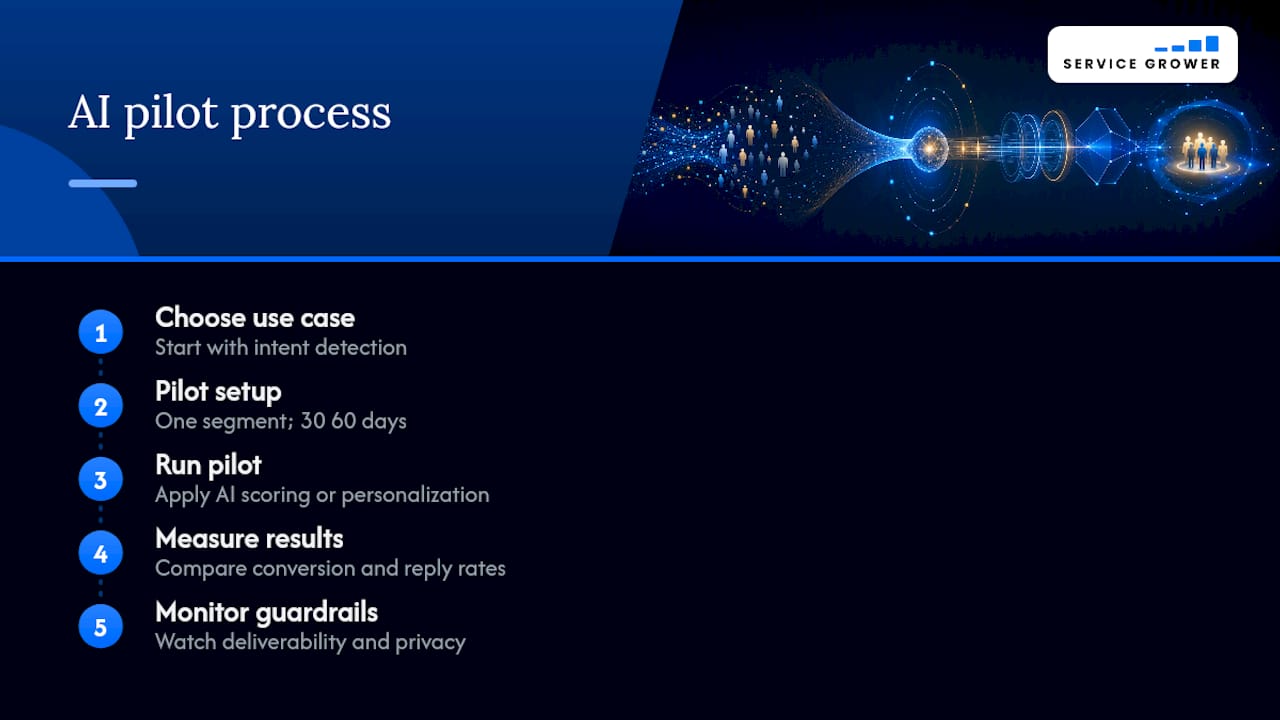
AI in 2026 reliably supports ICP refinement, intent detection, personalization at scale, and faster qualification, but the sensible approach is piloting one use case at a time rather than automating the whole funnel at once. Start with intent detection since it’s the easiest to measure against a clear baseline.
Run a small pilot: apply AI scoring or personalization to one segment for 30 to 60 days, then compare conversion and reply rates against your existing process before expanding. Watch two things closely. Deliverability, since AI-generated outreach at scale can trigger spam filters faster than a human-written sequence. And privacy, since personalization pulling from more data sources raises the compliance stakes covered below. Teams working with intent data providers, such as the signal pipelines partners in B2B outreach build, tend to get cleaner pilots because the underlying data is already structured for scoring.
What Legal and Ethical Rules Govern Lead Generation?
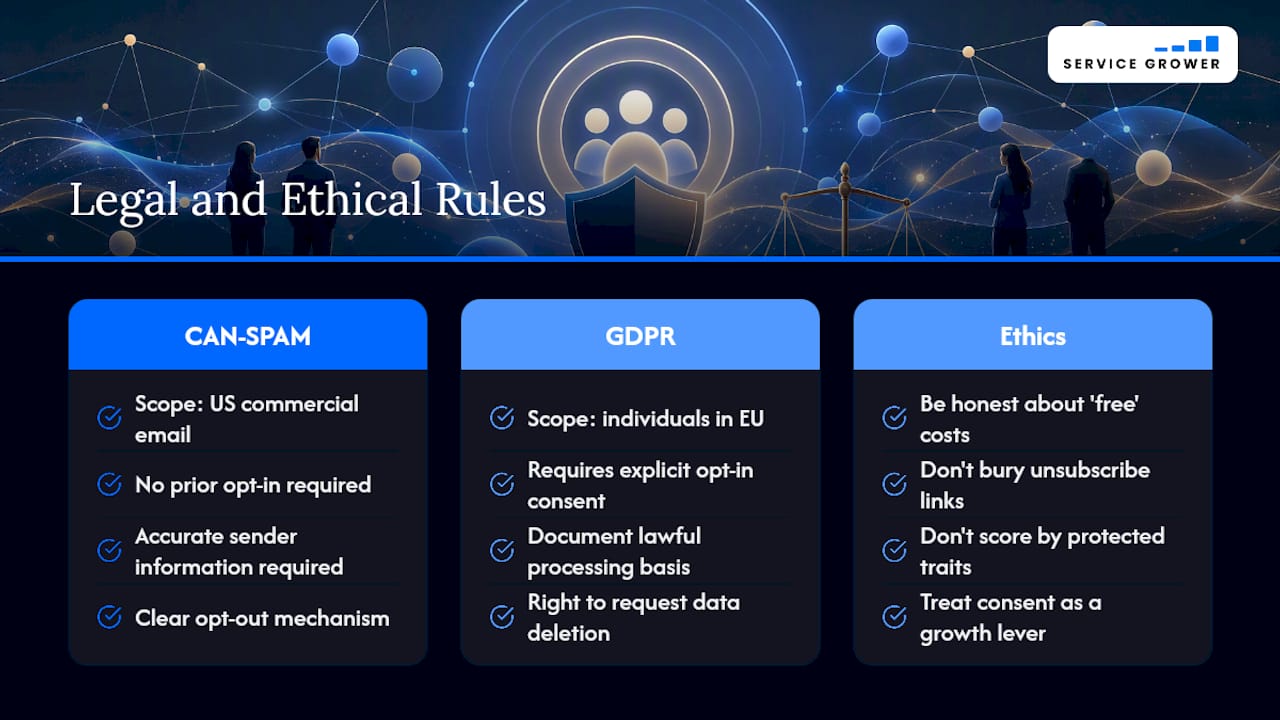
Consent and transparency aren’t optional add ons to a lead generation program. They’re the difference between a database you can legally use and one that exposes your business to fines and lawsuits. Two frameworks matter most depending on where your leads live.
The CAN-SPAM Act governs commercial email sent to recipients in the United States. It requires accurate sender information, a clear way to opt out, and honoring opt-out requests within ten business days. It does not require opt-in consent before the first email, unlike stricter regimes elsewhere, but it does prohibit deceptive subject lines and hidden sender identities.
GDPR applies when you collect or process data from individuals in the European Union, regardless of where your business is based. It requires explicit opt-in consent before collecting personal data for marketing, a documented lawful basis for processing, and the right for individuals to request deletion of their data. A business capturing leads through a form that might reach EU visitors needs a compliant consent mechanism, not just a checkbox buried in fine print.
Beyond the legal floor, ethical lead generation means being honest about what a “free guide” actually costs the reader (their contact information and future emails), not burying unsubscribe links, and not scoring or routing leads based on protected characteristics. Law firms and other high-consideration service businesses face particularly close scrutiny here, since trust signals in capture and nurture directly affect conversion in regulated industries. Treat consent as a growth lever, not a compliance tax: clean lists convert better and complain less.
Service Grower’s Take: Why Integration Beats Isolated Tools
Most local businesses don’t have a lead generation problem so much as a fragmented-systems problem: one tool for the website, another for reviews, another for booking, none of them talking to each other. Service Grower built AnswerReady™ Websites, SmartRequest capture forms, and review management to work as one system specifically because that fragmentation is where leads quietly disappear between the form fill and the follow-up call.
The businesses that rely least on paid ads over time are the ones whose organic and AI visibility, capture, and reputation management reinforce each other automatically instead of competing for the same budget line.
— Service Grower
Ready to Turn Your Website Into a Lead Generation System?
Everything in this guide, from ICP definition to lead scoring to capture mechanics, assumes your website and local visibility are actually working for you in the first place. This gap for local businesses can be closed by combining AI-optimized websites, capture forms, review management, and lead tracking in one platform instead of relying on separate tools.
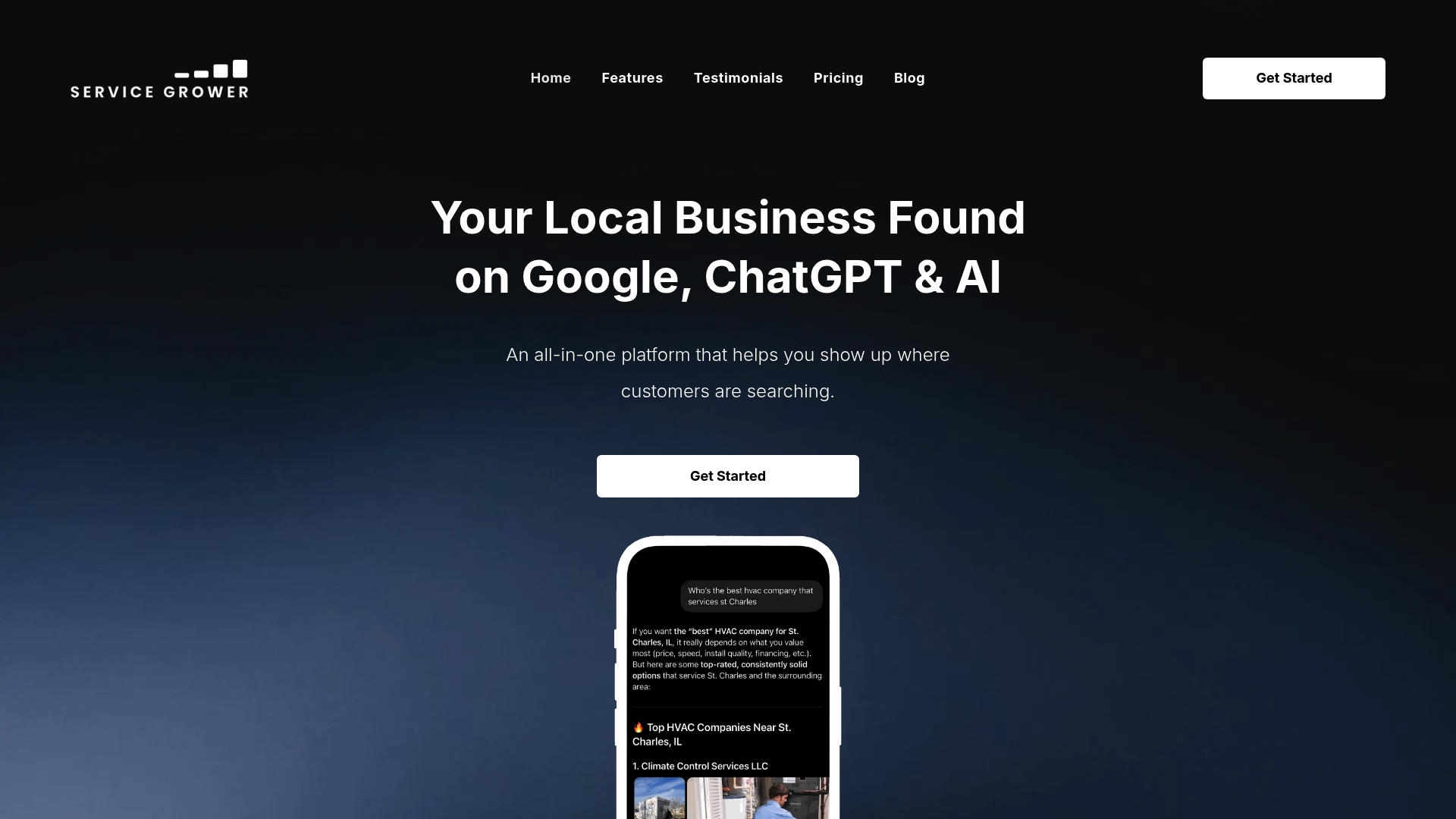
That integration matters most for local businesses where showing up first in a Google or AI search result often decides who gets the call. Some businesses report meaningful increases in bookings and reviews once visibility and capture start reinforcing each other instead of running as separate projects.
If you’re not sure whether prospects can even find you right now, start with a Free AI Visibility Check to see where your business stands before investing further in any of the tactics above. From there, explore how Service Grower supports local businesses end to end, from first search to booked appointment.
Sources
For deeper detail on the concepts covered here, the sources below offer solid starting points.
- What is lead generation? | Search Engine Land
- Lead generation process | Indeed Career Guide
- What Is Lead Generation? | ZoomInfo Pipeline
- Monday
- Lead generation guide | Sender