
 GROWTH GUIDE
Booked Jobs, Not Clicks: Campaign First Google Ads for HVAC
Google Ads works for HVAC contractors when the account runs segmented campaigns by service type, Local Services Ads carry the emergency load, and booked jobs get imported back into Google as conversion data. The levers that make or break performance are LSAs for same-day repair leads, dedicated landing pages per service, disciplined negative keywords, and offline conversion imports that teach Smart Bidding what a real job is worth.
TL;DR:
- Segmented HVAC campaigns by service type improve Quality Score and conversion rates, with each campaign requiring its own landing page and negative keyword list.
- Run Local Services Ads for emergency leads with lower cost-per-lead around 51 to 52 dollars and utilize Search for planned-service inquiries.
- Campaign budget should be based on job value, with at least 15 to 30 conversions per month for effective Smart Bidding, not just click volume.
- Prioritize offline conversion import and fast-loading, single-offer landing pages to accurately track revenue and boost ad performance.
- Managing seasonality risks involves continuous campaigns, weather-triggered budget adjustments, and gradual geographic expansion rather than pausing during off-peak seasons.
Table of Contents
- How to Structure a Google Ads Account for HVAC
- Search, Local Services Ads, or Performance Max: Which One Runs Your Leads?
- What Keywords and Match Types Should HVAC Campaigns Use?
- Which Ad Copy and Extensions Get the Phone to Ring?
- Building Landing Pages and Tracking That Actually Feed Google
- What Should HVAC Companies Budget and Bid For?
- Managing Seasonality Without Losing Your Account’s Momentum
- Which Metrics Actually Prove Google Ads Is Working?
- Why the Ad Account Isn’t Your Real Bottleneck
- The Real Problem With Most HVAC Ad Accounts
- A Managed Path for HVAC Owners Who Want This Handled Right
- Sources
- FAQ
How to Structure a Google Ads Account for HVAC
Most HVAC accounts fail before the first ad ever runs, because everything gets dumped into one campaign chasing “HVAC repair near me” alongside “AC installation cost.” Google can’t tell your $150 tune-up lead from your $12,000 system replacement lead, so it optimizes for neither.
The fix is separating your account into four core campaigns:
- Emergency repair — no heat, no AC, water leaks, burning smells. Highest urgency, highest willingness to pay, needs Local Services Ads running alongside Search.
- Replacement and installation — full system swaps, new construction, financing-driven decisions with longer research cycles.
- Maintenance and tune-ups — seasonal check-ups, membership plans, lower ticket but high lifetime value.
- Brand protection — your own company name, so competitors bidding on it don’t steal your traffic at a discount.
Each campaign needs its own ad groups, its own landing page, and its own negative keyword list. A searcher looking for “furnace repair emergency” and one looking for “furnace replacement quote” have completely different intent, and mixing them in one ad group tanks your Quality Score for both.
Budget allocation follows job value, not click volume. Separating campaigns by service type improves Quality Score and conversion rates because Google’s algorithm learns faster when each campaign has a consistent, narrow signal to optimize against. As a rule of thumb, give each campaign enough budget to generate at least 15 to 30 conversions a month. Below that threshold, Smart Bidding doesn’t have enough data to make good decisions, and you’re effectively paying to teach the algorithm rather than generate leads.

Search, Local Services Ads, or Performance Max: Which One Runs Your Leads?
Search ads remain the workhorse for replacement and maintenance leads, where the searcher is comparing options and reading before they call. You control the keyword, the ad copy, and the landing page experience end to end.
Local Services Ads exist for a different moment entirely: the customer whose AC just died at 2 p.m. in July. LSAs run on a pay-per-lead model rather than pay-per-click, and Local Services Ads deliver lower CPLs and higher conversion rates for emergency HVAC leads than standard search campaigns, with benchmarks landing around $51 to $52 per lead. The Google Guarantee badge and background-check verification also do something search ads can’t: they remove the trust question before the phone even rings.
Performance Max fits a narrower role. It’s useful for maximizing reach across Google’s inventory when you have strong conversion data already feeding the system, but without tight negative controls it happily spends your budget on display placements and low-intent searches that never call.
- Run Search for planned-service and replacement intent where research matters.
- Run LSAs in parallel for emergency and same-day categories.
- Use Performance Max only after Search and LSA data are stable, and audit its placement report monthly.
The three products aren’t competitors inside your account. They’re each solving for a different customer moment, and running them together, structured correctly, covers more of your funnel than any single product could alone.
What Keywords and Match Types Should HVAC Campaigns Use?
Keyword lists should mirror your campaign structure, not blend into one giant pile of “HVAC” terms. Emergency campaigns need urgency language: “emergency AC repair,” “furnace not working,” “no heat repair tonight.” Replacement campaigns need comparison and cost language: “AC replacement cost,” “new furnace installation quote.” Maintenance campaigns need scheduling language: “AC tune-up,” “furnace maintenance plan.”
Google recommends choosing match types deliberately rather than defaulting to broad match across the board. For HVAC, that means exact and phrase match carry your highest-intent, highest-cost terms, where you want tight control over exactly what triggers the ad. Broad match can work for discovery, but only when paired with an aggressive negative keyword list and daily monitoring in the first few weeks.
- Negative keyword categories to build immediately: DIY terms (“how to fix,” “diy repair”), job-seeker terms (“HVAC jobs,” “technician salary”), and unrelated trades (plumbing, electrical, unless you offer them).
- Geographic negatives: exclude neighboring cities you don’t service, especially if you’re bidding on broad service terms.
- Review cadence: audit the search terms report weekly for the first month of any new campaign, then shift to monthly once patterns stabilize.
One overlooked pattern: long-tail, locally anchored keywords like “mini split installation estimate” plus a city name often produce lower CPCs and higher booking intent than fighting for the generic “HVAC installation” term everyone else bids on.
Pro Tip: Add your service area’s smaller suburbs as their own keyword variants instead of relying on location targeting alone. A searcher typing the actual town name is telling you exactly where the job is, and that specificity usually pulls a lower CPC than the flagship city name every competitor is bidding on.
Which Ad Copy and Extensions Get the Phone to Ring?
HVAC searchers aren’t browsing. They’re either in a crisis or comparing quotes, and your ad copy needs to match which one it is instantly.
- Emergency ads should lead with speed and availability: “24/7 Emergency AC Repair” or “Same-Day Furnace Repair, Call Now.” Skip the branding language. Urgency searchers want to know you can show up today.
- Replacement ads should lead with value and trust signals: financing terms, warranty length, years in business. This searcher is comparing three companies right now and your ad is one input in that decision.
- Maintenance ads should lead with the plan itself: “$99 Tune-Up Special” or “Seasonal Maintenance Plans Starting At.” Price anchoring works well here because the ticket is small and the decision is low-risk.
Extensions matter more for HVAC than almost any other vertical because so much of the conversion happens on the phone, not the landing page. Call extensions, location extensions, and structured snippets listing services (installation, repair, maintenance, financing) all feed directly into Quality Score factors like ad relevance and expected click-through rate, which lowers your CPCs across the board.
Rotate ad copy seasonally. A checklist of HVAC-specific ad copy tactics consistently points to matching headline language to the season: heat-focused copy from May through September, heating-focused copy from October through March, with a two-week overlap window where both run to catch shoulder-season searches.
Building Landing Pages and Tracking That Actually Feed Google
A landing page that takes four seconds to load and buries the phone number below three paragraphs of company history is burning your ad spend before the visitor even decides whether to call.
Every HVAC landing page needs one offer, one clear promise above the fold, a tap-to-call button that’s visible without scrolling, and load times under three seconds on mobile. If you offer financing, show it near the top. Most of your traffic will hit on a phone in a moment of urgency, and every extra tap between the click and the call is a lead you’re paying for and not getting.
- One offer per page. Don’t send emergency traffic to a page that also promotes maintenance plans.
- Tap-to-call button fixed in the visible viewport, not buried in a footer.
- Load time under three seconds. Landing page speed is a direct Quality Score input, so a slow page costs you twice, once in lost visitors and again in higher CPCs.
Call tracking needs a minimum duration threshold, usually 60 seconds, to count as a lead. A shorter call is often a wrong number or a hang-up, and counting it as a conversion trains Smart Bidding on bad data.
The step most HVAC accounts skip: importing offline conversions from your CRM or job-management system back into Google Ads. Without that loop, Google only ever sees clicks and calls, never which ones became a $9,000 install versus a $150 no-show. A tool like checking your landing pages for common conversion leaks can catch the small UX mistakes that quietly cap your conversion rate before you even get to the tracking question.
What Should HVAC Companies Budget and Bid For?
Bidding strategy depends on how much conversion data you have and how far along the campaign is. Brand-new campaigns with fewer than 15 to 30 conversions a month should start on manual CPC or Maximize Clicks to build a data foundation. Once a campaign has enough conversion volume, moving to Target CPA or Target ROAS lets the algorithm bid based on the value of the lead, not just whether a click happened.
- Manual CPC or Maximize Clicks: use during the first 30 to 60 days of a new campaign, or any time monthly conversions fall under roughly 15.
- Maximize Conversions: a good middle step once volume is stable but you don’t yet trust the value data.
- Target CPA / Target ROAS: the end goal, but only once offline conversion imports are feeding real job value into the account.
On cost, benchmarks put well-managed HVAC accounts in the $20 to $50 per lead range in many markets, though this swings hard by campaign type and metro competitiveness. Emergency repair CPCs often run $22 to $45 in competitive markets, with blended cost-per-lead figures near $100 in some studies once you average across campaign types. The number that actually matters isn’t the CPL in isolation. It’s the CPL against average job value: a $100 lead that converts into a $9,000 install is a very different equation than the same $100 lead converting into a $150 tune-up.
Managing Seasonality Without Losing Your Account’s Momentum
The instinct to pause HVAC campaigns in the off-season is understandable and usually a mistake. Continuous, year-round campaigns preserve Quality Score and account history, while pausing forces months of re-learning every time you turn it back on, right when you need performance most.
That keeps the algorithm’s learning intact for the moment demand spikes.
- Set weather-triggered budget rules for heat waves and cold snaps. A three-day forecast above 95°F or below 20°F is a reasonable trigger to raise emergency campaign budgets by 25 to 50%.
- Use dayparting to push spend toward the hours your team can actually answer and dispatch, usually 7 a.m. to 8 p.m.
- Scale new geozones one at a time rather than expanding your whole service area at once, so you can isolate whether a new area is actually converting.
Pro Tip: Build your weather-trigger budget rule before the heat wave hits, not during it. Competitors scrambling to raise bids mid-spike will bid up CPCs across the board, and you want your increase already live and stable when that happens.
Which Metrics Actually Prove Google Ads Is Working?
Clicks and impressions tell you almost nothing about whether Google Ads is making you money. Booked-job value is the only metric that should drive optimization decisions.
- Track cost per lead (CPL) by campaign type, not blended across the account. Divide campaign spend by qualified leads (calls over 60 seconds, form fills that convert to booked appointments).
- Calculate job-level ROAS: total revenue from booked jobs attributed to a campaign, divided by that campaign’s spend. A campaign with a higher CPL but far higher average job value can easily outperform a “cheaper” campaign on paper.
- Run a monthly reporting cadence comparing CPL, booked-job rate, and revenue per campaign, then shift budget toward whichever service type shows the strongest ROAS, not the lowest CPL.
Experiments matter here too. Testing one variable at a time, a new headline, a new landing page offer, a new bid strategy, tells you which change actually moved booked jobs rather than just clicks.
Why the Ad Account Isn’t Your Real Bottleneck
Most HVAC owners treat Google Ads as an ad-copy problem, when the real leak is almost always operational. You can write a perfect headline and still lose the lead if the landing page loads slowly, the phone rings four times before someone picks up, or your Google Business Profile has three-star reviews sitting unanswered next to the ad.
Reviews and Google Business Profile responsiveness are a primary trust signal for local search and ad performance alike, and they compound with everything else the campaign is doing. Some approaches treat these pieces as one connected system rather than separate vendors: AI-optimized websites built to match search and AI-driven queries, review management that keeps your Google Business Profile active, and conversion tracking that closes the loop between the click and the booked job.
- Landing pages built around fast-load, single-offer principles that reduce Quality Score friction.
- Review and reputation tools feeding trust signals that raise click-through and conversion rates on both Search and LSA.
- Conversion import connecting booked jobs back into ad platforms, so Smart Bidding learns from revenue, not just clicks.
Using integrated review and lead-tracking tools can result in measurable increases in bookings and reviews when the ad account, the website, and the reputation layer work from the same data.
The Real Problem With Most HVAC Ad Accounts
Most advice on this topic focuses on ad copy and keyword lists, and that’s the least important part of the equation. A brilliant headline pointed at a slow landing page with no call tracking is a wasted click every time. The accounts that consistently produce cheap, qualified leads treat Google Ads as plumbing, not copywriting: campaign segmentation, negative keyword discipline, offline conversion import, and a landing page built for a phone screen.
The conventional wisdom that “more budget fixes bad performance” gets this backwards. Budget without conversion data feeding the algorithm just buys more expensive versions of the same mistake. The fix almost always sits upstream of the ad, in tracking setup or landing page speed, not in bid amounts.
If you’re prioritizing one thing first, make it this: get offline conversion import working before you touch your bids. Every other optimization, ad copy, extensions, Performance Max, gets meaningfully better once Google actually knows which clicks turned into a $9,000 install and which turned into nothing. That’s the lever that changes everything downstream, and it’s the one owners skip most often because it takes a CRM connection instead of a headline rewrite.
— Service Grower
A Managed Path for HVAC Owners Who Want This Handled Right
Running segmented campaigns, LSAs, negative keyword audits, and offline conversion imports all at once is a full-time job most HVAC owners don’t have room for between service calls. There are platforms built for exactly this gap: managed Google Ads campaigns paired with AI-optimized landing pages, review management, and conversion tracking that feeds booked-job data back into bidding.
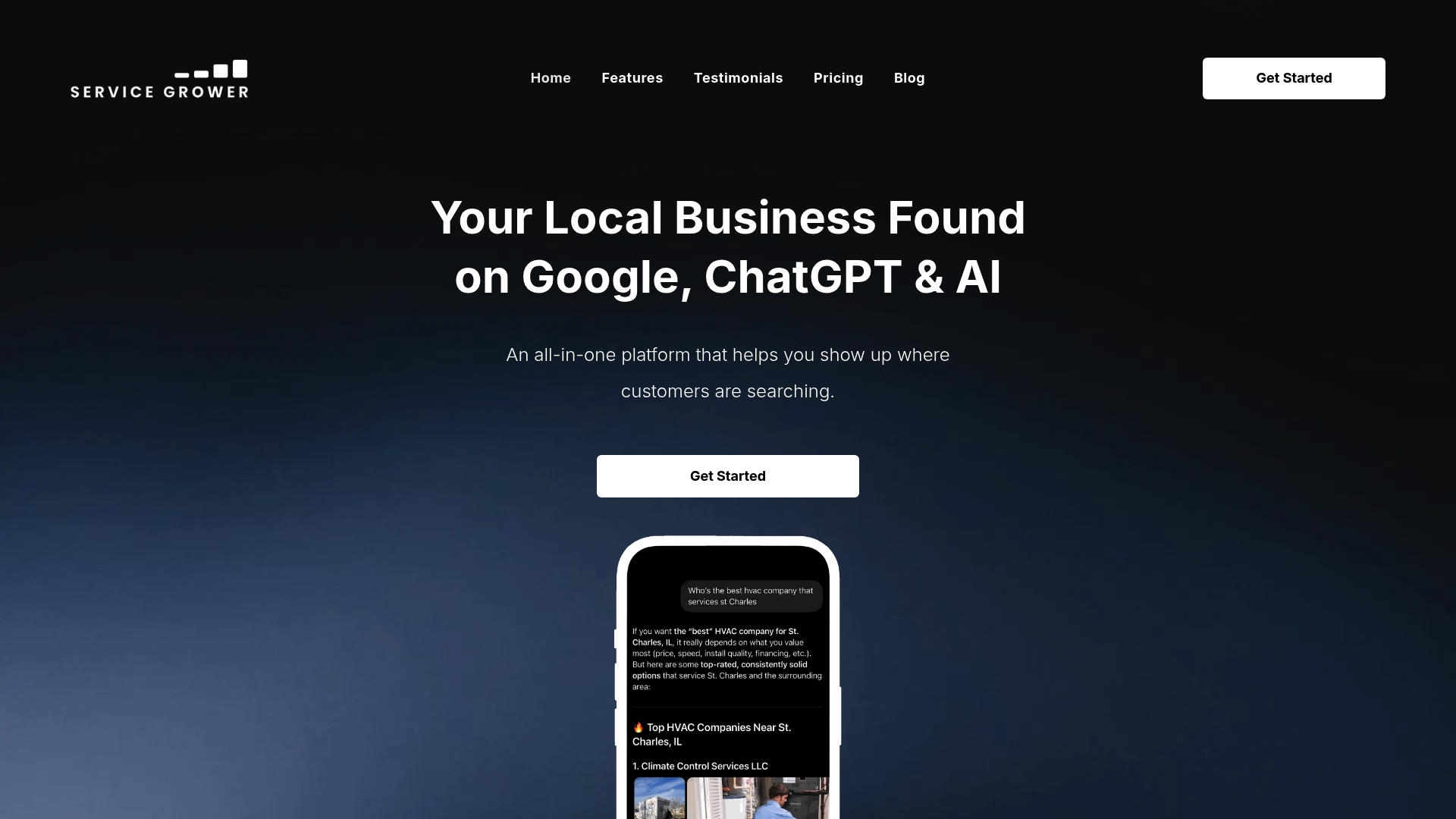
Instead of hiring a generic agency and a separate web developer and a separate review-management tool, you get one platform where the ad account, the landing page, and the reputation signals are already talking to each other. When vetting any managed partner for HVAC ads, check three things: do they build service-specific landing pages, do they set up offline conversion import from day one, and do they manage your Google Business Profile as part of the package, not as an upsell.
Take a look at what Service Grower offers HVAC and other local businesses and see whether a connected campaign, landing page, and reputation system fits how your team actually operates.
Sources
- HVAC Google Ads: The 2026 Campaign Guide for Contractors
- About keyword matching options for Search campaigns
FAQ
What Is the Best Way to Advertise HVAC Services on Google?
The strongest approach combines Search campaigns segmented by service type, Local Services Ads for emergency leads, and offline conversion import so Google’s bidding algorithm optimizes toward booked jobs rather than raw clicks.
Is $20 a Day a Good Budget for HVAC Google Ads?
$20 a day can work for a single tightly targeted maintenance or brand campaign in a smaller market, but it’s usually too low for emergency or replacement campaigns competing at $22 to $45 CPCs in busier metros.
Do Google Ads Work for HVAC Contractors and Other Trades?
Yes. HVAC and other home service contractors are among the highest-converting categories on Google Ads when campaigns are segmented by service type and paired with fast-loading, call-first landing pages.
How Much Do Google Ads Cost Per 1,000 Views for HVAC Campaigns?
HVAC advertisers typically pay per click or per lead rather than per impression, so a raw cost-per-impression figure isn’t the relevant benchmark. What matters is cost per lead, which lands around $20 to $50 in many markets depending on campaign type and competition.
Should HVAC Companies Run Local Services Ads or Search Ads?
Run both. Local Services Ads capture emergency, same-day leads through a pay-per-lead model with Google Guarantee verification, while Search ads handle planned replacement and maintenance searches where the customer is comparing options.